
Lac Viet ERP mechanical engineering is the solution overall management help business mechanical control sync from quotes – production – inventory – prices – finance in the context of orders, diverse, produced according to the requirement and cost of raw material volatility.
Article Lac Viet will help the business understand ERP for mechanical engineering what is the need to deploy, the actual benefits bring and where is the right solution in Vietnam.
1. ERP mechanical engineering what is? Why business mechanical need ERP?
ERP mechanical engineering not only is management software that mere is system administration enterprise, designed exclusively for the business of producing the gas. Here is the solution digitized to connect closely the core business, like quotes, technical, planning, production according to orders, materials management, progress tracking, production, pricing of detailed accounting and finance on a platform of data consistency.
Other than the accounting software or manage discrete ERP for mechanical engineering bring uniformity data as well as processes throughout between the parts. This is especially important when a business production according to drawings private BOM (Bill of Materials – list of materials) complex and the price of raw material volatility.
The difference with ERP traditional
An ERP system an industry standard general can better meet the business, financial, sales or management personnel. However, with business mechanical requirements in more depth. Below is the comparison table to clarify the difference between ERP traditional & ERP suitable for business, mechanical, focus on the angle of view admin operation:
| Content | ERP traditional | ERP is suitable for business mechanical |
| Quotes – single row | Quotation based on product categories fixed, less variation | Quote according to the product configuration private: calculated based on the drawing, BOMB, the level of investment and production stage |
| Management BOMBS | BOMBS simple, low-level, difficult to change | BOM multi-level, flexible according to each order, easy to adjust the details, accessories, raw materials |
| Expense tracking | Costs aggregated by period (month/quarter), difficult dissection | Expense tracking details, in each order, each stage, determine the profit – loss accuracy |
| Production management | Suitable mass production, less customizable | Suitable manufacturing according to the menu, according to the technical requirements private |
| Sync data | Data between the production – inventory – accounting often detached | Data continuity throughout, reduced deviation, delay information |
| Value management | Meet the professional basic | Support operational decisions, effective control according to each order |
This comparison table shows, with mechanical enterprise, ERP is not only recording tool to receive data which must be the foundation admin help control costs, profits and progress at the level of detail in each order specifically.
ERP industry mechanical data connection from the moment of receipt → reviews drawing → production planning → keep track of materials – human resources – machinery → delivery → collect money → analyze business performance. This helps leaders as well as to operating departments get comprehensive picture, uniformity of production operations – business.
2. Special operation management of engineering enterprises
Business mechanic have models operate distinctly different than mass production. So, the properly understand the peculiarities this is an important basis for selection of ERP industry mechanic fit, avoid applying general pattern but does not create the realistic effect.

2.1. Production according to orders, engineering drawings separately
Other than the manufacturing industry standard for the majority of businesses mechanical operation according to the model manufactured according to order. Every orders are usually associated with a drawing, technical requirements, materials, machining process, the delivery time different. In fact, each order is almost a “production project” private.
This poses a lot of challenges in operation management:
- Difficult to standardize the production process, if only just managed manually or by using Excel
- The quote depends much on personal experience, potential risks skewed cost
- Difficult to track overall progress when the number of orders increased
In that context, ERP mechanical engineering not only helps to manage orders, but more important is to standardize the way enterprises approach each order, words quotes, planning to control cost and schedule.
2.2. Management BOMBS complex, multiple stages – many machines
A mechanical product, often made from more detailed, semi-finished products and different raw materials. The category of materials (BOM) not only many levels, but also can change according to each order. Besides, the production process often undergo multiple stages such as cutting, turning, milling, welding, surface treatment, assembly... used many kinds of machines, workers different.
If management BOMBS, stage by manual methods, enterprises often encounter the problem:
- Uncontrolled supplies practical use than the norm
- Difficult to assess the performance of each stage, each machine
- Arising wasting materials, time, but not to determine the cause
ERP industry mechanical help businesses manage BOMB flexible, fastened with each order and each stage, from which control supplies, capacity, machine performance, produce a way more active.
2.3. Material price fluctuations, difficult to control price
Raw material inputs such as steel, stainless steel, aluminum occupies a large proportion in the price of mechanical products is constantly fluctuating according to the market. When businesses do not have the system track expenses in real time, work quotes, control, profits become risks.
In actual operation, many businesses:
- Quotation based on the materials and old
- Not timely updates expenses incurred in the production process
- Just know the results in profit and loss when the sum end of period
ERP mechanical engineering allows tracking the cost of materials, labor, machinery according to each order. Help business early detection of orders, risk anal, timely adjust the production plan or negotiate with customers.
2.4. Hard sync your data between production – inventory – accounting
A common trait in the business mechanics is that data is dispersed:
- Production management progress using the tracking private
- Inventory keep track of materials in Excel
- Accounting data aggregation end of period
This caused data inconsistency, reports slow down the potential deviations.
ERP mechanical engineering solved this problem by creating a data platform where every business arising from the production, warehouse to accounting are recorded as well as constant updates. This helps leaders can look throughout time about the situation operated business.
Many businesses mechanics still “do more, be single all” but only to the end of the new year to know profit or loss, due to lack of management systems deep enough to control cost, according to each order. So, ERP for mechanical engineering is increasingly seen as the foundation upgrade operation management overall, instead of just handling the discrete problem.
3. The common problems when the business mechanics hasn ERP application
In fact, many business engineering, particularly in the field of mechanic, still operate based on experience, Excel and other software discrete. This approach can be accepted at a small scale, but quickly reveal limitations when orders increase product diversity requires cost control become stricter. Here are the common problems that many businesses began to learn, consider implementing ERP mechanical engineering:

3.1. Management production, causing loss & schedule
In many enterprises and business planning as well as tracking production is still based on personal experience or the board track craft. This leads to two results.
- Planning to lack of grounds capacity machinery: production planning are often built on feeling, not based on actual data about the performance machine, machining time or condition maintenance. When additional orders or change the priority business easy to fall into overload or conflict plan.
- Do not track the progress of each stage, each order: Do not systematically track focus, the progress control is usually “post-test”. Upon detection delay progress, business missed a chance to adjust soon.
As a consequence, medium business arising waste of resources, just often delay delivery schedule. The management of production that leaders lack of timely data to the coordinating machinery, personnel reduces operational efficiency and credibility with customers.
3.2. Deviations inventory & materials
Raw material accounts for a large proportion in the price of mechanical products, but are areas to false if managed manually.
- Do not grasp the inventory fact: Data inventory often not homogeneous between window warehouse, Excel and reality, causing the production department does not know the exact supplies or lack of at the moment need to use.
- Teen – excess supplies constant: the Lack of supplies caused production interruptions while excess supplies increased inventory costs, misappropriation of funds.
- 't access the original source materials as plot: When an error occurs, the product, or quality problem, business is hard to determine lot of materials related to handling thoroughly.
As a consequence, medium business, endure disruptions to production, just increase inventory costs, risks and quality. The deviations inventory, lack of traceability of materials impair the efficient use of capital and the ability to control the quality of products.
3.3. Do not control the price and the fact
In many businesses mechanical, production cost is still calculated in the traditional way: set cost, and then allocated into the end of the period. This makes leaders know only “results” when the order completed while the entire process of development costs previously almost beyond control.
- Price is calculated “end of period”: the Cost incurred in the production of no is tracked by orders or stages, that business could not detect points exceeded the plan. When I realized the price of real often completed orders, can not be adjusted.
- Not determined order any profit – loss: Due to the cost that is collected in the general, and the bearing allocation estimates, business mechanical very difficult to answer the core question in the admin:
- Order any real interest, orders, would only “make available revenue”?
- Every stage is a cost to team up but have not yet been identified?
As practice shows, not less business only to the end of the new year to know overall is profit or loss, but do not get profit came from and where the risk is in order anyway. This is a big weakness when expanding business scale or receive multiple orders with different configurations.
3.4 management reports slow, missing data, decisions
In the competitive environment today, the speed of decision making has a direct impact to operational efficiency. However, many businesses mechanics are still faced with the situation:
- Leaders do not have data realtime report: often only after synthesis of the craft, that the information being late and no longer reflect reality.
- Depends Excel, general craft: The synthesis of data from many different sources just time consuming, and easy to errors, reduce the reliability of the report.
As a consequence, leaders must make decisions based on data, slow, inaccurate. Administration report is not timely made business difficult to control the operational efficiency, flexible responses to fluctuations of the market.
4. ERP mechanical engineering, including the distribution system, which is the most important?
When business mechanical learn about ERP for the mechanical engineering industry, it is important to determine the support system, what distribution would really necessary. In the production environment according to orders, ERP role data connection, the same process across the enterprise. The ultimate goal is to control the cost better, enhance effective decision-making.

4.1. Sales management & quotation technical
In business, engineering, sales process, not just selling consumer product standards. Each quote is usually to be the cost structure based on drawings, material and production stage.
- Quote according to the product configuration & drawing: Instead of entering the price manually, this module directly linked with data, materials as well as manufacturing processes to calculate the cost based on the configuration requires practice. This helps to reduce errors, faster response to customers.
- Track the change history of engineering & order: As customers adjust to technical requirements, the system recorded all changes, as well as calculate the cost correspondingly, avoid false data, as well as take time update.
Shorten quotes, increased precision in professional interaction with customers, thereby improving the rate pegs menu.
4.2. Production management mechanical depth
Production management is the center of business engineering. This is where the plans, practical resources are organized and supervision.
- Production planning flexibility: ERP support planning in two main directions of forward scheduling (planning from the time orders), backward scheduling (plan based on the required delivery date). Combining this help enterprises balance between delivery schedule, production capacity.
- Order management production, stage machinery: Instead of track using a spreadsheet, businesses can immediately see the status of each stage, the status of the hook from which the optimal use of resources.
Minimize the waiting time between the stages, enhance the efficient use of machines and resources, from which shorten the lead time (time to complete orders) reduce operating costs.
4.3. Inventory management & purchasing of raw materials
In mechanical manufacturing supplies occupy a large input values. Inventory management is not effective, will give rise to many unnecessary costs.
- Traceability of materials: ERP allows for tracking shipments of supplies from the moment of entering the warehouse to when used on the product, making it easy to trace when happen to quality problem.
- Optimal inventory safety: the System is based on data of practical use to calculate inventory optimization, reducing the shortage – excess supplies.
Reduce inventory costs, limiting the risk of lack of raw materials lasts production chain, at the same time transparent backgrounds and supplies when needed prosecuted quality.
4.4. Cost management & financial accounting
One of the biggest challenges with the business mechanics is to calculate the price of each order accurately reflected in the financial statements.
- The calculated price details according to the orders & stage: Instead of just summing up the cost of the system recorded the cost right from when incurred in each stage (materials, labor, machine).
- Appropriate accounting standards in Vietnam: ERP mechanical engineering industry to ensure accounting data in compliance with the current regulations, reduce audit risk flaws present report.
Businesses can assess the right business performance of each order, to identify orders with profit margins low in order to adjust the pricing strategy and cost.
4.5. System administrator reporting & BI
Management reports and Business Intelligence is the part that many business managers expect the best when investing in ERP.
- Report multi-dimensional leadership: Instead of waiting for the synthesis report final states, business leaders can view reports by date, by order, according to the product... right when you need it.
- Decision support fast, accurate: With data unified, intuitive leadership no longer have to waste time waiting aggregate or collate multiple data sources.
Increase transparency, shorten decision-making time, help businesses flexible responses to market volatility as well as the cost of inputs.
5. Engineering enterprises should choose ERP how to correct?
As practice shows, many ERP project in business mechanical't fail because of technology, but due to the approach as well as the selection criteria is not appropriate. ERP is not just buying software, which is the investment for a system administrator to operate long-term. So engineering enterprises need to focus on three core criteria when choosing solutions.
- Suitable peculiar mechanical manufacturing in Vietnam: ERP industry required mechanical support production according to orders, according to the drawings with many stages and cost flexibility. The system must manage the BOMBS in each order, tracking actual costs according to the segments. Most important is reflected properly operate your business without imposing rigid models.
- Scalable & customized by size of business: ERP for the mechanical engineering industry, need flexible expansion according to the development process of the business. The system not only increase the number of users but also to additional modules such as production, maintenance, project management, custom report management. This helps ERP continue to meet demand as business expansion, conversion of numbers more deeply.
- Suppliers experienced implementation in manufacturing sector: ERP for mechanical engineering only effective when deployed by partners to understand the peculiarities of production according to orders, the price of progress and inventory. Supplier suitable not only strong technically but also has experience in management consulting, the actual project to the same long-term business.
ERP is not just software, which is a conversion project operation management. The right choice from the outset to help businesses save a lot of cost and time in the long term.
6. Lac Viet ERP mechanical engineering optimal machining process to increase productivity & quality
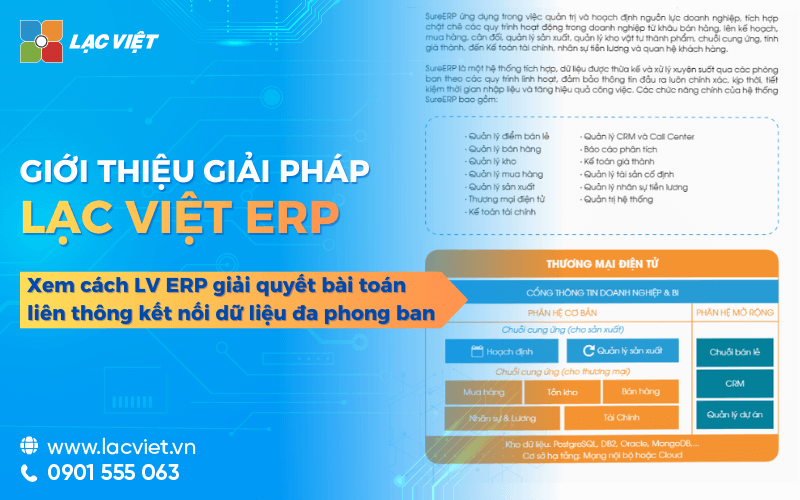
In business, mechanical, controlling cost, schedule and profit in each order increasingly difficult when extended scale, fluctuations in raw material. This is the reason many business learn ERP mechanical engineering, interested in LV ERP of Lac management solution overall is designed in accordance with the peculiarities mechanic in Vietnam.
6.1. Overview of LV ERP of Lac Viet
LV ERP solution is not to be “translated” from abroad, then pressure on Vietnamese enterprises. Instead, it was developed based on experience in implementing practical for the manufacturing enterprises in the country. Understand the difficulty of operation and management that enterprises and business must face.
Businesses mechanical commissioning many different departments: production, inventory, purchasing, accounting. When there is no management system, unified, data is often fragmented, leading to the decision to inaccuracies or delays. LV ERP focuses on the connection of the functions operate on a data platform unified help leaders see the “panorama” in real-time, make decisions faster.
LV ERP helps business mechanical shift from management to run according to data from discrete to decisions based on data accurately and timely.
6.2 why LV ERP business suit mechanical?
From the perspective of management, commissioning, LV ERP better meet the core requirements of the ERP industry, mechanical manufacturing:
- Production management – stock – prices – accounting on a unified platform: Data is connected through from order, production to finance to help businesses limit deviations of data, shorten the synthesis time report.
- Flexible production model mechanical: LV ERP supports both produce according to orders, according to the project, produced in conjunction, in accordance with the characteristics of the business mechanic in Vietnam.
- Appropriate accounting standards & governance in the country: the System is designed to keep abreast of regulatory accounting – tax in Vietnam, helping medium sized businesses meet compliance requirements, just good service for internal administration.
- Management reports in real time: Leaders can track the progress of production, cost efficiency, each order, without waiting for general craft from many parts.
For business are learn ERP mechanical engineering, LV ERP of Lac Viet is the right option when targeted towards advanced management ability to operate, not only in the number of goods. The solution is built on experience, practical implementation at the enterprise and versatile enough to the long-term in the expansion process to convert the number.
ERP mechanical engineering is becoming the platform management important to help businesses control costs, progress and effect according to each order in a transparent way. The deployment ERP allows businesses to move from management craft, based on experience to management based on real-time data. This is also a necessary step to standardize operation, enhance competitiveness as well as create a platform for sustainable development in the long term.