
Lac Viet ERP the food industry is management system, enterprise resource designed specifically to address the peculiarities of the sector such as management term use, traceability, inventory control batches – term use, ensure food safety and optimum cost of production.
This article Lac Viet will help the business understand ERP what is the food, why need to implement the core features, benefits the actual yield and suggest appropriate solutions in Vietnam such as LV ERP of Vietnam.
1. What is ERP for the food industry?
ERP food industry is systems management software, enterprise resource designed exclusively for the business of production, processing and distribution of food. Other than the ERP solution general ERP food not only gather all the data from purchasing, warehousing, production, sales to accounting to a place, but also handle the particular requirements of the industry. As management term use, traceability, control batch – term use, monitor the quality and safety of products throughout the chain operate.
When businesses use ERP business of producing food instead of admin discrete by many spreadsheet software, no related information they receive a single data source, accurate to update in real time. Helps to reduce errors, increase transparency, and improve operational efficiency overall.
The biggest difference compared to ERP casual
ERP business food production, the core functionality is complemented optimized to suit the characteristics the product has a shelf life of the raw material volatility and risk, food safety, high. The difference highlights include:
| Criteria | ERP business food production | ERP casual |
| Inventory management | Management details in batches – term use – status, quality, warning order is about to expire | Primarily managed according to the quantity, little or no follow-term use |
| Principles of stock | Support FIFO/FEFO automatic priority old batch or lot near expiration | Often only FIFO basic or export warehouse craft |
| Traceability | Fast access from raw material → production → finished products → customer support product recall | Access restrictions, data dispersion, time-consuming synthesis |
| Troubleshooting food safety | Localize the exact plot of the error, reduce legal risks, as well as brand damage | Difficult to determine the range of influence, the risk of withdrawal wide area |
| Production management | Track produced in batches (batch), evaluate productivity, attrition, the quality of each batch | Track overall production, the little details in cool |
| Optimal recipe & plans | Easy to adjust the recipe, the production schedule based on real data | Ability to analyze, optimize restrictions |
| The level of fit food industry | Specialized design for perishable products, high risk | Suitable for many sectors but lack the depth to foods |
2. The issue business of manufacturing food processing frequently
Food business frequently the point of clogging operation comes from the term used, the safety requirements traceability. If not well controlled, these problems increased attrition, hidden costs and risks quality. The challenge of commissioning popular, including:
- Loss of inventory due to store expired, rotation, slow control, not tight batches: When not manage inventory by lot, shelf, business, easy to use the wrong order and to the overdue still inventory, waste, risk quality. ERP for food industry to help control batches, expiry date as well as warning rotated to reduce wastage, optimal inventory costs..
- False data between inventory – production – accounting of input discrete: Input discrete, do inventory, cost no joints should be delayed reporting, lack of trust. ERP recorded data right at the point arises, instant sync between the parts help data accurate, timely decisions.
- Difficult to access quickly when an incident occurs or quality require product recall: Data not contact the batches that access is slow, the range retrieval is extended to affect credibility. ERP business food production link through the data in batches, which helps fast access, zoning exactly meet compliance requirements.
- Production planning depends experiences, missing data, forecast accuracy: When aggregate data plan, easy to deflection demand, causing excess inventory or raw materials. ERP connect sales data, inventory and production history, planning assistance-international more.
The problems on the congestion of the food business, located in admin, inventory, traceability as well as planning lack of data related information. When operating't be controlled in real time, wastage, hidden costs, risks, quality will increase.
3. Why the food industry should implement ERP system in-depth, comprehensive
The food industry requires administrator strict, so the product has a shelf life, safety requirements – traceability, high cost of raw material fluctuations. Disjointed tools such as Excel or software alone no longer meet this requirement. ERP food industry's role as system administrator consistency helps to control risks, optimize costs and support the decision more accurate.
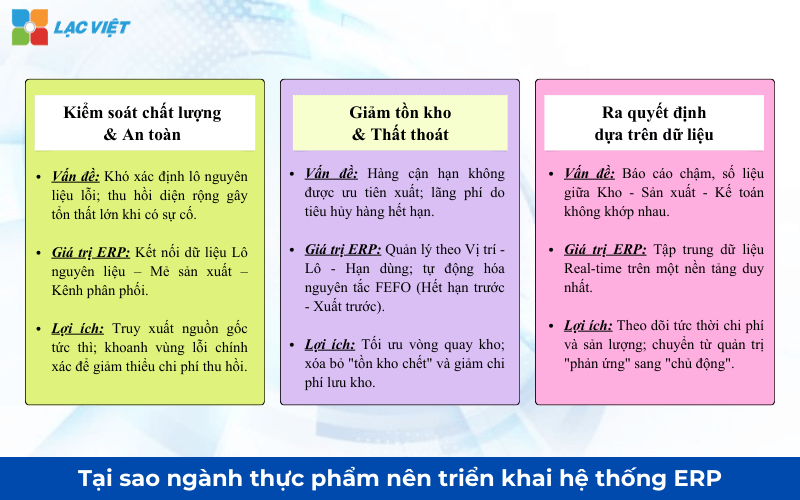
3.1 quality control & food safety
In manufacturing – food processing, risk, quality can arise only from a batch of raw material or a batch production. When the data is not centralized management, contact information business is very difficult to determine the exact scope of influence, led to the trend of recovery area to ensure safety, entailed large losses of cost.
Specifically, enterprises often encounter difficulties in:
- Determine the batches of material were used for each batch production
- Track finished products are delivered to the customer, sales channel, any
- Properly assess the extent, range, influence of the fixed quality
ERP food industry allows management throughout the data in batches of raw materials – semi-finished products – finished products, fastened with batch production as well as distribution process. When an incident occurs, the system supports:
- Fast access source material related
- Localize exactly the plot of finished products affected
- Clearly define the orders, distribution channels need to be processed
Thanks to the ability to access fast, accurate, should business can narrow the scope of recovery, minimize financial losses, protect brand reputation. With the food business, this not only benefits commissioning which is a core element of the risk management and compliance with food safety.
3.2 inventory Reduction – reduce losses
Unlike many other disciplines, inventory in the food industry is always associated with term use. Inventory as long, the risk of losing value as high. The fact is that many businesses still manage inventory by the total number of energy, lack of control, age of inventory, which leads to:
- Top pov term is not preferred before
- Expired materials must be destroyed
- Costs of storage, capital backlog rising
ERP food industry allows for inventory management according to many criteria at the same time: storage location, batch, expiry date, and age of inventory. The system automatically:
- Warning goods reach limit
- Support export warehouse according to the principle of FIFO/FEFO (expiration ago – export ago)
- Provide accurate data for the distribution production, sales
Manage inventory by shelf help business optimal rotation, inventory reduction die as well as the costs of storage, thereby improving the efficient use of capital. This is a financial benefit significantly with the food business in the context of the price of raw materials, logistics fluctuations.
3.3 decisions faster, more accurately
In fact many businesses, food shows, the decision management is still mainly based on aggregated reports slow data inconsistency between the inventory – production – accounting, or personal experience of people management. This potential risk, especially when expanding business scale, increasing the number of products or distribution channels. Restrictions frequently include:
- Report is not timely, lack of overall perspective
- Data between the parts does not match, difficult to collate
- Difficult to detect early trends or unusual points in the operation
ERP food industry to change the way decisions by focusing, data updates constantly on a unified system. Through which leaders can:
- Track instantaneous inventory – production – operating costs
- Effective analysis according to each product, sales channel or stage production
- Identify early risks to adjust the plan timely
About practical value, ERP helps businesses move from governance response to administration initiative based on the data. In the food industry, where minor deviations can also lead to major losses, ability to make decisions quickly, precisely, is the basis for competitive advantage sustainable.
4. The module's core ERP food industry
An ERP system food industry, efficiency is the foundation data connection throughout, from input to output of manufacturing operations – business. ERP helps to concentrate the data, automate processes to ensure information is not discrete, from it support business decisions more accurate. Below is the the core, the actual value that ERP brings.

4.1 Management, purchasing & material input
Raw material input is the starting point of all food products. Quality of raw materials, the time of entering the warehouse, relationships with suppliers decide directly to the quality of finished products and raw material costs. The purchasing manager helps enterprises:
- Control supplier & high quality material: Instead of recording craft, storage systems, information each provider, including the history of delivery, quality, delivery time, help businesses choose a reliable partner to reduce the risks of poor-quality raw materials.
- Track details raw material lot – day – term use: Each batch of raw material is mounted full information about the production date, expiry, the actual number of warehouses. This helps parts warehouse the same manufacture avoid entering wrong, to avoid confusion between the plots have term using different.
- Suggestive ordering automatically keep inventory safe & production plan: When inventory of raw materials up to the warning level, the system will automatically proposed quantity need to order to maintain operation, continuous production, without causing inventory excessive. This helps to reduce the financial costs related to working capital.
Thanks to centralized management right from the stage of purchase of raw materials, food businesses can better control quality, cost, and operational risk. This is an important foundation for stable production, reduce waste, ensure quality of the products right from the root.
4.2 Manage inventory by lot – term use
In the food industry, each product materials are limited in use. If not managed in batches, business, cumshot, wrong day, causing a status of near expiry is living longer, increasing the cost of storage and waste. This module allows:
- Inventory management, multi-dimensional: Data inventory is recorded at the warehouse, according to the location in the warehouse, according to each batch, limited user. This makes it easy to query and control the goods according to each of the criteria exactly.
- Track the age inventory & warnings row access/ overdue: When goods coming-term use, the system will timely alerts to sales department or production priority use to avoid waste.
- Support the principle of export warehouse FIFO/FEFO: FIFO (First In First Out – first in, first out before), FEFO (First Expiry First Out – expired, first out before) is a very important principle in food. Compliance to automatically help reduce the risk inventory overdue.
Thanks to inventory control in batches, expiry date and enterprises to reduce the significant loss of goods, overdue, the optimal rotation lower cost storage. At the same time, data inventory accurate sales planning, production initiative to enhance the efficient use of capital.
4.3 Management food production
Production planning in the food industry not only based on orders, which must also be adjusted according to the market demand, the shelf life of raw materials and equipment capacity. Production batch (Batch Production) or according to the formula need to closely monitor each stage to guarantee quality, reduce wastage. The production allows:
- Plan flexible production according to order & demand market: ERP synthetic data, inventory, orders, and consumption history to suggest optimal plan, to avoid producing excess or deficiency.
- Track produced by each stage, ever cool: Each production step is recorded in detail, easy progress control quality at each stage.
- Control the shrinkage – the broken ratio – productivity line: this will help early detection of a loss of efficiency in production, from which improve processes, reduce costs, to improve productivity.
Through the production management, ERP, food industry, helping businesses move from production-based experience to produce based on the data, control good quality, wastage and cost, while improving flexibility before market movements.
4.4 cost Management in the food industry
Prices in the food industry often fluctuate due to material cost, labor and wastage. Not have the system calculate flexible according to each production batch makes business difficult to determine the exact profit on each product or product group. The cost management allows:
- Calculate the price of batches, batch production: Each batch of production, there may be material costs, labor, different ERP allows the recording accurate calculation according to each batch.
- Cost analysis, raw materials – employee – attrition: this helps businesses know which elements are increased costs to take control measures.
- Compare price fluctuations to optimal profit: Communication price to be compared over time, conditions of production help the strategic direction input sales price of raw materials.
Calculate the price according to actual data to help businesses determine which products are generating high profits, any product yet effective. This supports the allocation of resources, adjust business strategies accordingly.
4.5 accounting – financial – management reports
Financial reporting accounting data if collected from many different systems will easily lead to errors, deviations and delays. This directly affects the ability of strategic planning, cost management, as well as compliance with accounting standards. The finance and accounting in ERP system food:
- Update financial data in real-time: Data from production, inventory and sales are updated right into the accounting system, ensuring consistency.
- Profit and loss statement according to the product – sales channel – duration: Businesses can easily profitability analysis by regions, by product or by channel, sales support, strategic decisions.
- Appropriate accounting standards in Vietnam (VAS): compliance with the accounting standards to help enterprises easily in audit, reporting to management agencies.
Through it, businesses have background data to control finances, optimize costs, and governance decisions in a timely manner.
5. Selection criteria ERP food industry for business in Vietnam
Many food business ERP implementation but the effect is not as expected because the system does not fit the peculiarities industry, practice management in Vietnam. The problem does not lie in technology, but in choosing to deploy. ERP food only really create value when properly meet the core criteria below:
- Have the ability to manage batch – term use – traceability: is mandatory criteria with ERP business food production. The system should track throughout raw materials, semi-finished products, finished products according to each batch and expiry date, batch production, at the same time supports fast access when the incident occurs. Core values lies in the ability to localize accurately, reduce the cost recovery ensuring the operation sustainable.
- Flexible customized according to the scale & pattern enterprise: is the key element. ERP should be adapted to the production batch, big – small, model medium of production and distribution level standardized different. The right solution must allow configuration according to the actual operating according to the development roadmap 3-5 years, to avoid incurring manipulation system or data, teen, uniform.
- Easy to use with a team of non-experts IT as: warehouse, manufacturing, QC and accounting are important requirements. ERP need simple, intuitive to restrict data entry deal, ensure the accurate data. Effective system to help employees do it right from the start, reducing manipulation excess mounts the daily work with data general administration.
Summing up the above criteria showed choose ERP food is decision management long term. Only those solutions keep abreast particular industry match reality Vietnamese enterprises to deploy effective in operation daily new help control risks, optimize cost and enhance competitiveness and sustainable.
6. Lac Viet ERP – ERP Solution for food industry customized according to the needs to the business
For food businesses, selection of ERP is to choose the platform administrator in accordance with actual operating in the direction of development. LV ERP of Lac Viet was built as an ERP solution for food industry, focusing on solving the core of inventory, production, price, and management reports.
6.1 overview of ERP of Lac Viet
Lac Viet ERP is ERP solution overall due to Lac development, deployment, according to the model on-premise in accordance with the business manufacturing – distribution in Vietnam wishing to control internal data closely, custom depth in accordance with the actual operation.
Unlike many ERP international standardization, high LV ERP is developed based on experience in implementing practical for business English. Especially in the manufacturing industry, food. Thanks to this system, more suited to working habits, qualified personnel and management model in Vietnam. Help business easy to apply, operate effectively in practice.
Lac Viet ERP helps connect through data from purchase, warehouse, manufacturing to finance, create a source of information for leaders. Thanks to that, the business reduced depends on reporting the management based on accurate data, timely.
6.2 Lac Viet ERP solve nothing for the food industry?
In the food industry, the problem of commissioning do not usually appear singly, which link closely with each other. Lac Viet ERP is designed to handle the “point of congestion” this is a synchronized way.
- Manage inventory by lot – term use details: Lac Viet ERP allows to manage inventory for each lot, shelf mounted to the date of entry, and fresh produce. Thanks to better control the age of inventory, priority handling, pov, term, businesses reduce losses and optimize the costs of storage, ensuring safe operation in ERP food industry.
- Traceability fast, exactly when the problem: LV ERP for quick access from the finished product back to the raw materials, the production stage involved when an incident occurs. Thanks to localize correctly in short time, avoid the withdrawal of wide-area reduces financial losses, protect brand reputation.
- Optimal production plans, reduce shrinkage: Lac Viet ERP support production planning based on the data inventory, orders, and actual capacity. The track each batch, each stage helps to control attrition, the rate of damage. Productivity consistently, reduction depends on the personal experience of management studio.
- Report of management board of “Fast – accurate – real-Time”: help leaders track inventory, costs, prices and profits correctly. Thanks to that, the business gradually move from administration feelings to make decisions based on data, improving efficiency in a competitive environment.
Overall, Lac Viet ERP not only solve each problem individually, which creates a management platform for food business. When data is connected throughout the enterprise can control risk better in optimal operating costs, capacity building and governance sustainable in the long term.
6.3 Why the food business should choose LV ERP?
From the fact consultant ERP deployment for many enterprises to manufacture, can see Lac Viet ERP in accordance with the food industry thanks to the three core elements such as:
- Designed with realistic operating in Vietnam: LV ERP does not require businesses to change the whole process, familiar only to fit the software. Instead, the system is configured to support each step standardize existing processes, help business approach as well as a more effective implementation.
- Flexible customized according to each model's production – distribution: Every food business scale, products, as well as how to organize different. LV ERP allows customized according to each specific model, from the production batch, in order to combine production and distribution, help system, with the business in the process of expanding.
- Our team of consultants understand business management & food production: ERP only valuable when deployed by our team understand both technology and problem management. Lac Viet orientation LV ERP is not only software products, which is management solution with a team of consultants with the business throughout the process to deploy and operate.
Lac Viet ERP is ERP solution overall production – processing – distribution of food management throughout from purchase, inventory, production, price to financial and management reports. The solution is developed based on actual operation in Vietnam, aiming to help ERP not only be deployed, which is effectively used to create long-term value.
The food industry is standing before increasing requirements on quality control, traceability optimal operating costs. In that context, ERP, food industry, not only is the tool of the process, which is the platform that helps business management through decision-making based on data, minimize operational risk. Choosing properly implemented ERP in-depth will help businesses improve the efficiency use of resources, increase the ability to respond to market and build competitive advantage sustainable in the long term.