Enterprise Content Management (ECM) system is a solution to help enterprises collect, digitize, manage, store, search, run the entire set of documents, data and internal processes on a centralized platform. This is technology important in conversion of, in particular with respect to the organizations and enterprises are to find out information about enterprise content management with objective optimal operation, reduce risk, enhance the availability of data.
Search needs and application ECM increasingly strong growth as businesses are faced with three major problems: data dispersion, process and handling time-consuming, pressure comply with legal increasingly strict.
The same Lac Viet learn about system ECM solutions in this article.
1. Enterprise Content Management is what?
1.1. The concept of ECM according to international standards
According to the definition from Management association, information and images (AIIM)Enterprise Content Management is a “set of strategies, methods, tools used to collect, manage, store, preserve, deliver content support the operational processes of the organization”.
In simple words, the ECM is the “brain data management” of the business, where all documents – from contracts, personnel records, invoices and receipts to transaction data is centralized and controlled system. This helps businesses remove condition material dispersed in many departments, many software for small retail or even form of traditional paper.
With respect to the organizations and enterprises are understanding, enterprise content management, understanding the concept of international standards to help them capture the essence of the ECM is not just technology, but also the governance model based comprehensive data.
1.2. ECM includes what? – The 5 pillars core
According to AIIM, an ECM system is composed of 5 main pillars:
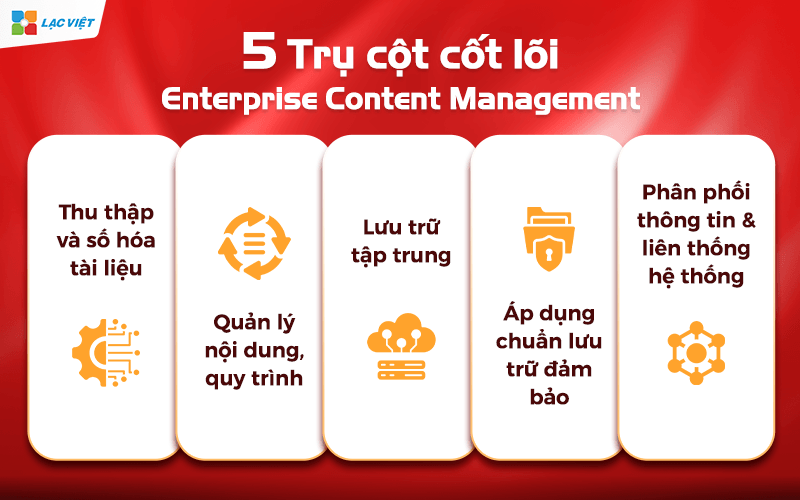
- Capture – collect and document digitization: include scanning paper documents, extract information by AI OCR, classification record automatically. For example: automatic recognition of contracts, bills, vouchers without the need to enter manually.
- Manage – Manage content, process: material is organized according to structural metadata, assign, detail, version control, automation steps for approval.
- Store – store focus: the document is saved in a central repository, security, capable of quick search by content, keyword or category.
- Preserve – preserve long-lasting: Apply standard storage to ensure documents are not lost or damaged over time, at the same time support the legal compliance of data storage.
- Deliver – delivery information: Provide materials right people, right time, right context; support contact information with other systems such as ERP, HRM, CRM.
5 pillars this form lifecycle document fulness, ensuring information is processed throughout, from the reception until the end, helps to lose up to 30-50% of the time processing, according to research conducted by AIIM.
2.3. ECM what other than Document Management System (DMS)?
Many businesses often confuse the ECM and DMS. However, these two concepts are clear differences:
- DMS only focus on document management (storage, search, decentralization).
- ECM open wider, including process management, unstructured data, automation, AI, control life cycle, material, deep integration with enterprise systems.
For example easy to understand: DMS like a library archive. The same ECM as a “central executive” whole data, documents and processes in the enterprise.
With ECM, business not only find documents more quickly, but also ensure that document is put in the right processes, the right time to serve the profession.
2.4. Object businesses should use ECM
ECM is suitable for all types of businesses, especially:
- Businesses have large archives: banking, manufacturing, logistic, insurance, health.
- Businesses need to comply with strict legal regulation, long-term storage.
- Businesses are converting some want to sync data, processes on a common platform.
- The organizations and enterprises are to find out information about enterprise content management to solve distributed data, process and requires transparency information.
ECM helps businesses save storage costs, reducing processing time records, improve work performance and increase the ability to control data – the core values that any units also needed in the context of competition today.
2. The main components in a system, Enterprise Content Management, modern
A system ECM modern not just a place to store documents, which is the foundation managing the entire lifecycle of data in the enterprise. Each component of the ECM play a role to solve a group of problems: digitalization, management, operation, security and integration. Below is analyzed in detail according to each component, to help businesses understand the real value that ECM bring.
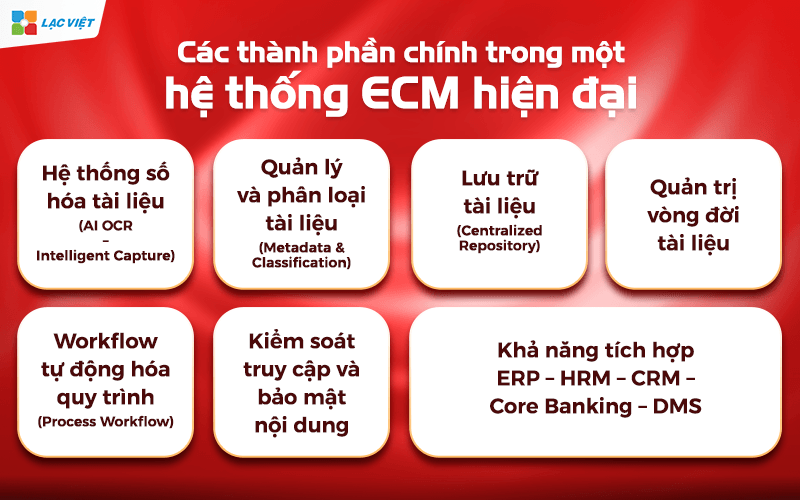
2.1. System digitization (AI OCR – Intelligent Capture)
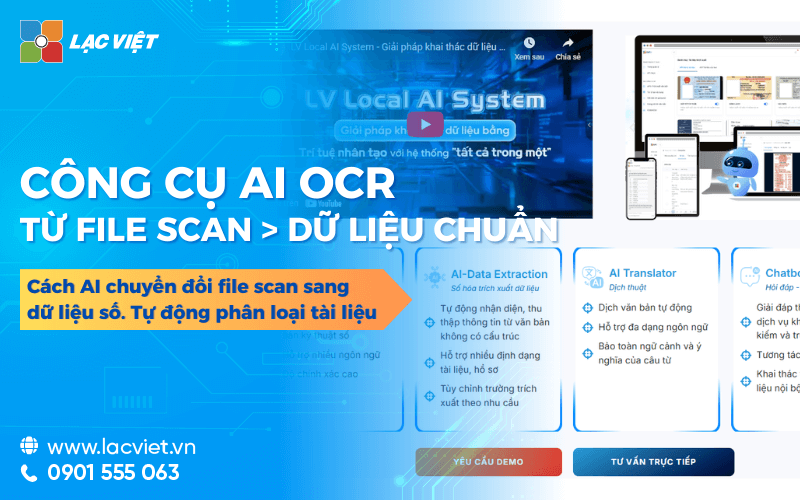
AI OCR (Optical Character Recognition application artificial intelligence) is a technology that helps convert images, documents, PDF scan of data possible number search, automatic processing.
Other with OCR the optical character recognition, AI OCR has the ability to:
- Classification profile automatically
- Extract market key information (customer name, contract number, amount...)
- Recognize different formats
- Up to 80% operation input crafts
Example common application:
- Automatically read, classification of contracts, invoices, warehouse, personnel records, ID card/CCCD.
- Automatically put the data into the system ECM or ERP without the need to enter manually.
Help business remove completely process your data public capital to errors and time-consuming.
2.2. Manage and document classification (Metadata & Classification)
Metadata is the descriptive data to help “understand the material” as the record type, creation date, approver, department, level of security.
ECM modern use:
- Metadata dynamic
- Auto classified according to AI
- Tag content for easy search
- Manage document versions
The intelligent classification help businesses not based on the folder structure of traditional crafts – things often leads to disorders after a few years.
Employees to easily find the right document in a few seconds, instead of wasting time searching in folders or email.
2.3. Document storage (Centralized Repository)
Repository is a central repository where all documents are gathered instead of lying discrete in multiple systems or individual devices.
ECM provides:
- Storage according to security standards
- Automatic backup
- Search by content (Full-text search)
- Storage stratified according to the amount and time limit
- Possibility of unlimited expansion
Business control is the only source (single source of truth), to ensure the synchronization accuracy.
2.4. Management lifecycle document
Each document type is round, his private life: make – approval – use – hosting – get. ECM role automate and control the entire life cycle of this.
Includes:
- Automatically apply storage period prescribed
- Automatic transfer document status (draft, approved...)
- To save the entire history edit
- Get document according to the policy, legal compliance
Businesses always maintain state compliance, especially important for banking, insurance, medical, financial.
2.5. Workflow process automation (Process Workflow)
Workflow in ECM support the automation of processes related to the document, for example:
- An approval process contract
- Process bill payment
- Process additional personnel records
- Process internal audit
ECM allows:
- Create process drag and drop
- Assigned task automatically
- Reminds limit warnings
- Communication department
Ensure the process runs properly term reduction depends on the human, reduce losses, improve operational efficiency.
2.6. Access control and content security
Security is the most important factor when document management business. ECM modern supply:
- Decentralize the details of each file or each school information
- Data encryption when transmitting, when you
- Multi-layer authentication (MFA)
- Access logs (Audit log)
- Privacy policy according to the role
ECM solved this problem by laying out layers of strict control, ensuring that only people have the right to a new view or edit the document.
Value: minimize the risk of leakage of sensitive information, especially important for documents related to financial, customer, hr.
2.7. The ability to integrate ERP – HRM – CRM – Core Banking – DMS
One of the biggest advantages of ECM modern is the ability to integrate with other enterprise systems, including:
- ERP: financial management, purchasing, manufacturing
- HRM: personnel records, reviews, attendance
- CRM: customer data, interaction
- Core Banking: transactions, contracts credit
- DMS: management system, document existing
Thanks to the possibility of API integration, businesses can:
- Sync data automatically
- Automatically insert the documents into the workflow processing
- Avoid data entry duplicate
- Reduce errors
- Create data flow throughout the organization
Business has an eco-system data consistency, reduce fragmentation, improve decision-making abilities.
3. Deployment process Enterprise Content Management for business
Implement ECM is not only install the software which is a project to convert numbers have a direct impact on the way businesses operate, stored data mining. The procedure below describes how the organizations and enterprises are to find out information about enterprise content management can deploy a system efficiency, reduce risks and optimal long-term benefits.
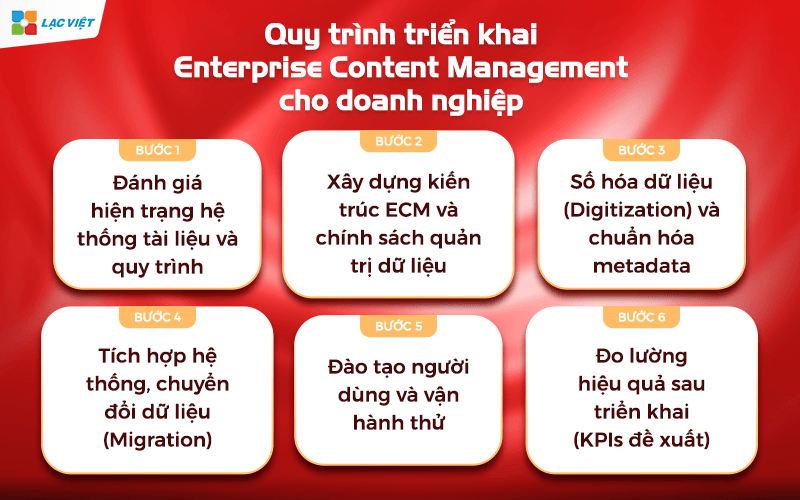
Step 1. Assess the current state system documentation and processes
This is the most important step because it determines the scope and level of complexity, the cost of deployment. Business exactly the “knot” and building range development match, avoid investment wasted.
Content rating include:
- Storage status current: documents scattered across multiple systems, email, individual machines, Google Drive...
- Document type primary: customer records, contracts, documents, commissioning, invoices, personnel records...
- Process current: approval of the contract, rotated stock from internal audit.
- Tough: take a lot of time looking for, lack of standards, duplicate data, misplaced.
For example, An insurer can take on average 12-20 minutes to find a customer record if the document does not have metadata standard (AIIM – https://www.aiim.org). ECM helps to reduce this time down to just a few seconds.
Step 2. Building architecture ECM and policy data management
Architecture ECM included:
- Storage model focus
- Policy metadata, document classification
- Rules security
- Policy lifecycle document (retention policy)
- Plans to expand, integrate later
Businesses need to choose the appropriate architecture: on-premise, cloud or hybrid depending on the scale, budget and security requirements.
Ensure the system stable operation, reduce operational risk, support to extend long-term.
Step 3. Digitized data (Digitization) and standardized metadata
This is the stage business document conversion, physics, data is not structured in the form of numbers can search handle. Business data control better, reduce dependence on stock paper to ensure the information available for the business process.
Includes:
- Bright scan the entire paper records
- App AI OCR to extract information
- Standardized metadata according to the rule was designed
- Remove duplicates
For example, personnel records, employment contract or bill payment can be AI OCR recognition to transfer the data automatically.
Step 4. System integration, data conversion (Migration)
ECM is not able to operate effectively if freestanding. The integration ensures data is rotated throughout between the ECM and the business systems such as ERP, CRM, HRM, Core Banking.
Content integration:
- Connect API with the operating system
- Sync data documentation – customer – transaction
- Process automation related departments
- Migration data from the old platform
Value: no longer discrete data; businesses have “picture data” to make decisions fast more accurate.
Step 5. User training and commissioning
One of the main reasons why projects ECM failure is employees do not understand how to use or reject the changes. This step helps businesses ensure user confidence to operate, reduce the error operation, optimum performance immediately after the official implementation.
Training activities include:
- Instructions for use for each departments
- Training system administrator (administrator)
- Commissioning (pilot) on a small group
- Recorded feedback and refine the process
Step 6. Measure the effectiveness after implementation (KPIs proposed)
Businesses need to evaluate the effectiveness ECM based on the clear indicators:
KPIs operation:
- Duration document search up how much percent
- The approval time record shorten how many days
- The error rate of data entry craft decrease how much
KPIs cost:
- Reduce the cost of paper storage, warehousing
- Reduced operating costs (personnel data entry, shipping records)
- Reduce the cost of processing flaws
KPIs compliance:
- Record rate standard metadata
- The rate of material expired, be duplicated, lost
Measurement clearly help businesses understand the impact of ECM, optimal operating constantly and ensure the system bring long-term benefits.
4. Selection criteria platforms ECM suitable for business
Việc lựa chọn một nền tảng Enterprise Content Management phù hợp không chỉ là chọn một “phần mềm lưu trữ tài liệu”. Đây là quyết định ảnh hưởng trực tiếp đến hiệu quả vận hành, chi phí quản lý thông tin và khả năng mở rộng của doanh nghiệp trong 5–10 năm tới.
Dưới đây là các tiêu chí quan trọng mà các tổ chức, doanh nghiệp đang tìm hiểu thông tin về enterprise content management cần xem xét trước khi ra quyết định.
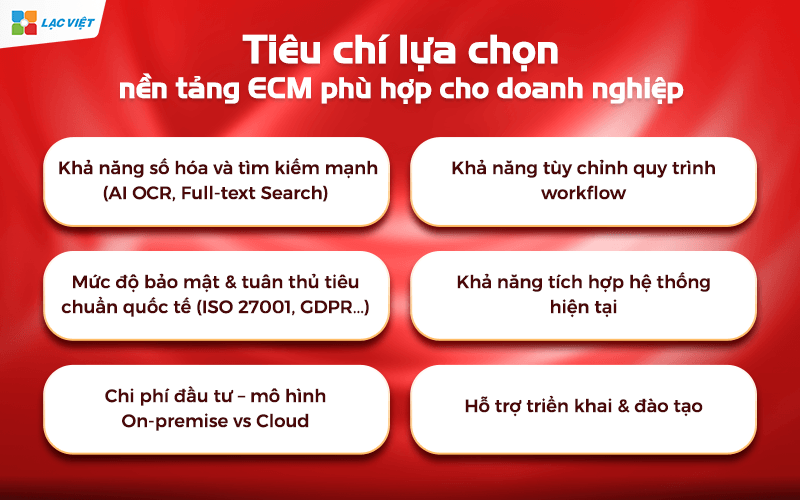
4.1. The ability to digitize and search (AI, OCR, Full-text Search)
Ability to document digitization is the platform to help enterprises shift from management model papers to the operating environment of.
AI OCR allows software to “read” text in image or PDF and transfer of data may be looking for. This is especially important with the banking sector, insurance, hr or finance – where the volume of paper records is very large.
Benefits focus for business:
- Looking for fast documentation 5-10 times in comparison with the manual method
- Reduced from 30-50% of the time input thanks to automatically extract information.
- Increase accuracy, reduce errors people in the handle profile.
A platform ECM good need to ensure:
- Support AI OCR multi-language.
- Full-text search (full-text search) high speed.
- Identification, automatic document classification record form.
4.2. The ability to customize the process workflow
Workflow is the “backbone” of the ECM system. This is the ability to design approval process – handling documents according to the peculiarities of each business.
Score business that need attention:
- Allows drag–and-drop to create workflow not?
- That support version process (versioning)?
- There is automated by AI, send prompts limit processing, threading docs?
4.3. The level of security & compliance to international standards (ISO 27001, GDPR...)
The document is intellectual property important of business. So platform the ECM must meet the requirements of privacy – safe data at the enterprise level.
The standard should consider:
- ISO/IEC 27001: international standards on management information security.
- GDPR: regulation of protection of personal data in Europe, suitable for the multi-national corporations.
- SOC 2 Type II: evaluation criteria security when operating on the cloud.
Besides, the platform ECM needs to support:
- Decentralized access according to role.
- Save access logs (audit log).
- Data encryption in the state storage and transmission.
4.4. The ability to integrate the current system
A platform ECM good to play the role of “heart connection” with other systems such as ERP, CRM, HRM, Core Banking, Email Server or DMS.
The questions to ask when evaluating ECM:
- Have open API (RESTful API) to integrate?
- Be connected with the existing system of business?
- That support Single Sign-On (SSO) to optimize user experience?
Business is what?
- Reduce the status data is fragmented across multiple systems.
- Shorten time searching for relevant information.
- Create work experience more seamless for employees.
4.5. Investment cost – model for On-premise vs Cloud
Depending on the scale and level of security, businesses can choose from:
- On-premise: deployment in place, complete control over the data, in accordance corporate financial industry – banks.
- Cloud: flexibility, lower cost, easy to extend.
Note when comparing cost:
- The total cost of ownership (TCO), including: - deployment – maintenance – upgrade – archive.
- The level of expansion in demand in the next 3-5 years.
- The cost of training users.
4.6. Support deployment & training
A solution ECM strong, but there is no support team deployment, it is very difficult to put into actual operation.
The business should check out:
- Unit provided with counseling conversion process't?
- Can support the training according to the user role?
- Have SLA clear about time technical support?
- The documentation has the full update?
5. Set 3 solutions digitized comprehensive data of Lac Viet Computing: AI OCR – LV SureDMS – LV Dynamic Workflow
In the context of business increasingly have to handle the volume of material large, diverse formats, requires processing speed faster, the need to build a system, content management, intelligent digital become urgent.
Set 3 solution of Lac Viet Computing – AI OCR, LV SureDMS and LV Dynamic Workflow is designed as a complete ecosystem to help businesses automate the entire lifecycle of documents from the moment of reception, storage to processing and approval.
- AI OCR play the role as the “gateway digitized smart”, to automatically identify, extract data from paper documents or images with high accuracy. AI technology helps to classify records according to each type of form, the maximum reduction in time to enter data manually, limiting flaws. This foundation is important, especially for business has the record as big as banking, insurance, finance, hr or logistics.
- LV SureDMS system is a document management business, which allows storage, decentralized, search, management, life-cycle documentation on a space of unity. With the possibility of full-text search, version control, LV SureDMS help employees access information faster, reduce risk, lost records, standardizing processes and stored according to standard ISO 27001.
- LV Dynamic Workflow role automate the entire workflow is based on documents. The system allows enterprise flow design approval, the approval, electronic, assign tasks, track status, and process optimization in real time. Operation process becomes more transparent, reduce dependence on email or exchanged manually make sure the job rotation right person – right time – right standard.
When combined, the 3 solutions of Lac Viet formed a platform Enterprise Content Management, modern business support, shorten processing time, documents, increase accuracy, reduce operating costs, create data platform, standardized to develop apps AI in the future. This is a suitable option for the organizations and enterprises are learn about enterprise content management and the desire to implement an optimal solution – safe – flexible according to specific needs.