Accounting is the process of collecting, recording, processing and sorting of information about assets, capital, revenues and expenses of the business. Through the vouchers and accounts and pricing methods, data are aggregated for financial reporting. This process helps to provide accurate information, transparency, service management, decisions and assess business performance.
However, errors in accounting can lead to financial data is not accurate, affect the rating business results enclose the potential legal risks. Mastering methods, principles and rules of accounting according to the current standards are important factors that help business control costs, manage cash flow and optimal operational efficiency.
This article Lac Viet will provide overall perspective about bookkeeping, including objects, methods, processes, and the note essential to perform accurate and efficient.
1. Overview of accounting
1.1. Accounting what is? Classification of accounting in business
Accounting is the process of acknowledging, processing and synthesis of the economic – financial of the business in order to determine the exact situation of property, capital, costs, revenues as well as profits at each point of time. Accounting helps business, “measuring financial health” track cash flow, from which to make decisions timely and accurate.
Depending on the intended use management information, accounting is divided into three main groups:
- Accounting: in order To prepare financial reports, reflecting comprehensive financial situation business including assets, liabilities, capital, revenues, expenses and business results. This is the basis for evaluating the operational efficiency, reporting, tax compliance with the law.
- Accounting management: Provides information for internal leadership to decisions about the budget, resource allocation, planning, spending and assess the effectiveness each department.
- Accounting statistics: Synthetic data for trend analysis as well as macro picture of economic activity, the nature of quantitative data, support long-term forecasts to assess market volatility.
1.2. Accounting what is? Importance of accounting
Accounting is the system of operation observe, measure, calculate and record the economic and financial arise in business, according account accountant accounting standards current.
The role of accounting entries accounting in business:
- Asset management – capital: accurately track the type of property, liabilities and equity, controlling cash flow, the efficient use of capital.
- Track the cost – revenue – profit: Determine the right price of capital, cost management as well as cost of sales, grasp the actual profit by product or service.
- Ensure transparency – compliance with the law: Notes to the account and the account accounting standard financial reporting, accuracy, transparency.
- Save time – resources: accounting software is the automation of the synthesis report and collate public debt, warehouse.
- Decision support fast: Data timely and accurate help leaders take strategic decisions quickly, as well as optimized business performance.
2. Subjects & method of accounting standard
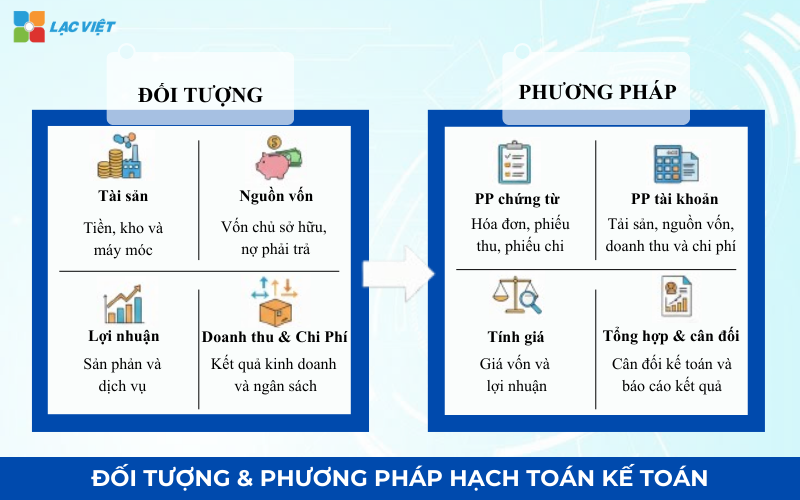
2.1. Objects of accounting
In accounting, the object is the composition of economic activity – finance that businesses need to monitor and manage. Includes:
- Assets: Cash, bank deposits, inventory, and fixed assets. Know the value of existing assets, from which making a decision to buy, shopping, maintenance, or liquidation of assets.
- Source of capital: Equity, debt, loans, accounts payable supplier. Help control debt to pay, avoiding the risk of late payment term and optimal cost of borrowing.
- Revenue – expenses: revenues and expenditures incurred in the operation of production – business, is the basis for determining the results of the business and budgeting.
- Profit: The end result of business activity, reflecting effective according to each product and service.
- The volatility of assets – debt: reflects the change in cash flow, inventory, public debt, support identify early financial risks.
All the objects when this is accounted for, it will help the business to capture the full financial picture serves for both internal management and reporting standard legal.
2.2. The method of accounting basic accounting
To manage the objects on the business use of the method of accounting basic, each method brings specific value:
- Method vouchers: recognition of the economic and arises on the basis of evidence from legal as bills, receipts, voucher, acting as legal grounds and the original data service check, compare and explanations when necessary.
- The method accounts: Using the system account accounting to classify, track constantly fluctuating assets, capital, revenue, and cost. Each transaction is designated account according to the principle Debt/Can help control the flow of money as well as property values exactly.
- Price calculation method: Determine the value of the object of economic currency, as the basis for the financial statements properly reflect the actual value. The calculation of the exact price, especially for inventory, fixed assets and the cost of production,... to help businesses determine the right price of capital, profits, and decision support effective governance.
- Synthetic methods & balance: After recorded on each account, the data are aggregated into the balance sheet accounting and reporting business results. This method helps to assess the financial situation and adjusted cash flow time.
3. Prescribed accounting standard circular current
To account effectively, businesses need to fully comply with the standards and regulations accounting now, just to meet legal requirements while ensuring the correct management of assets, capital and business results.
3.1. Circular no. 200/2014/TT-BTC
This is the mode of accounting applies to most businesses in Vietnam, the rules in detail how to record, review and presentation of financial information. This circular provides guidance, revenue recognition, expenses, fixed assets, liabilities, along the other financial. Apply accounting according to Circular 200 help business:
- Ensure financial statements properly reflect the situation of the property, business results.
- Limit the risk of errors, avoid penalties and tax law violations.
- Easy synthesis as well as data analysis for internal management, thereby making the strategic decision accuracy.
3.2. Circular 133/2016/TT-BTC
Apply for business medium/small Circular 133 provides instructions simplified accounting helps small business to comply with that still ensure the accuracy and transparency.
- Reduce cost, time reporting and accounting for small & medium business.
- Ensuring the data on assets, liabilities, revenues and expenses are accurately reflected.
- Business support meet the requirements of the audit, the tax authority.
4. Instructions on how accounting under the new rules
Accounting is the process of acknowledging, processing and synthesis of the economic and according to current standards (such as circular no. 200/2014/TT-BTC) to ensure financial reporting accuracy and supporting performance management, cash flow, assets and expenses. Here are detailed instructions according to each professional, popular.
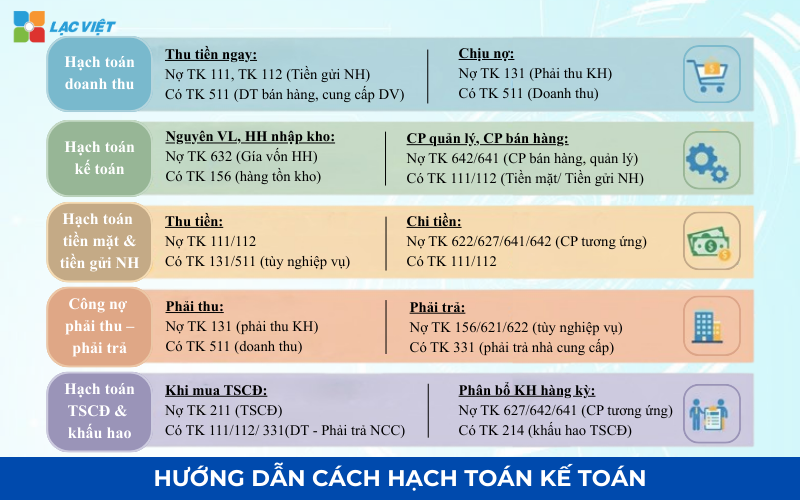
4.1. Accounting for revenue under accounting standards
Revenue is all the earnings from selling goods, providing services or other business activities.
How accounting:
- When businesses collect cash:
- Debt TK 111 (Cash) or TK 112 (bank deposits)
- Have TK 511 (sales revenue, service provider)
- When sales incur debt:
- Debt TK 131 (customer receivables)
- Have TK 511 (revenue)
Accounting revenue exactly help businesses understand cash flow practice, assess business performance and determine the correct accounting period, from which financial reporting honest and reliable.
4.2. Accounting by cost
The cost is the entire account business money spent to generate revenue, including: the cost of production, cost of sales and cost management business.
How accounting:
- The cost of raw materials, goods warehousing:
- Debt TK 632 (cost of sales)
- Have TK 156 (inventory)
- Cost management, cost of sales:
- Debt TK 642 (Cost of sales) or TK 642/641 (Cost management)
- Have TK 111/112 (Cash/bank deposit)
Accounting cost details in order to control each expense, performance evaluation activities by departments, or products, from which the optimal budget and reduce waste.
4.3. Accounting, cash and bank deposits
Tracking cash flow out into the business, including cash in the fund and bank deposits.
How accounting:
- Collecting money:
- Debt TK 111/112
- Have TK 131/511 (custom service)
- Spend money:
- Debt TK 622/627/641/642 (cost respectively)
- Have TK 111/112
Business control liquidity, ensure affordability, timely and optimized working capital management.
4.4. Accounting in receivables – payables
Public debt is the client accounts owed (receivable) and the business account to pay for the supplier (pay).
How accounting:
- When recorded receivables:
- Debt TK 131 (customer receivables)
- Have TK 511 (revenue)
- When the recorded accounts payable:
- Debt TK 156/621/622 (custom service)
- Have TK 331 (pay suppliers)
Debt management accurate reduced risk for late payments, optimize cash flow and support prevention of bad debt.
4.5. Accounting for fixed assets and depreciation
Fixed assets are long-term assets such as machinery, equipment, buildings. Depreciation is allocated value of the property according to duration of use.
How accounting:
- When buying fixed assets:
- Debt TK 211 (fixed Assets)
- Have TK 111/112 (Cash/deposit) or TK 331 (pay suppliers)
- When allocating depreciation of bank:
- Debt TK 627/642/641 (cost respectively)
- Have TK 214 (depreciation of fixed assets)
This is to track the exact value of the property, planning, maintenance, upgrade or liquidated in a timely manner. At the same time, accounting depreciation regulations to report profit, fully reflects the actual cost.
5. Process accounting standard for business
Process accounting is the system of standards to help enterprises recognize and general business, economic – financial, accurate, timely, and ensure legal compliance improve efficiency management, cash flow, debts and assets.
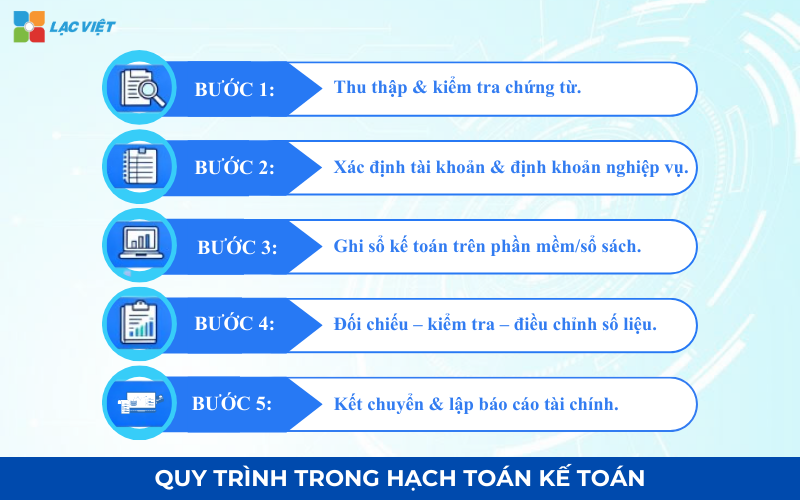
Step 1: collect & check stock from.
Ensure all economic transactions incurred are legal, complete and accurate.
How to perform:
- Collect all documents related to the transaction: bill of sale, receipt/payment, contract, receipt, lists, payment receipts and inventory warehouse.
- Check the legality – valid certificate from: confirmation date, unit name, amount, signature, seal and tax code (if any).
- Remove stock from duplicate, damage or flaws before putting on accounting.
Reduce the risk of errors, disputes with suppliers and customers to ensure that accounting data reliable.
Step 2: Identify the account and the account service.
Accurately record each professional, economic accounts system of accounting and identify the account accordingly.
How to perform:
- Determine the type of transactions: revenue, cost, liabilities, fixed assets, cash, bank deposits...
- Select accounting accounts right under circular no. 200/2014/TT-BTC.
- Apply the Debt – Is exactly for each profession.
Ensure financial data is accurate and complete, support effective analysis business according to each product group, room board. At the same time help control the flow of money and public debt, limiting the risk of loss of property.
Step 3: bookkeeping software/books.
Storage of accounting information in a systematic way, easy lookup and synthetic.
How to perform:
- Recorded the fixed account to the window, general window details or accounting software.
- Test data after recording window to ensure no missed trades.
- Made for lighting interim between the parts: accounting – inventory – sales order to avoid deviations.
Accounting data is updated continuously, service management reports as well as financial reporting, timely, and track financial situation and detect deviations to adjust.
Step 4: collate – check – adjusting the data.
Detection, timely correction of errors before the establishment of financial statements.
How to perform:
- Collated data between accounting books and original documents, bank statement, liabilities as well as inventory.
- Check out the difference, cause analysis to make adjustments.
- Establish a mechanism to control the cross: the chief accountant approved the adjustments and important.
Reduce the risks of financial statements misleading, avoid violating the law to increase the transparency and reliability of accounting data.
Step 5: transfer & financial reporting.
Synthetic data was accounting to financial reporting, assessing business results.
How to perform:
- Transfer revenue, cost, depreciation and advance payment to the account business results.
- Set the report important:
- Balance sheet: Reflection assets – liabilities – equity.
- Report results of business activities: Reflect revenue, expenses and profit.
- Statements of cash flows: Help track cash flow in the business.
- Data analysis to support leadership decision making in terms of cost, investment, budget, cash flow and business strategy.
Financial statements accurately reflect the financial situation, business support, risk management, review of operational efficiency, strategic planning aims to enhance credibility with banks, investors and tax authorities.
6. Common risks when accounting & how to fix
In the process of accounting according to the circular, 200, businesses can face the risks that affect the accuracy and transparency of financial data. Recognition and timely control the risk of this condition is necessary to improve the efficiency, financial management and support strategic decisions.
| Risk accounting | Consequences for business | Solution fix |
| Errors in the record & the account | Enter false data, write the wrong account, omissions, service led to the financial statements is not accurate, deviation profit and cash flow. | – Use accounting software is automated accounting, the account and check for projection.
– Set up process, check the internal periodically. – Training personnel on the account and the account standard. |
| Loss of asset / inventory management less | Control elements with inventory, cash, fixed assets led to the loss or use of ineffective, affect business performance. | – Detailed tracking assets & inventory (quantity, value, location, responsible person).
– Connection accounting software with inventory & fixed asset management to update the data continuously. – Inventory periodically compare actual figures with the books. |
| Public debt difficult to control | Management does not closely the account receivable and payable slow fall, slow pay, affect the cash flow and corporate reputation. | – Use system for monitoring the debt automatically, prompt payment and accounting arise.
– Classification of public debt according to the customer, project or department. – For projector periodically with customers, suppliers to detect deviations. |
| Financial report incorrect | Data reported deviations lead to strategic decisions, investment planning and management, cost-ineffective. | – Use software accounting automatically according to TT200 to synthesis report.
– Compare data with the books, the original documents before reporting. – Establish control over cross between accounting – stock – finance – project management. |
7. Accounting system Accnet ERP – Manage & optimize the efficient accounting
To optimize the whole process accounting accounting and business can apply software Accnet ERP help automate transparency of business finance and accounting:
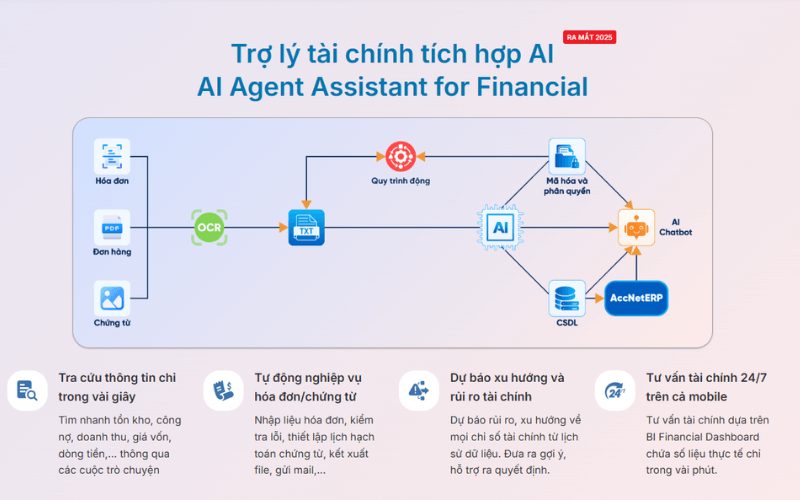
- Automatic recognition & making payment service: The software automatically accounting transactions (sales revenue, cost, depreciation), help reduce errors manually ensure data accuracy compliance with circular no. 200/2014/TT-BTC.
- Track debt – inventory – fixed assets management software and detailed public debt, inventory and fixed assets according to each object, synchronized data related departments, reducing the risk of bias.
- Allocation of costs & depreciation automatic: the System automatically calculates depreciation and cost allocation management/sales, which reported profits reflect the actual cost correctly.
- Financial reporting & intuitive administration: Provides the balance Sheet reports the results HĐKD accompanied by the management report details, support leadership decisions faster, optimize budget and cash flow.
- Compliance with accounting standards & legal: The software automatically accounted for by the Standard VAS & Circular 200/133, ensuring tax declaration regulations, reduce risk, legal and audit.
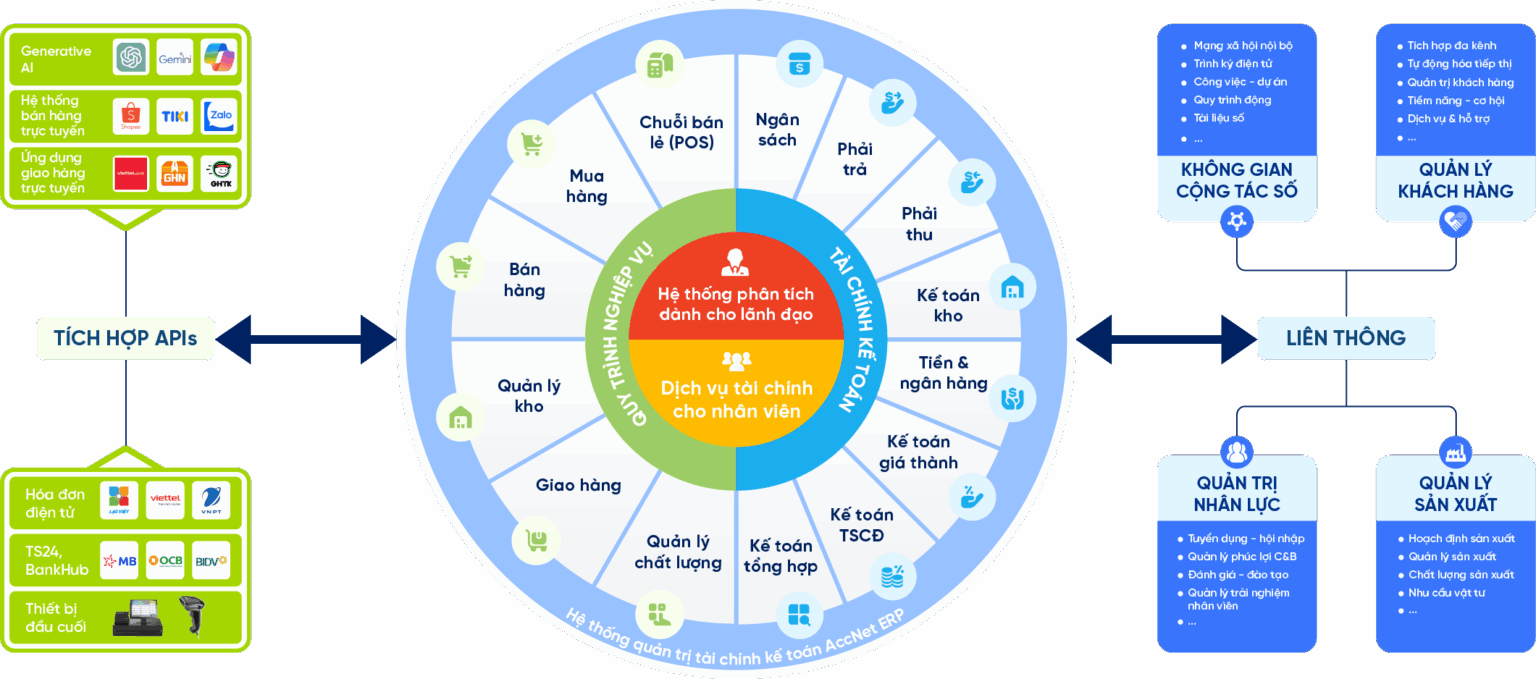
INTEGRATED AI ACCELERATION CONVERTER OF ACCOUNTING
AI in AccNet ERP't just stop at automate data entry, but also:
- Identification & classification certificate from smart: AI scan, read & sort invoice, voucher, receipt, limit errors due to input manually.
- Financial forecasting & budget: the system uses algorithms machine learning to forecast cost, revenue, business support decision fast.
- Warning risk accounting: AI to detect abnormalities in the book, from which timely warning of false or fraud risks.
- Reports assistant smart: AI suggested report template, automatic data aggregation support, leadership, financial analysis instant.
BUSINESS IS WHAT WHEN IMPLEMENTING ACCOUNTING SOFTWARE LAC VIET?
- Experience more than 30 years develop software solutions business management in Vietnam.
- Ecosystem of comprehensive: AccNet ERP easily connect with other solutions of Lac Viet (HRM, Workflow, Portal...).
- Advanced technology: Integrated AI support, cloud & on-premise flexible.
- Services dedicated support: A team of knowledgeable professionals with accounting – finance in Vietnam, companion throughout the deployment.
- Trust from thousands of customers in many areas: finance, banking, manufacturing, trade, services.
The accounting is not only legal obligations but also are important tools to help businesses effectively manage assets, capital, revenue, and cost. When done properly process the same method norm, business will ensure financial data is accurate, transparency, from which support strategic decisions promptly, as well as optimize operational efficiency.




![[ĐẦY ĐỦ] Mẫu báo cáo tài chính, tình hình tài chính file excel theo Thông tư 200 và 133](https://lacviet.vn/wp-content/uploads/2025/04/mau-bao-cao-tai-chinh.png)