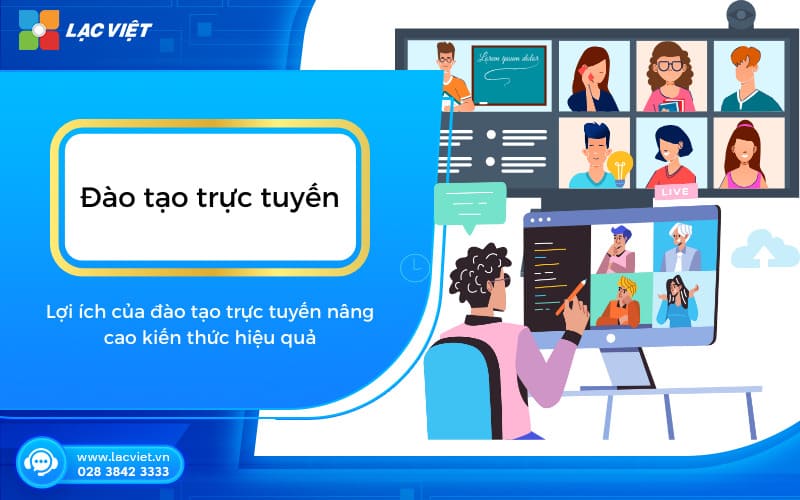
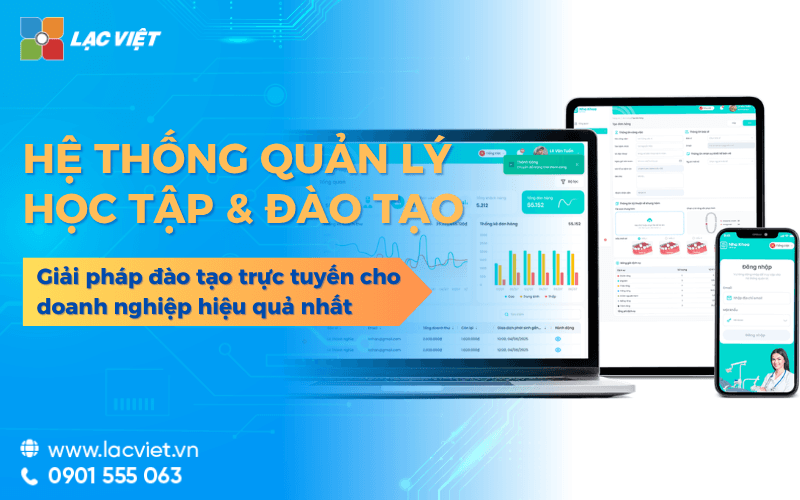
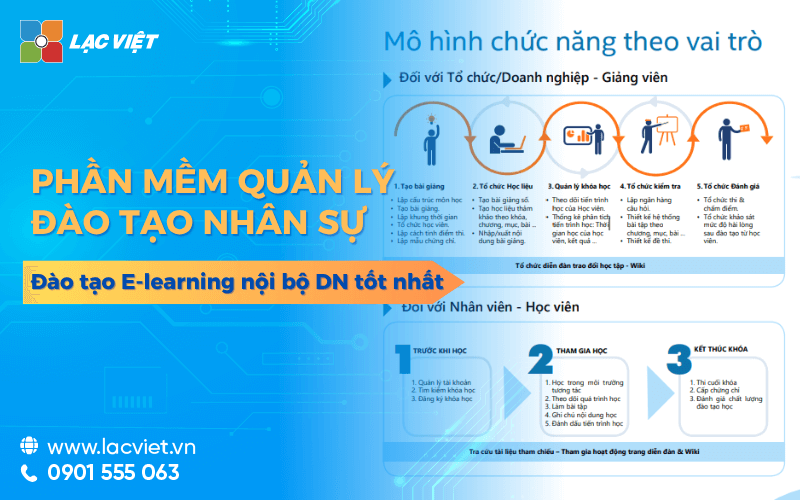
System LMS (Learning Management System) là phần mềm quản lý học tập trực tuyến giúp doanh nghiệp tổ chức, triển khai, theo dõi đánh giá toàn bộ hoạt động đào tạo nội bộ trên một nền tảng duy nhất. Các nền tảng LMS phổ biến 2026 tại Việt Nam như Lạc Việt E-Learning (chuyên đào tạo nội bộ doanh nghiệp), Moodle, TalentLMS, Docebo, … Thông qua phần mềm LMS, nhân viên có thể học mọi lúc, mọi nơi; còn nhà quản lý dễ dàng kiểm soát tiến độ, chất lượng khóa học, hiệu quả đào tạo.
Doanh nghiệp hiện đại cần một công cụ giúp quản lý, phân phối và đánh giá toàn bộ hoạt động học tập nội bộ một cách khoa học – đó chính là hệ thống quản lý học tập LMS. Với khả năng số hóa nội dung đào tạo, tự động hóa quy trình quản lý học tập, cung cấp báo cáo dữ liệu học tập chi tiết, phần mềm LMS đang trở thành xu hướng tất yếu của các tổ chức tiên phong trong việc phát triển nguồn nhân lực.
This article Lac Viet will help the business understand the concept of LMS system, the actual benefits, how to select and deploy effective, as well as the evaluation criteria suitable software.
Bảng so sánh 10 Hệ thống LMS quản lý học tập trực tuyến phổ biến 2026 cho doanh nghiệp
| System name | Detailed features | Suitable object | Deployment costs |
| Lac Viet E-Learning |
|
|
Flexible: subscription SaaS (per user/year) or on-premise deployment (according to package requires separately) |
| Moodle |
|
Schools, educational institutions, big business has a team of IT system administrator | Free installation; cost servers and staff management |
| Elearning industry |
|
Small and medium business, startup or organization short-term training | Free pack (5 users); paid from ~69 USD/month |
| Docebo |
|
Global business, large corporations | From USD 25,000/year or more (depending on scale users) |
| SAP SuccessFactors Learning |
|
Multi-national corporations, business process HR complex | From 4 – 6 USD/user/month (according to package SAP) |
| Cornerstone OnDemand |
|
Big business, organized professional training | From 6 – 15 USD/user/month |
| Blackboard Learn |
|
University, academy, business training intensive | According to the package license (estimated from 10,000 USD/year) |
| Absorb LMS |
|
Medium and large business, organization, training partners | From 800 – 1,200 USD/month |
| iSpring Learn |
|
Medium enterprises, training centers, internal | Basic package from 2.99 USD/user/month |
| EdApp by SafetyCulture |
|
Business labor force, dispersion, retail chains, factories | Basic free; Pro version from 1,95 USD/user/month |
1. Tổng quan về hệ thống LMS quản lý học tập trực tuyến
1.1 Hệ thống LMS là gì?
System LMS (Learning Management System), also known as management system, online learning, is a software platform that helps businesses manage the entire training activities on environment number. If for traditional training is “class of physics” with faculty, students, writing boards, paper documents, then LMS is the “virtual classroom” – where all those elements that are digitized, stored, managed, operated automatically.
A learning management system LMS usually includes the core functions such as:
- Create and distribute educational content (videos, documents, tests, of course).
- Track the learning process of each individual, noted the results of capacity assessment.
- Report data learning for the manager or hr department.
Difference of LMS compared with the individual instruments (for example only video management or just create quiz) is located in the integrated. An LMS helps enterprises to focus the entire training data into a single system, avoid to help managers have the overall look about effective learning of the organization.
For example: previously, a business must send PowerPoint presentation by email, autumn test with Google Form and summarize the results with Excel. With the LMS, all operations that are performed on the system: employee login, if I do this, the system automatically graded, recorded progress. This not only saves time but also enhance the learning experience for employees.
1.2 Vai trò của hệ thống quản lý học tập trực tuyến trong doanh nghiệp
In the context of convert numbers are going strong, the investment into the system, learning management system, online LMS is no longer choose that become the essential needs of many businesses. Below is the actual value that this system brings:
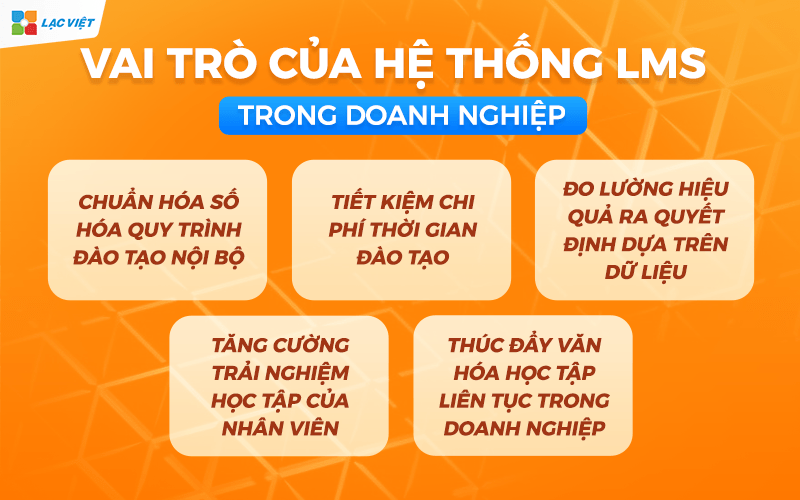
- Standardized digitization process internal training: LMS helps enterprises to focus the entire training activities into a single platform. Each course, coaching program or internal documents are all managed system, ensure the uniformity, easy to update.
- Save time cost of training: school forms online through LMS can help organizations reduce from 40 to 60% training time compared to the traditional learning thanks to the ability to learn, flexibility and eliminates the cost of hiring trainers, venue, printing. This is especially valuable to businesses large-scale or more branches, as training will be costly, difficult to organize in sync.
- Measuring effective decisions based on the data: One of the big advantages of the system LMS is the ability to report the data analysis learning. Businesses can track the rate of completion of the course, duration, average score, or even comparison between the departments to adjust the program more suitable. This is the factor that helps hr department to prove the ROI of training – something that the traditional methods difficult to do.
- Enhance the learning experience of employees: generation of young and today desire to learn anytime, anywhere, according to their own pace. LMS helps to personalize this experience: employees can choose to study in the evening, when free, or repeat many times content has not yet understand.
- Promote a culture of continuous learning in the enterprise: An organization is only really the sustainable development when there is a culture of learning. LMS is tool created “ecology of learning” in internal – where every employee can learn, share and develop skills constantly.
2. Hệ thống quản lý học tập trực tuyến LMS đem lại lợi ích gì?

2.1. Improve efficiency, employee training
Một trong những giá trị nổi bật nhất của hệ thống quản lý học tập LMS là khả năng tối ưu hóa hiệu quả đào tạo thông qua mô hình học tập linh hoạt. T
In fact, the business organizations deploy LMS shows that new employees can complete the program faster integration 30-40%, especially with the module microlearning or brief video tutorial. With the business have employees who work from remote or branch dispersion, LMS help ensure standardized training content, and the ministry of information, limiting state “each place a-type”.
2.2. Measurement efficiency improvement investment training
Not only is the place, sermon archive, system, learning management, LMS, and also acts as a central data analysis training. Each learning activity from course registration, completion rates, test results to school time average – are recorded in detail.
This allows parts HR or L&D easily create reports assess the capacity to detect gaps in skills and suggestions for the training program accordingly. T
2.3. Control costs, optimize resources
A clear benefit of another system, online LMS is the ability to reduce the cost of traditional training, including rentals, instructors, locations, printed materials, travel expenses.
In addition, because employees can learn anytime, on any device, enterprises do not need to interrupt production operations – business to organize the classroom focus. In particular, enterprises with large-scale or more branches, LMS allows deployed simultaneously training program without incurring the cost of expanding the facilities.
2.4. Increase the learning experience, retaining top talent
In the context of competitive personnel harshly, learning experience are important factors to retain, and develop employees. LMS allows the learning content suggestions according to job position, rank or skills need to develop.
According to LinkedIn Learning Report 2024, 94% of employees said they will stick long-term than if businesses invest in training personal development. By providing learning platform friendly, easy to access, and integrated gamification (badges, charts, certificates, electronic), business not only enhance the capacity team, but also create a culture of learning, sustainable, promotes the initiative and innovation in the organization.
3. Hướng dẫn lựa chọn phần mềm LMS triển khai đào tạo trực tuyến cho doanh nghiệp
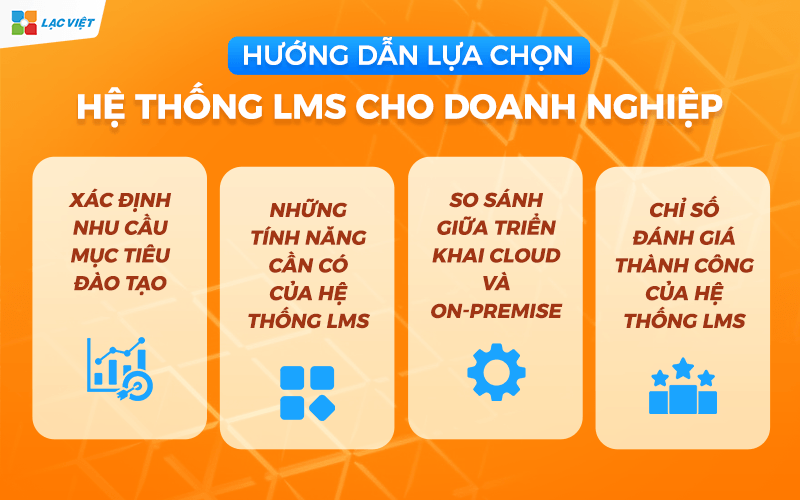
3.1. Determine needs target training
Trước khi đầu tư vào hệ thống quản lý học tập LMS, doanh nghiệp cần xác định rõ ràng mục tiêu đào tạo và đối tượng học viên. Việc này không chỉ giúp lựa chọn nền tảng phù hợp mà còn đảm bảo LMS thực sự giải quyết được “nỗi đau” hiện tại của tổ chức.
Ví dụ, nếu doanh nghiệp cần đào tạo hội nhập nhân viên mới (onboarding), phần mềm LMS phải hỗ trợ xây dựng lộ trình học tự động, giúp nhân viên nhanh chóng nắm bắt quy trình làm việc. Trong khi đó, nếu mục tiêu là nâng cao kỹ năng chuyên môn hoặc tuân thủ pháp lý, hệ thống cần có khả năng theo dõi tiến độ, nhắc hạn hoàn thành và lưu trữ chứng chỉ điện tử.
In addition, identifying KPI training right from the start as the rate of completion of the course, the cost of the average training/staff, or time minimization for onboarding – will help enterprises easily evaluate effective deployment later.
3.2. Xác định những tính năng cần có của phần mềm LMS
Một hệ thống quản lý học tập trực tuyến LMS hiệu quả không chỉ dừng lại ở việc đăng tải bài giảng, mà còn phải cung cấp các công cụ hỗ trợ toàn bộ vòng đời đào tạo – từ thiết kế, triển khai đến đánh giá kết quả. Dưới đây là những tính năng trọng yếu doanh nghiệp nên ưu tiên:
- Manage learners: allow to create layer, assign, enroll automatically, track progress, learning outcome details.
- Content management learning: support for diverse format (video, document, test, practice situations) to increase the interactivity.
- Reports & analysis: provides dashboard general help HR or L&D easily measure capacity, discovered a “skill”.
- Khả năng học trên di động: theo khảo sát của TechJury 2024, 91% người học mong muốn có thể học mọi lúc, mọi nơi, vì vậy giao diện thân thiện trên điện thoại là yếu tố bắt buộc.
- Personalize the learning experience: the system can hint content by rank, location, or needs, career development, increase the autonomy for employees.
- Integration with hr systems, other: as HRM, ERP or software reviews-capacity data, contact information, save time on data entry and management.
Doanh nghiệp nên ưu tiên những nền tảng phần mềm đào tạo doanh nghiệp có khả năng mở rộng linh hoạt tích hợp công nghệ mới như AI gợi ý lộ trình học hoặc chatbot hỗ trợ người học 24/7, đây là xu hướng đang được các tổ chức lớn áp dụng để tối ưu trải nghiệm và hiệu suất đào tạo.
3.3. Phân tích so sánh giữa triển khai Cloud và On-premise
An important factor in the process of selecting LMS system is the deployment model. Two popular models today are Cloud (cloud) and On-premise (hosted at place), each bring different benefits depending on the scale and operating policies of the enterprise.
| Deploying Cloud | On-premise deployment |
|
|
With the small and medium business or have employees who work remotely, pattern, Cloud-based LMS is the optimal choice thanks to its ability to deploy quickly with flexible cost. Meanwhile, big business in the field of financial, medical or state data need high security is often preferred On-premise LMS.
3.4. Đo lường các chỉ số đánh giá thành công của hệ thống LMS sau triển khai
Sau khi triển khai, doanh nghiệp cần theo dõi đo lường hiệu quả của hệ thống quản lý học tập LMS dựa trên các chỉ số cụ thể. Những KPI phổ biến bao gồm:
- The rate of completion of the course: reflects the level of commitment, excitement of the school.
- The average time of completion: help assess the appropriate level of content and form of training.
- The level of satisfaction of the learner: collected via survey after the course, embodied experience, practical application.
- Affect job performance: for example, reduce the error rate, productivity growth, or shorten the duration of onboarding.
- ROI training (Return on Investment): compare the cost of investing LMS with the benefits such as saving time, reducing costs, teaching, increase labor productivity.
4. Quy trình triển khai hệ thống quản lý học tập trực tuyến LMS cho doanh nghiệp
Để việc ứng dụng hệ thống quản lý học tập trực tuyến mang lại hiệu quả thực tế, doanh nghiệp cần triển khai theo một lộ trình có kế hoạch rõ ràng thay vì chỉ cài đặt phần mềm và để nhân viên tự học. Một quy trình triển khai LMS hiệu quả thường bao gồm 7 bước sau:

Bước 1: Thành lập đội dự án triển khai phần mềm LMS
The project team should include representatives from the department of Human resources (HR), department of Training & development (L&D) IT department (IT) and leader board.
- HR is responsible for determining the training needs, roadmap development, staff capacity.
- L&D charge of content learning method.
- IT support infrastructure, connectivity, data security.
- Leadership plays a role in determining budget allocation.
A team project related departments to ensure the LMS is deployed not just about the right technique, but also consistent with the development strategy of the enterprise.
Step 2: Survey the current state of training identified “gaps skills”
Before choosing LMS systems, businesses need to survey current training:
- Staff are learning how (direct, online, mentoring)?
- What skills are lacking compared to the job requirements?
- Technical infrastructure, technological level of the employees out?
Results of this survey will help clearly define the training content priority, the number of people learning how to deploy fit (training under the lock, according to the capacity or elective courses).
For example, If the majority of employees working remotely, LMS should support mobile learning, multi-device access. If the business has multiple groups of different levels, so choose the LMS has the function of decentralization and of course suggestions personalization.
Step 3: Choose platform LMS, suitable provider
When you have specific requirements, the project team conducted reviews the platform LMS on the market according to the criteria:
- Scalability, integration: can connect with HRM, ERP or system capacity assessment.
- Features user friendly: easy to use interface, multi-language, quick access on your mobile device.
- Security data storage: especially important with the business in the field of financial, medical, or state.
- Cost of deployment models: choose between Cloud or On-premise depending on your budget and security requirements.
Step 4: Deploy the test
Instead of immediately applied to the whole business, so choose a small group of employees or a department representative to run the test.
- The purpose is to check the stability of the system, the ability to access the fit of the content, feedback of the learners.
- This stage helps businesses adjust the course structure, enrolment processes, the evaluation report before the open.
For example, A service company can try to deploy LMS for team and sales team to measure the level of participation, learning and impact assessment to sales after 3 months.
Step 5: Training user and internal communication
One of the reasons that many projects LMS failure is employees don't understand or don't enjoy using. Therefore, enterprises need to implement the program guide to internal communication clear:
- Organization the introduction about the benefits of LMS for personal development.
- Provides video-manual, FAQ, or chatbot, technical support.
- Mounting learning activity with the reward policies, certified internal or criteria for evaluating competence.
Step 6: Monitor, evaluate and continuously adjustable
After commissioning official business need to track the data from LMS to evaluate the effect:
- The proportion of students involved, the rate of complete response of the learner.
- The course is rated the highest or the proportion of unmaintained high.
- The degree of improvement in work productivity after training.
From there, the project team can adjust the content, methods, policy, and training, to enhance the effect. LMS is the usually integrated analysis report learning (Learning Analytics) to help businesses measure continuous improvement based on real data.
Step 7: Expand the business and maintain content updates
When the LMS system has stabilized, the business can scale to apply to the whole organization. However, the deployment of LMS is not one-time projects, which is a constant journey.
- Need regular updates, new courses, interface improvements, integrating new features such as AI course suggestions personalization, gamification (games of learning) or microlearning (short lessons).
- Maintain a feedback channel between the school and the administrator for the system to always keep abreast of the actual demand.
As such, a process to deploy LMS success not only ensures operating system stability, but also create a culture of learning initiative sustainability in business.
5. Lạc Việt Elearning giúp xây dựng hệ thống LMS quản lý học tập trực tuyến chuyên nghiệp
Trong bối cảnh chuyển đổi số ngày càng sâu rộng, việc đầu tư vào một hệ thống quản lý học tập LMS hiện đại, linh hoạt phù hợp với đặc thù doanh nghiệp Việt là yếu tố quyết định để nâng cao hiệu quả đào tạo nội bộ. Lạc Việt Elearning là giải pháp LMS chuyên cho đào tạo nội bộ doanh nghiệp thuộc hệ sinh thái phần mềm nhân sự SureHCS của Công ty Cổ phần Tin học Lạc Việt, được phát triển dựa trên kinh nghiệm hơn 20 năm triển khai hệ thống nhân sự cho hàng nghìn tổ chức, tập đoàn lớn tại Việt Nam.
Tại sao nên chọn phần mềm LMS Lạc Việt E-learning?
- Flexible design to suit any business model: Lac Viet Elearning allows business development, training, integration, training, periodic training skills and compliance training on the same platform. System support structure, flexible learning by department, location, or route capacity, to help manage the thousands of hr easy.
- Process automation learning management: From the recording list, send notification to school, prompting the school calendar, to report on the results – all of which is automated. Businesses save up to 60% of the time management training, time, and ensure academic data transparency, accuracy.
- Experience modern learning: Employees can learn on many devices (computer, phone, tablet), direct interaction with the instructor, do the online quiz and receive a certificate auto electronics. Friendly interface, easy to use help increase the rate of completion of the course.
- Tích hợp mạnh mẽ với hệ sinh thái SureHCS: Lạc Việt Elearning kết nối trực tiếp với human resource management software (HRM), đánh giá năng lực, hệ thống lương thưởng trong cùng nền tảng SureHCS. Cho phép doanh nghiệp đánh giá toàn diện hiệu quả đào tạo gắn liền với kết quả công việc – một lợi thế lớn mà các LMS quốc tế khó đáp ứng tại thị trường Việt Nam.
- Security and customized according to business requirements: the System is implemented according to the model on-premise or cloud, ensuring data security is absolute, the ability to customize the process of internal training each organization.
LAC VIET E-LEARNING – EMPLOYEE TRAINING SOLUTIONS FOR MEASURING EFFECTIVENESS
Lac Viet E-learning is the trusted choice of many large corporations such as FrieslandCampina, PV GAS, Shinhan Bank... with more than 100,000 users across the system.
Lac Viet E-Learning is not just a training system online, which is the platform that helps businesses build human capacity in a sustainable way. The solution is designed to solve the fulness of the problem: training – measurement – develop – retain talent in the work environment is great.
- Difference of Lac Viet E-Learning lies in the ability to combine flexibility between technology, learning experience and management training. Businesses can deploy according to the SaaS model or on-premise, easy to integrate with existing systems
- In compliance with the international standards such as SCORM, OpenBadges, ensuring standardized and scalable long term.
- Don't stop at the “bringing material up system,” Lac Viet E-Learning create learning environments multimodal: online class, learning materials, multimedia, forum for exchange of knowledge, exam – assessment – certificate automatically.
- The entire learning process of the employees are tracking, analysis, reporting in real time, to help businesses accurately assess the effectiveness of training and the level of capacity development.
- Modern interface, high security, automation, deep, ability to analyze training data to help businesses optimize the cost of training, improve work productivity, increase employee engagement.
Ready to elevate effective internal training in your business?  Contact us Lac Viet today for advice model implementing E-Learning in accordance with the scale, industry and development goals of the business.
With version Cloud, Lac Viet E-learning can deploy fast in 7 daysno need to invest in infrastructure, high security and are willing to expand to tens of thousands of users.
In the era of training, no longer is cost, which is the investment strategy to help businesses adapt quickly, maintain competitiveness, and develop a team of high-quality personnel. A system LMS modern such as Lac Viet Elearning not only of the process of learning, but also create a culture of continuous learning in the organization.