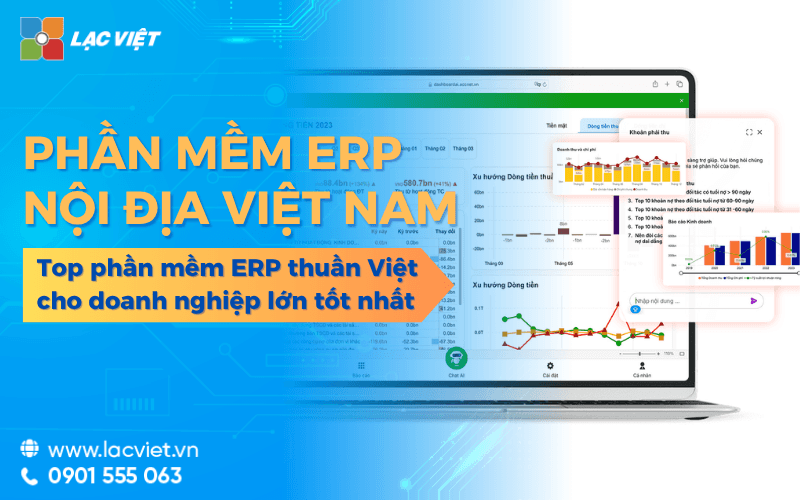
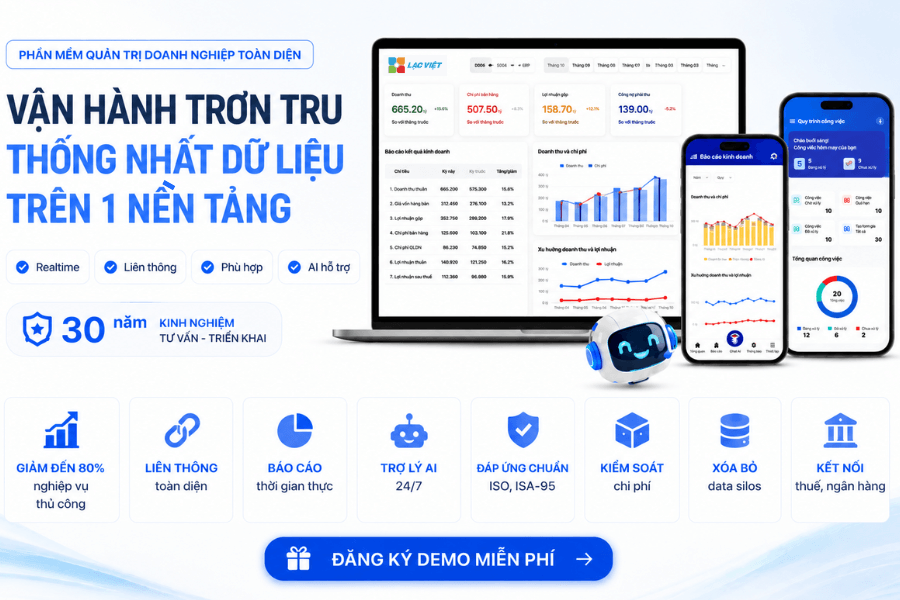
ERP (Enterprise Resource Planning) is a software system for managing the overall business, enable connectivity, centralized management of core operations, such as finance and accounting, sales, purchase, inventory, production, and personnel on a single platform. Instead of using multiple software discrete, ERP, data is synchronized in real time, reduce errors, increase transparency, support the management decision-making faster, more accurate based on the data consistency.
What is ERP that increasingly many businesses mentioned when talking about optimizing the operation, cost control and decision-making based on data? In the context of business must manage at the same time financial, sales, inventory, manufacturing, human resources,... the use of disjointed tools such as Excel or software singly are revealed many limitations: data is not synchronized, reports slow, difficult to control, much depends on the person.
In this article Lac Viet will help you understand what is ERP, ERP, how it works, bring the benefits for the business, and where's approach to ERP in accordance with actual operating in Vietnam.
1. Overview of ERP
1.1 what is ERP?
ERP is the acronym of Enterprise Resource Planning, translates as system resource planning business. As the name suggests, ERP is a software system that helps businesses manage coordination most of the core operations on a single platform, from financial, manufacturing, buying and selling to hr and logistics. Instead of each department using the software individually or Excel, ERP gom all data processes in a centralized system to all parts “speak the same data language” with each other.
You can imagine ERP same as the coordinating center of business: all data entered once are share for the related functions helps to reduce errors, save time, put out accurate information to the leader to decide.
Examples illustrate the fact: Before ERP, sales department send Excel sheet inventory for accounting every day, then accounting back hand-written report cash flow. With ERP, the system automatically updates the inventory in each sales transaction and automatically reflected on the financial statements. This helps reduce data entry many times, errors, the report is not synchronized, which is the cause of many wrong decisions in business.
1.2 other ERP nothing compared to software management tradition?
Để hiểu rõ giá trị khác biệt của ERP, ta cần so sánh nó với các phần mềm quản lý từng mảng mà doanh nghiệp thường dùng riêng lẻ (ví dụ: phần mềm kế toán, phần mềm bán hàng, hr software).
Simple comparison:
Accounting software
- Only handle financial data (income and expenditure, public debt, financial statements).
- Not automatically updated data about sales, inventory, or production activities, if not connected to other systems.
Software sales
- Focus on orders, customers and sales revenue.
- Provide information about the transaction, but usually not connected directly with your accounting, warehouse or personnel.
Hr software
- Professional staff management: record, attendance and salary.
- Not related to financial data, sales, inventory, or production plan.
While the traditional software single operation and “single-task”, ERP lumped all these functions in an integrated system seamless. When a process takes place (such as sales incurred), ERP automatically update data to the relevant section (inventory, revenue, public debt, accounting), limiting the need to enter data manually between multiple systems — this caused the error, delay the time hard to control.
Difference core
- Concentration data in real time: ERP allows every department to access data accurate and updated as soon as changes occur, instead of each of the departments have “copy” private. This helps leaders have a comprehensive view of the business at all times.
- Standardized internal processes: ERP promote departments follow the same operating procedures, from pegs orders, production planning to manage expenses, payments. This reduction or loss of data, standardized work, saving time training new personnel.
2. The common problems in operating the business when there is no ERP
When businesses have not implemented ERP solution, most of the departments often have to manage work and data with the individual instruments, such as Excel, file share or software discrete served each separate function (accounting, sales, warehouse, hr...). This seemingly simple but in the long run will create difficulties commissioning seriously affect the efficiency, speed, decisions, increase operational costs.

2.1. Data fragmentation, delayed reporting inaccuracies
One of the biggest challenges when there is no ERP's data is scattered in many different systems. Each department managing the data of his own way, leading to the condition data is not homogeneous, duplicate or conflicting. For example, inventory is recorded the difference between the sales department, accounting or customer data appear multiple copies with information not the same. This makes the synthesis report becomes complicated, time-consuming, easily lead to misleading information when presented for leadership.
The data is not homogeneous longer entail as a consequence, synthesis report report does not reflect the real situation, that leadership should be based on the number of materials might be outdated when making operational decisions or strategy.
2.2. Hard to control costs, inventory and cash flow
When the data warehouse management, finance, sales no contact information, businesses lose the ability to track in detail the fluctuations as important as inventory too much, inventory virtual or cash flows to the fact compared with the estimate. This is not only report problems, but also directly related to operating costs and capital turnover. For example:
- Inventory excessive make capital closed and stagnant in goods, increasing the costs of storage, the risk of wear and tear.
- Inventory deficiency leads to loss of sales opportunities, late orders, reduce customer experience.
- Cash flow is not controlled, and would make the debt not be timely monitoring, leading to deviations in the forecast payment, the influence financial planning.
ERP help of this data is recorded, updated as soon as events occur, creating paintings financial and inventory precision real-time instead of having to aggregate craft each part.
2.3. Depends on the person, the risk of errors is high
In the business there is no path data automatically, data-entry, synthesis report, rotation information still depends on the personnel. This creates the risk of errors due to human, especially with the repeat task like:
- Nhập liệu bằng tay từ phiếu bán hàng, hóa đơn, bảng công nhân sự vào nhiều bảng tính khác nhau.
- Standardized customer information, code or partner through many different file.
This mistake not only deflects the data, which also causes time-consuming fixes, slow down the decision-making process and sometimes leads to business decisions, lack of correct base.
Điều này còn ảnh hưởng đến năng suất lao động; nhân sự dành nhiều thời gian cho việc “theo đuổi dữ liệu” thay vì những nhiệm vụ giá trị hơn như phân tích số liệu hay tối ưu quy trình. Một to the ERP system giúp tự động hóa chuẩn hóa quy trình thay vì dựa vào thao tác thủ công, giảm thiểu rủi ro sai sót, tạo ra môi trường dữ liệu có thể tin cậy lâu dài.
2.4. Leadership lack of data to make timely decisions
A business wants to operate effectively need to process a fast decision based on reliable data. However, when data is fragmented, waiting to sum up, leadership is often received reports late, lack of updates, not full. This directly affects the strategic decision about:
- Adjust inventory according to the market demand.
- Tracking cash flow forecasts payment.
- Allocation of production resources or personnel for the key projects.
This is one of the reasons why ERP became the foundation is many businesses considered to be “data center reliability” for leadership.
3. ERP activities, like in business?
When businesses decide to apply ERP solution, the most important thing is to understand the principle of operation of the system and the practical benefits when departments use it every day. An ERP system is effective not only is the software, which is the way in which data and processes are connected to create value for the entire business.
3.1 Principle of operation of the ERP system
ERP operating based on a few basic principles to help businesses move from work to work automatically, standardized data transparency throughout.
- Data entered once – used throughout: In the ERP system, data no longer has to be re-entered multiple times in different departments. For example, when the sales department recorded an order, this information is automatically updated right into inventory, income statement, liabilities, accounting without the employee must be copied to many places.
- The process is standardized automation: ERP helps to normalize the process between the parts. Instead of each department self-propelled habitual or Excel file, separate ERP set up the workflow in general. For example, the process from the moment of purchase of raw materials put into production to warehouse, recorded sales will follow a single threaded. From there, repeat steps can be automated, reducing manipulation craft, enhance operational efficiency.
- Data updates in real time: One of the biggest benefits of ERP's data is always updated almost instantly when there is new transactions, creating a “picture of business operations” that leaders, managers/ employees can see and reliability.
3.2 The distribution system in the popular ERP system
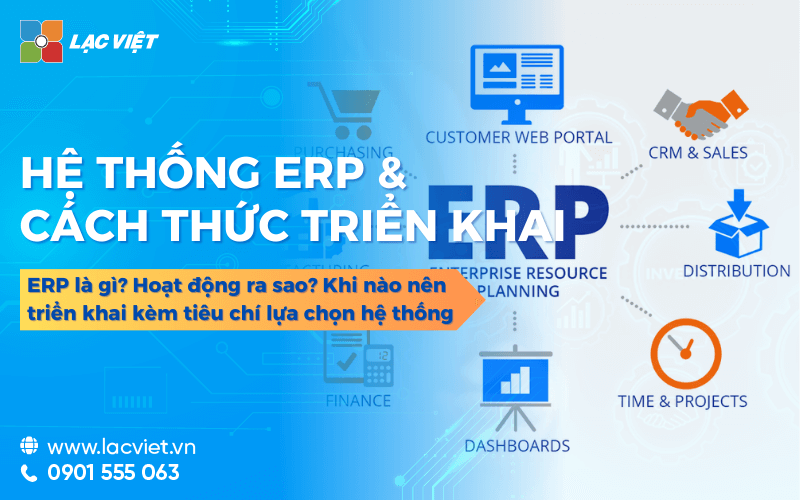
An ERP system not only the fact as a “block software”, which is a collection of modules (modules) are designed for each specific function of the business. Each module helps handle professional, but most important is that they all use a common data source, so information is automatically shared between the parts.
Below is a brief description of the common need to have:
-
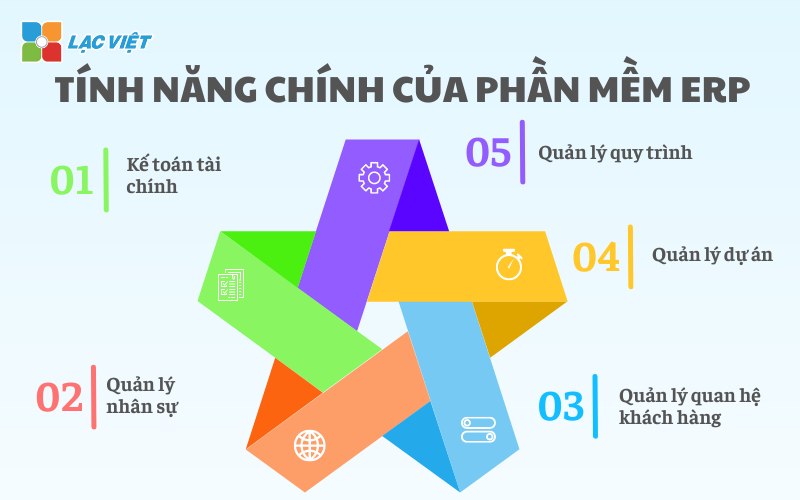
The features, the main of ERP system
- Accounting – finance: this module is central to financial data of the business. It automatically recorded income and expenditure, debts, cash flow, financial reporting, real-time help accounting reduce the synthesis time and reduce errors compared to processed by Excel. This provides for leadership financial picture more accurate to take timely decisions.
- Purchase – sale of goods: The task from making a purchase request, accept delivery, processing sales orders are recorded in the same system. This helps to better control the order process, confirm inventory before the sale, payment for suppliers. Business reduce errors and speed up order processing and improve customer experience.
- Inventory – inventory: The inventory management helps in tracking inventory quantity, storage location and movement history of the goods. Because the data is updated in real time, the administrator can know exactly when you need additional rows, to avoid inventory stagnant or lack of inventory, causing production disruptions, sales.
- Production: In the business of production, distribution system, ERP support, production planning, progress tracking, cost of production. Thanks to data, flexible, business not only optimal schedule that also minimizes the imbalance of raw materials, increase efficiency, use of machinery and workers.
- Nhân sự – tiền lương: ERP software tích hợp dữ liệu nhân sự, chấm công tính lương giúp tự động tính toán lương, phúc lợi cùng các khoản phải trả. Điều này không chỉ giảm thời gian làm việc cho bộ phận nhân sự mà còn đảm bảo tính nhất quán chính xác của dữ liệu nhân sự.
Management reports, analyze data: ERP provides the tools synthesis report, chart visually helps leaders see the overview of business operations in a single interface from finance to sales, production. Thanks to the automatic reporting this waiting time, the report is reduced, the leadership team has gained important information to make decisions faster.
4. Benefits of ERP for business
When businesses consider investing in an ERP system, the first question often is not only “what is ERP,” which is “ERP benefits specific?”. An ERP system not only is management software which if properly implemented will become the platform to create transparency, data alignment process and decision support faster, which help businesses operate more efficiently.
Below is the main value that ERP brings, as evidenced by research data from the reporting reputation in the industry.

4.1 strategic Benefits for the leader board
One of the biggest value of ERP is to support leadership decisions based on actual data instead of gut feel or discrete data.
When using the ERP system, all information from the financial, inventory, sales to hr are updated in real-time on a single platform. This helps leaders:
- Understand business performance according to each moment, not waiting for reports aggregated by week or month.
- Based on data for planning long-term strategies, such as market expansion, regulate the production or investment in distribution channels.
According to a report overview of ERP in the year 2023, 36% of businesses said the ERP system help them shorten the time take business decisions than ever before when there is no ERP.
Decision-making faster, more accurate is the key element in the business environment, fluctuations in current. This not only helps businesses avoid risks, but also to seize opportunities faster than competitors.
4.2 Benefits operation for the departments
ERP benefit markedly in the level of operating internal help each departments work more efficiently:
- Reduce data entry duplication, errors: Before ERP, departments often have to enter data into multiple systems or separate files. This guide to easy-to-happen errors, take time for projectors, causing delayed report. With ERP, data need only be entered once and is shared throughout between the parts, reduce errors, save processing time.
- Increase work productivity: When employees no longer have to fool around with the search for and synthesis of data from multiple sources, or perform the task manually repeated, they can focus on activities with higher value, such as analysis of the performance, suggestions for improvement process or interact with customers.
- Standardized process, reducing dependent individuals: ERP create the workflow for the whole business. What this means is that even though the personnel have changed or expanded scale, businesses still operate smoothly. Standard procedure to help reduce dependence on personal experience, ensure all steps are performed according to a general standard.
4.3 financial Benefit – cost
One of the main questions of the business before investing in ERP is “material expenses have to deserve what get you?”. Many studies show that ERP brings return on investment (ROI) pronounced in a reasonable amount of time.
- According to combined data from many organizations use ERP, 83% said unit ERP project has met expectations in terms of ROI after development for more than a year.
- The business also reported reduced operating costs, labor costs after implementing ERP, because the system help optimize processes and eliminate manual work is not necessary.
Inventory control, reduce the costs of storage, With ERP, businesses can track inventory in real time, from which you can easily avoid a situation of excess inventory, reduce the cost of storage is not required and the risk of damaged, expired. Research statistics show that organizations implement ERP realize the expected benefits of inventory management amounted to almost 91%.
Manage cash flow and expenses more precisely, ERP helps to synthesize cost, cash flow throughout the enterprise easier, thus helping accounting and leadership, cost control, accurate budget planning, effective implementation of financial strategies wisely.
Benefits of ERP lies not only in the software integration or automation of some processes. Value is more important ERP transform how enterprise data management and commissioning internal help decision making fast, accurate, optimize costs, improve productivity, reduce risk of errors.
5. Synthesis of the ERP software in Vietnam, best
When a business has to understand what is ERP and the role of ERP in operation management, the next question is usually: Vietnam Business should choose ERP solution to both efficiently, just match the actual operation?
5.1 Giải pháp LV ERP của Lạc Việt phù hợp doanh nghiệp Việt Nam
LV ERP của Lạc Việt là một trong những giải pháp được nhiều doanh nghiệp trong nước lựa chọn vì xuất phát từ bài toán quản trị thực tế tại Việt Nam, không phải một hệ thống “nhập khẩu nguyên mẫu” rồi mới chỉnh sửa lại cho phù hợp.

- LV ERP là gì?
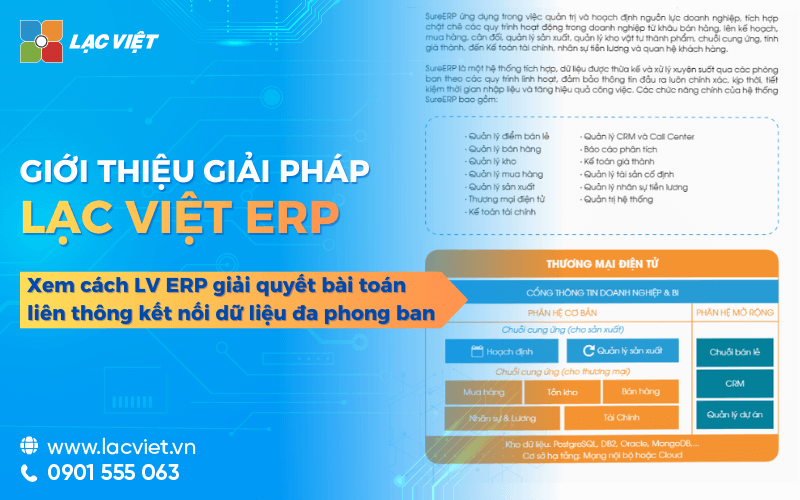
LV ERP là giải pháp quản trị nguồn lực doanh nghiệp (ERP) do Công ty Cổ phần Tin Học Lạc Việt nghiên cứu phát triển. Hệ thống được thiết kế để giúp doanh nghiệp quản lý xuyên suốt toàn bộ hoạt động vận hành, từ tài chính kế toán, mua hàng, bán hàng, kho vận cho đến nhân sự và báo cáo quản trị.
Điểm khác biệt của LV ERP không nằm ở việc “có bao nhiêu tính năng” mà nằm ở việc hệ thống được xây dựng dựa trên cách doanh nghiệp Việt Nam đang vận hành thực tế. Điều này giúp quá trình triển khai và sử dụng ERP trở nên gần gũi, dễ tiếp cận hơn với đội ngũ nội bộ, đặc biệt là các phòng ban nghiệp vụ không chuyên công nghệ.
The system is many Vietnamese enterprises in the field of trade, production, distribution and service trust development, thanks to the ability to adapt flexible management model, different
- Điểm mạnh nổi bật của LV ERP:
Appropriate design professional business English
Một trong những rào cản lớn khiến nhiều dự án ERP thất bại là phần mềm không phản ánh đúng cách doanh nghiệp đang vận hành, buộc người dùng phải “làm theo phần mềm” một cách gượng ép. LV ERP được thiết kế dựa trên nghiệp vụ phổ biến của doanh nghiệp Việt Nam, từ cách hạch toán kế toán, quản lý tồn kho, giá thành sản xuất cho đến quy trình bán hàng.
Thus, enterprises can standardize the process step by step, instead of having to change the whole way right from the start – it is especially important with the medium and large business was stable operation for many years.
Flexible, easy to expand according to each stage of development
Ở góc độ quản trị vận hành, không phải doanh nghiệp nào cũng cần triển khai toàn bộ ERP ngay từ đầu. LV ERP cho phép doanh nghiệp triển khai theo từng phân hệ, phù hợp với nhu cầu và ngân sách của từng giai đoạn phát triển.
For example, businesses can start from finance – accounting and inventory, then expanded to manufacturing, human resources or management reports as the scale increases. This approach helps to reduce the pressure of the initial investment, at the same time ensure ERP system development, along with business, instead of becoming a burden.
Management throughout from the financial – manufacturing – human resources – sales
LV ERP được xây dựng với triết lý quản trị xuyên suốt, nghĩa là dữ liệu chỉ cần nhập một lần nhưng được sử dụng cho nhiều bộ phận. Khi một đơn hàng được ghi nhận, hệ thống tự động cập nhật tồn kho, doanh thu, công nợ và các báo cáo liên quan.
The biggest value here is not “automation”, which is the transparency, consistency of data. Leaders no longer have to collate multiple reports from different departments, which can rely on a source of data to assess the situation commissioning.
Report of management board of fast, accurate service, leadership
Theo kinh nghiệm quản trị vận hành, chậm báo cáo đồng nghĩa với chậm ra quyết định. LV ERP cung cấp hệ thống báo cáo quản trị đa chiều, giúp lãnh đạo theo dõi kịp thời các chỉ số quan trọng như doanh thu, chi phí, tồn kho, hiệu quả sản xuất hay biến động nhân sự.
Việc có báo cáo cập nhật liên tục giúp doanh nghiệp chủ động điều chỉnh kế hoạch, thay vì chỉ “nhìn lại quá khứ” khi kỳ báo cáo đã kết thúc.
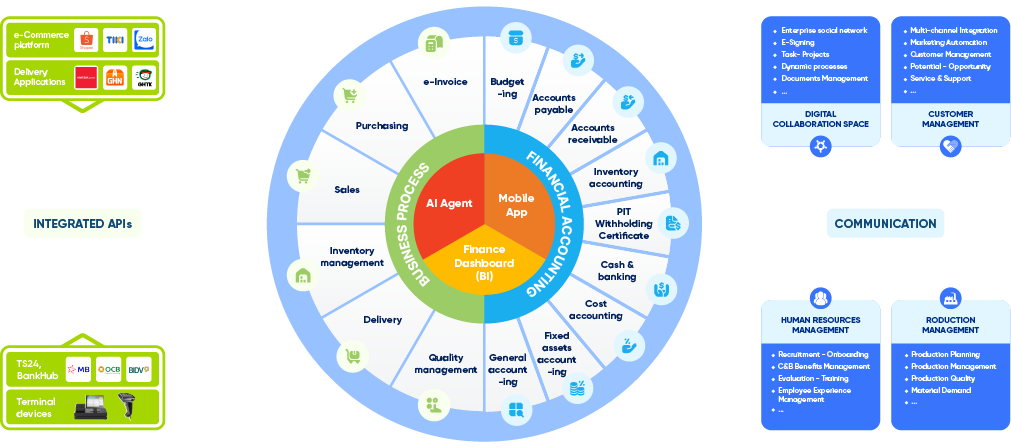
INTEGRATING AI ACCELERATES DIGITAL TRANSFORMATION AND PROMOTES COMPREHENSIVE OPERATIONS MANAGEMENT
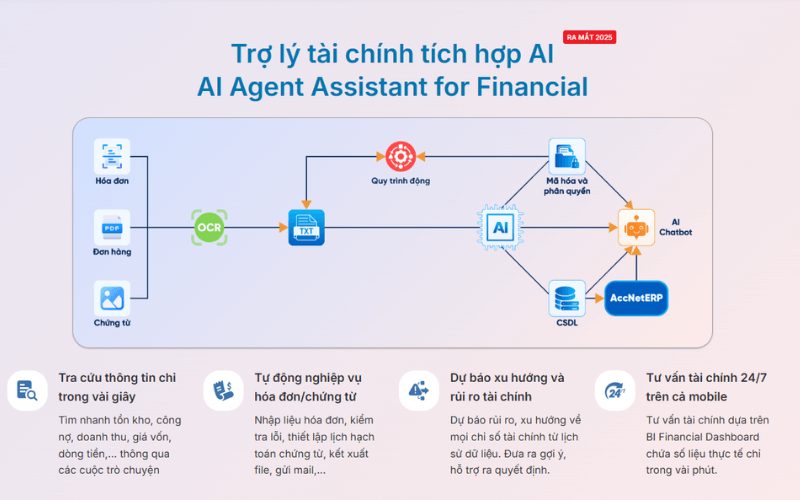
AI in LV ERP goes beyond just data entry automation; it also includes:
- Identification & classification certificate from smart: AI scan, read & sort invoice, voucher, receipt, limit errors due to input manually.
- Financial forecasting & budget: the system uses algorithms machine learning to forecast cost, revenue, business support decision fast.
- Warning risk accounting: AI to detect abnormalities in the book, from which timely warning of false or fraud risks.
- Reports assistant smart: AI suggested report template, automatic data aggregation support, leadership, financial analysis instant.
Lac Viet ERP is particularly suitable for:
- Medium and large business
- Manufacturing enterprises have multiple stages
- Commercial enterprise – scale distribution
- Business has multiple departments, branches
- Businesses need ERP “go deep operation”, not only management accounting
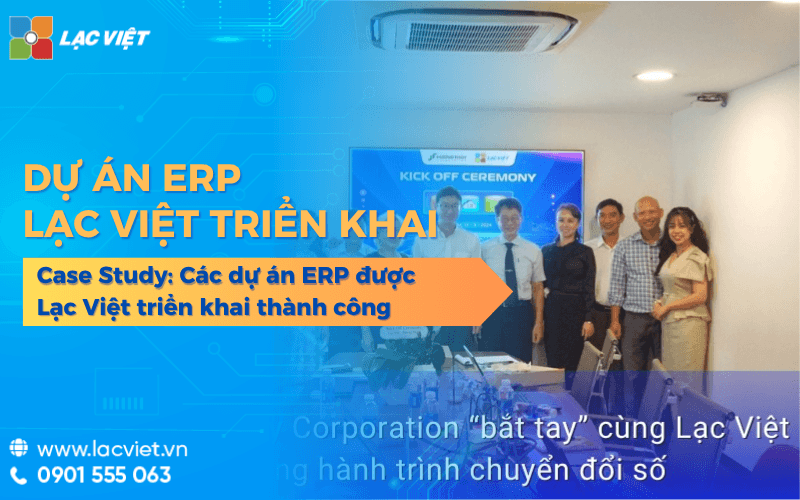
TYPICAL CLIENTS CURRENTLY IMPLEMENTING LAC VIET ERP
From manufacturing and trade to multinational corporations, LV ERP đã giúp doanh nghiệp chuẩn hóa quy trình – tối ưu chi phí – nâng cao năng lực quản trị.
- Nitto Denko – Kiểm soát chi phí sản xuất hiệu quả: Ứng dụng phân hệ kế toán giá thành giúp doanh nghiệp tính toán chi phí chính xác, đồng bộ dữ liệu sản xuất – tài chính, nâng cao hiệu quả kiểm soát và tối ưu chi phí.
- ANTESCO – Tái cấu trúc quy trình vận hành: Triển khai ERP giúp chuẩn hóa quy trình liên phòng ban, cải thiện khả năng quản trị vận hành, tăng tính linh hoạt và đồng bộ trong toàn hệ thống.
- Hương Thủy Corporation – Chuẩn hóa quản trị tổng thể: Ứng dụng ERP để kết nối dữ liệu toàn doanh nghiệp, nâng cao khả năng kiểm soát và hỗ trợ ra quyết định nhanh, chính xác.
- Mễ Tân – Số hóa hoạt động sản xuất: Triển khai hệ thống ERP giúp tối ưu quản lý sản xuất, tồn kho và nguyên vật liệu, nâng cao năng suất và tính minh bạch trong vận hành.
LV ERP mang lại giá trị gì cho doanh nghiệp?
In the perspective of management, an ERP system is only really meaningful when solved is the problem operate in particular:
- Thứ nhất, chuẩn hóa quy trình vận hành. LV ERP giúp doanh nghiệp xây dựng các quy trình làm việc thống nhất giữa các phòng ban, giảm sự phụ thuộc vào cá nhân, kinh nghiệm truyền miệng. Điều này đặc biệt quan trọng khi doanh nghiệp mở rộng quy mô hoặc có sự thay đổi nhân sự.
- Monday, optimal cost-effective use of resources. When data is connected throughout, businesses can better control inventory, production costs, operating costs and cash flow. Many international studies show that enterprises deploy ERP can improve operational efficiency and reduce indirect costs by reducing errors, duplicate work.
- Thứ ba, hỗ trợ ra quyết định dựa trên dữ liệu. LV ERP không chỉ giúp “ghi nhận số liệu”, mà còn giúp biến số liệu thành thông tin quản trị. Khi lãnh đạo có trong tay dữ liệu kịp thời, đầy đủ đáng tin cậy, các quyết định về đầu tư, mở rộng sản xuất hay điều chỉnh chiến lược sẽ có cơ sở vững chắc hơn.
Nếu doanh nghiệp của bạn đang tìm kiếm một giải pháp ERP phù hợp với thực tế vận hành tại Việt Nam, có khả năng triển khai theo lộ trình, linh hoạt theo từng giai đoạn phát triển, LV ERP của Lạc Việt là lựa chọn đáng cân nhắc. Giải pháp được xây dựng trên kinh nghiệm triển khai ERP cho nhiều ngành nghề, tập trung vào hiệu quả quản trị, tính ổn định và khả năng đồng hành lâu dài cùng doanh nghiệp.
Để hiểu rõ hơn ERP có thể giải quyết những vấn đề cụ thể nào trong hoạt động của doanh nghiệp bạn, hãy đăng ký nhận tư vấn chi tiết từ chuyên gia LV ERP.
5.2 solutions ERP software Microsoft Dynamics 365
Microsoft Dynamics 365 is a collection of application of business intelligence to help you run your entire operation of its business, bring better results through the information detailed predictions based on AI.
Microsoft Dynamics 365 ERP brings the ability to analyze deep-to-use Business Intelligence (BI). The analysis of high precision thanks to the display in real-time, enabling users to easily track performance.
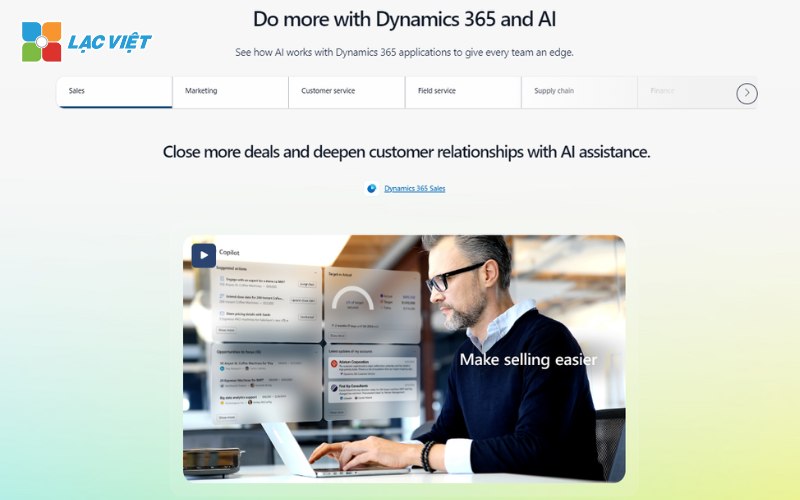
Microsoft Dynamics 365 is an ERP solution with integrated solutions, CRM, SCM and HCM by Microsoft. This software provides a variety of comprehensive features to meet the needs of the business at any scale.
5.3 application ERP Vietnam Amis Misa
ERP software MISA AMIS is designed in accordance with the needs administration's comprehensive enterprise based on the research compliance system financial – accountant – tax and the circular, decree, law in Vietnam. At the same time, the foundation inherited the management process advanced was the business of domestic and foreign successful application.
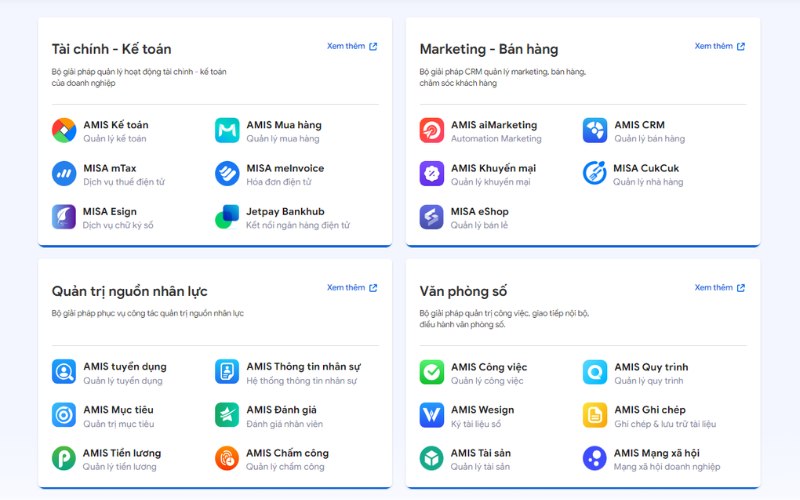
MISA AMIS is designed in accordance with the needs administration's comprehensive enterprise, including 4 professional core business of the enterprise:
- Financial management – accounting: accounting (Cost, revenue, Public debt, Purchasing, Sales, Warehouse,...), Bill electronic digital Signature, e-Tax, bank connections,...
- Marketing management – Sales: CRM, Marketing automation, Management, promotion,...
- Human resources management: attendance, Recruitment, salary, goals, personnel information, SOCIAL insurance,...
- Văn phòng số doanh nghiệp: Job management, process Management, Signed the document number, business social Networking, Management, meeting room...
5.4 software ERP foreign Odoo
Odoo app is an open source ERP (open-source), bringing the ability to customize and develop features a infinite way.
Application Odoo ERP integrates available multiple modules of the same basic modules like POS, CRM, warehouse management, project management, management personnel, etc. and allows businesses the freedom to edit, add or remove features or create the new module according to own needs.
Currently, Odoo has 46 module (subsystem) and more than 17,000 application by the user community grows. The module can operate independently or in conjunction with each other to help business operate smoother.
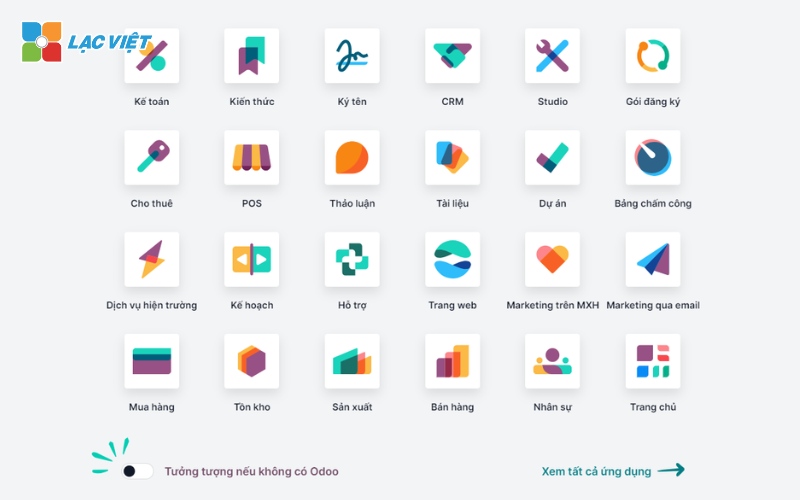
The following are the app highlights and module comes of Odoo:
- Financial accounting
- Customer management CRM
- Document management
- Project management
- Timesheets
- Planning
- Marketing in social networks, via email
- Inventory management
5.5 ERP System Oracle
Oracle is ERP software powerful, integrated cloud platform (cloud-based) allows the user remote access using the internet. Oracle help the process in the business activities of the business are automation, increase productivity and reduce costs not necessary.
In addition, Oracle Cloud ERP also has the ability to KPI analysis and predictions based on AI. Managers can spend more time for strategy work by automation, 96% of business processes.
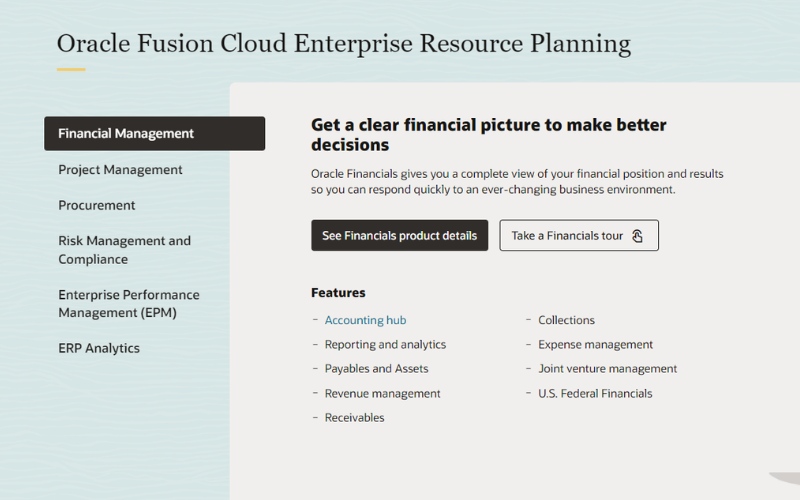
The main features of ERP Oracle:
- Financial management
- Supply chain management
- Project management
- Personnel management
- Risk management
- Performance management
6. Obstacles ERP implementation in business Vietnam & solutions
6.1 obstacles when implementing ERP in business
Although ERP software brings many benefits, but the process of implementing always exist many obstacles. First, the deployment of an ERP system requires the commitment and investment of resources, time, finances. This process can be complicated and time-consuming to train employees to adapt to the new system.
Monday, changing business processes and ways of working may encounter difficulty or opposition from the members of the organization. This requires strong leadership and the ability to persuade to change thinking habits work.
6.2 factors to consider before implementing ERP software
Before implementing ERP, business need to consider a number of important factors. First, clarify the goals and expectations of the business from the deployment management system business. This helps to shape the scope and decide on the functions/features you need for business.
Next, research and choose a ERP software tailored to the needs, the scale of the business. Reviews technical features, ability to customize, flexibility and technical support of software to ensure compatibility, the ability to expand in the future.
At the same time, prepare well for the implementation process by identifying resources, implementation team, schedule and employee training plan. Ensure that the business has adequate preparation and support from stakeholders.
With the continuous development of technology and the need for increased business efficiency, deployment management software business online is an important step in the conversion of enhanced productivity for the business. However, to ensure success, businesses need to thoroughly review the important factors before deploying.
ERP software is a comprehensive solution to support business solved all the problems on finance, hr, project management, customer. Businesses can consider choosing the ERP system in Vietnam that Vietnam was that a hint, combined with the note when buying to find the most suitable option.
CONTACT INFORMATION:
- Lac Viet Computing Corporation
- Hotline: 0901 555 063 | (+84.28) 3842 3333
- Email: info@lacviet.vn – Website: https://lacviet.vn
- Headquarters: 23 Nguyen Thi Huynh, P. Phu Nhuan, Ho Chi Minh City