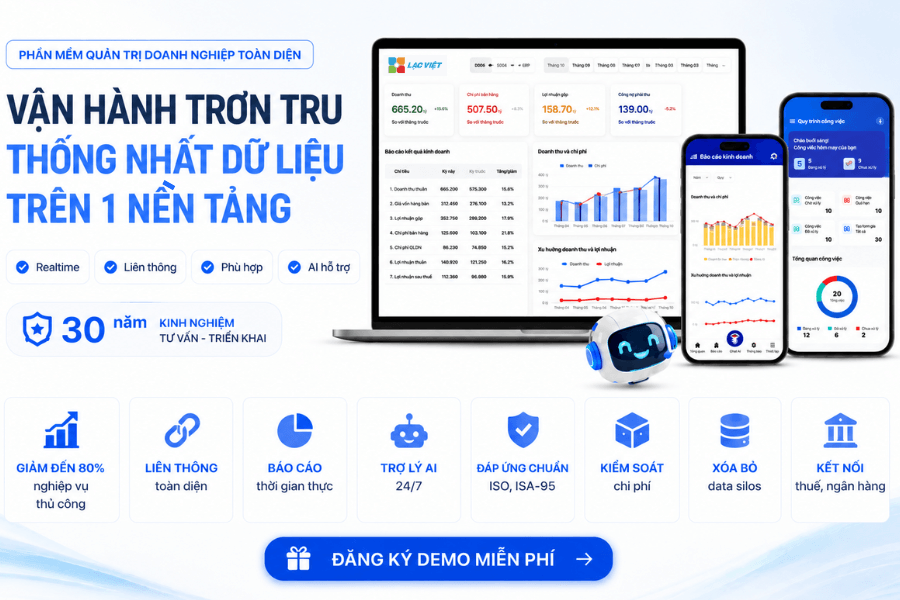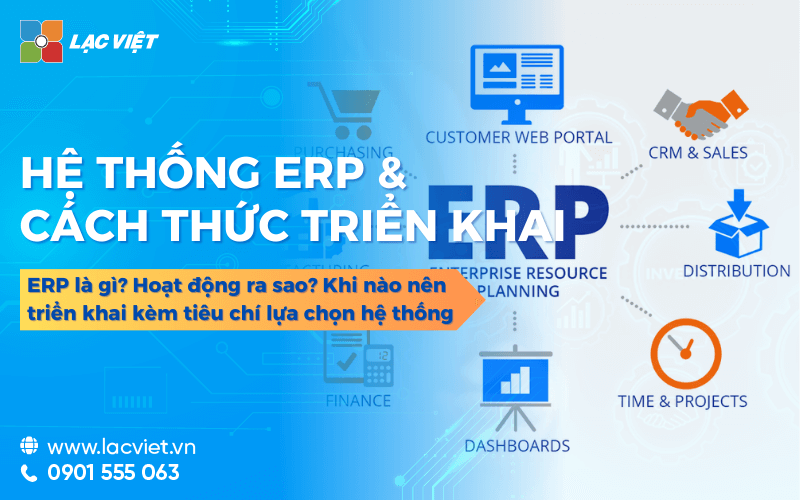

To the ERP system is the solution overall management help business connect data, standardize processes and improve operational efficiency across the entire organization. Instead of managing discrete by many individual software, ERP allows businesses to focus control, finance, hr, production, sales, supply chain, on a unified platform.
This article Lac Viet this will help businesses understand what ERP management systems are, how they work, what value they bring, when to implement them, and what criteria are suitable for selection, especially in the context of Vietnamese businesses accelerating digital transformation.
1. System what is ERP? Why need a business number?
1.1. Learn about the concept
When it comes to ERP systems, many people immediately think of “software”. But ERP is not merely a technological tool that is a system, ERP business management comprehensive help connect and standardized coordination, operations management core value of the business from finance and hr to sales – production.
ERP stands for Enterprise Resource Planning which means “resource planning enterprise”, reflecting the nature of an erp management system to help businesses effectively use all available resources to achieve strategic goals.
A simple example: before ERP, accounting used Excel to compile data from sales, inventory, and human resources; the inventory department managed inventory using its own software; and the sales department used a different CRM system. Each separate system led to conflicting data, requiring significant time for adjustments and synchronization. When an ERP system is implemented, all data from various departments is consolidated into a single "data source," giving the entire enterprise a unified view of operations, facilitating faster and more accurate coordination and decision-making.
This means that ERP software not only IT, which is a management system business erp integrated multiple function logic operation, help enterprise administrators throughout synchronize the internal operations.
1.2. Why has ERP management systems become the core management platform of modern businesses?
In actual operation, when the business began to grow in scale, number of orders, personnel and cash flow increased exponentially, commissioning data will be increasingly dispersed if the business continues to manage discrete. This situation causes three main problems:
- Lack of transparency data between the departments,
- Reports slow or false, to influence strategic decisions,
- Operating costs, errors due to rising duplicate data entry, cross-check between the different systems.
That's why ERP systems are so important: they collect, standardize, and link data within a single ERP management system, ensuring that all information is updated in real time and shared consistently across the entire enterprise.
Study by Panorama Consulting Group (is synthesized in the overview of the benefits ERP) show that the majority of business after implementing the ERP recorded markedly improved in efficiency, coordination, standardized processes, capacity decisions – the survival factor in the environment of fierce competition today.
2. What core modules should an ERP system include?
In an ERP system, the module core is designed to comprehensively manage resources and operational processes of the business. Each subsystem responsible for a functional business separately, but are connected and share data on the same platform that helps business to operate in sync, quick decisions.
Below are the common core modules of an ERP enterprise management system:
2.1. Module – accounting & Finance (Finance & Accounting)
This is the central module of the ERP system, helping businesses manage all their financial cash flow operations.
Main function:
- Management ledger, receivables – payables
- Revenue and expenditure management, budgets, cash flow
- Financial reporting, management reports
- Tax administration, compliance with accounting standards
This module helps businesses understand the financial situation in real time, serve for the cost control, business decisions.
2.2. The sales Manager (Sales Management)
The sales support business to manage the entire business process from approaching the customer to collect the money.
Main function:
- Manage quotes, orders,
- Management, policy, price, discount, promotion
- Track the progress of delivery, payment
- Analysis, sales, sales effectiveness
ERP helps to automate sales processes, reduce data entry duplication and provide data accurate business for administrators.
2.3. Management buy (Procurement / Purchasing)
This module operations management procurement of raw materials, goods or services, production and business.
Main function:
- Establishment requires a purchase
- Supplier management
- Manage orders and receipt of goods
- Cost control purchase
The system can automatically recommend a purchase based on inventory levels, minimum and production needs, help optimize inventory costs.
2.4. The warehouse Management (Inventory Management)
The warehouse helps enterprises control goods, raw materials, finished products.
Main function:
- Manage import – export – inventory
- Location management warehouse, shipment, serial
- Inventory control minimum – maximum
- Analysis of inventory turnover
ERP allows businesses to track inventory in multiple-dimensional data such as items, warehouse location, batch production... help reduce the cost of storage and avoid missing goods.
2.5. Management, production
This is the important for manufacturing enterprises to help plan and control the entire production process.
Main function:
- Production planning
- Manage production orders
- Calculate the demand for raw materials
- Track production progress, productivity
ERP helps businesses optimize production resources, reduce costs, enhance operational performance of the plant.
2.6. Management personnel – salaries (HRM & Payroll)
The HRM management support the entire life cycle of employees in the business.
Main function:
- Records management personnel
- Timekeeping, and payroll
- Recruiting, training
- Reviews employee performance
The integration of HRM into ERP helps business data connectivity personnel with financial, production and operations, other.
2.7. Management of fixed assets (Fixed Asset Management)
This module manage the entire assets of the business throughout the entire lifecycle of use.
Main function:
- Manage information assets
- Depreciation of assets
- Management maintenance
- Track liquidation of assets
Thanks to that business control, efficient use of assets and depreciation.
2.8. Analysis, customer relationship Management (CRM)
The CRM helps businesses manage customer information, business activities.
Main function:
- Managing customer data
- Track sales opportunities
- Manage marketing campaigns
- Customer care
CRM helps businesses increase sales effectiveness and improve customer experience.
2.9. System reporting and analysis
ERP provides system analysis report helps the administrator to monitor the situation on business operations.
Main function:
- Dashboard admin in real time
- Financial statements, sales, hr
- Analyze business trends
- Support strategic decisions
Thanks to that business can make decisions faster based on data focus.
3. When business should implement ERP system?
The decision ERP system implementation this shouldn't be a random or trendy decision. It's a strategic decision with long-term implications for the company's operational efficiency, costs, and scalability.
This section will help you recognize signs of pronounced that the business was “to the threshold” need to invest in an erp management system, real analysis, business type suit with ERP.
3.1. Signs that indicate a business has reached the point where it needs ERP.
A small business with simple operations often doesn't feel the need for an ERP system. However, as operations become more complex, the following signs become very clear:
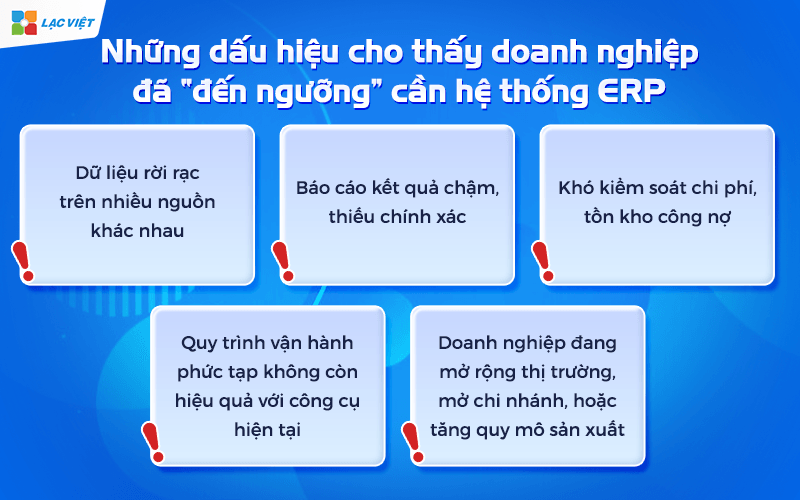
Discrete data on various sources
When the amount of data increases with the many departments involved in the process of operation (finance, inventory, sales, purchasing, hr), the use of Excel or other software individually will lead to fragmented data, difficult to control leads to errors. This reflects that the management system business current no longer meet the operating requirements.
In this context, the erp management system with centralized data will help remove the status of “bait stuffing” data from many different sources and create a “single source” for the whole business.
Report results slow, inaccurate
If the aggregated financial statements, inventory or business performance, take many hours or several days because it get data from various sources and “apply” them again by hand, that is a clear sign the business has exceeded the ability to manage manually.
ERP system provides real-time reports help leaders grasp the situation accurately and more quickly.
Hard to control costs, inventory liabilities
As business operations expand, the number of transactions and the volatility related to cost, inventory, and public debt increased rapidly, the track will lead to the loss of working capital or the debt is overdue. ERP helps to automate control of these factors, warning timely when data exceeds a safe limit.
Process commissioning of the complex is no longer effective with current tools
Doanh nghiệp càng lớn thì số lượng quy trình giao tiếp giữa bộ phận càng nhiều: từ đơn hàng đến giao nhận, từ mua hàng đến thanh toán… Khi các quy trình trở nên phức tạp hơn mức công cụ hiện tại có thể đáp ứng, đó là lúc cần một hệ thống quản trị ERP toàn diện để chuẩn hóa quy trình, đồng thời nâng cao năng lực phối hợp giữa các phòng ban.
Businesses are market expansion, opening of branches, or increase the scale of production
The rapid growth cause the tool to operate ago no longer fit. ERP helps business scale in a controlled manner, at the same time, standardized operation throughout many parts and many different locations.
3.2. ERP in accordance with the type of business do?
Implementing the right ERP system isn't just for large corporations with thousands of employees. In fact, many small and medium-sized enterprises (SMEs) also reap significant benefits by choosing the right solution at the right time. The following types of businesses are often well-suited to consider ERP implementation:
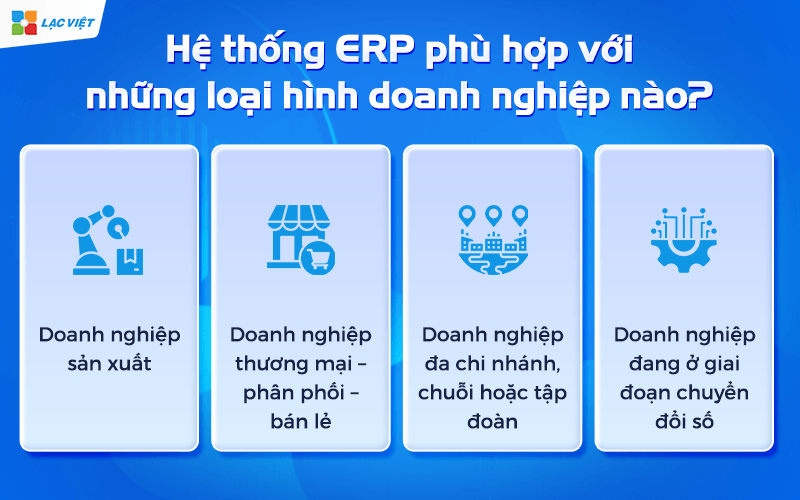
- Business production: In manufacturing businesses, tracking and managing raw materials, production schedules, production costs, and product quality requires accurate and continuously updated data. ERP systems help automate production planning and material control, reducing waste and improving production quality.
- Trade, distribution, and retail businesses:These businesses must manage multi-location inventory, constant goods movement, and optimize cash flow. ERP provides a comprehensive overview of inventory, automatically updating with sales or purchases, helping to reduce fictitious inventory and increase the ability to serve customers on time.
- A multi-branch, chain, or conglomerate business.: When a business has multiple branches or operates in various sectors, synchronizing data and processes across member units is a major challenge. An ERP system integrates data from multiple business locations into a single system, enabling leaders to effectively monitor and manage the entire organization.
- Businesses are in the digital transformation phase.: Today, according to expert predictions, a large proportion of businesses are moving towards digitizing their operations to increase competitiveness in the face of increasingly fierce market pressure. ERP is a key platform for digital transformation strategies, generating real-time data and supporting faster operational decisions.
Note: a common mistake is that ERP is only for large organizations. In fact, with the ERP solution modular, small and medium enterprises can deploy each part consistent with the needs, step by step extended when necessary. This not only helps businesses control the cost of the initial investment but also optimal thorough process before expanding deeper into other modules.
4. Process deployment ERP management system for effective business English
Implementing ERP system i.e. bring a unified solution to manage the entire operations of the business from finance, inventory, sales to production, and personnel. A project complete't just install software, but also helps business sync process, normalize data, create the foundation for better decisions in the future.
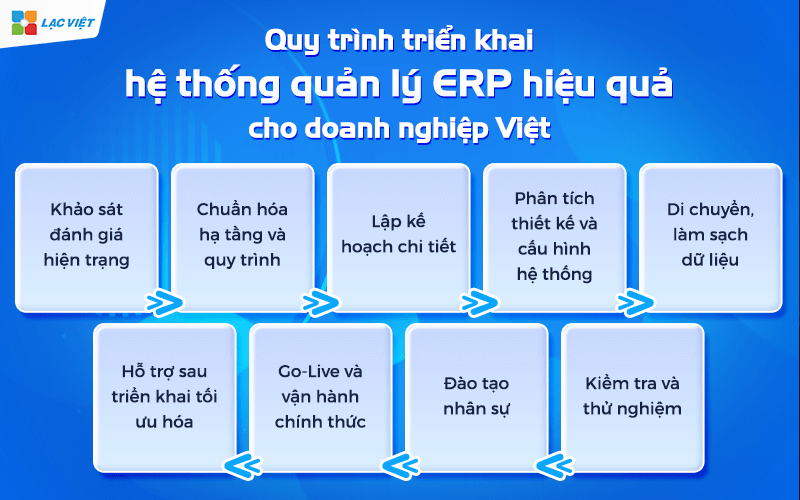
Step 1. The survey reviews the current state
The first stage is to understand the actual current activity of the enterprise. At this time, the deployed along with the enterprise will survey:
- The business process is taking place (for example, sales process, purchasing, accounting),
- Records, documents, reports, forms are used,
- System current data, ways to handle.
The aim is to determine the strengths – weaknesses, the process was repeated craft, fragmented data... From that can clearly define requirements that erp management system must meet.
Step 2. Standardized infrastructure and processes
After assessing the current situation, the two sides (represented business and the deployment) should agree what needs standardized before the software goes to work:
- Standardized data (example: definition of the value of the key information school),
- Standardized business processes according to the model of governance desire,
- Prepare technical infrastructure if necessary (server, connection, security, etc.).
The standardized ERP no “bumps” with the actual operation and reduce the risk data error, help user to get acquainted with the system.
Step 3. Plan details
This stage clearly define:
- Project scope
- Roadmap for implementing each part,
- Allocate project resources (department which responsible for what),
- Duration, milestones, controlling progress,
- Cost estimates, risks related.
This plan is “map” the most important of the entire project, and help minimize the unknowns in the deployment process.
Planning skills to help businesses control the progress and investment costs, ensuring that ERP implementation efficiency.
Step 4. Design analysis and system configuration
In this step, the deployment will:
- Design details configure the system based on business processes have been standardized,
- Specified access rights, user roles,
- Customize the form, reports in accordance with individual requirements of the business.
This step is important because ERP management system will reflect the way the business operated fact, rather than “getting business right in software”.
Step 5. Moving, cleaning data
The data from the old system (Excel, software, individual...) will be:
- Move to the new ERP system,
- Cleaning to remove duplicate data or incorrect
- Check the consistency of standardized according to the new format.
Clean data accurate system for out the report, right – quickly, reduce errors in operation and management reports.
Step 6. Inspection and testing
Before putting into operation formally, the system should be strictly checked:
- Check features according to the real situation,
- Trial users according to their role to ensure that the system accurately reflects the professional
- Bug fixes if any.
This stage helps to ensure ERP works properly as expected the business.
Step 7. Training personnel
ERP not only is install the software, which is to change the way of working of the whole organization. Training help:
- Users understand how to use according to job role,
- Reduce the time to convert from the old system to the new system,
- Increase the adoption rate and use the system.
Good training helps personnel to proactively work, avoid the “afraid to use the new system” led to the data is not fully updated or false.
Step 8. Go-Live and operate, formal
Go-Live is the stage system is put to use in daily activities. This is at:
- Users started to replace the old processes with ERP systems,
- Operate according to the cycle industry new service is standardized,
- Start tracking data, reported from the system.
Đây là bước mà doanh nghiệp bắt đầu “thu hoạch” lợi ích từ hệ thống quản trị ERP, như quản lý tồn kho theo thời gian thực, báo cáo tài chính tự động…
Step 9. Support after deployment optimization
After go-live, the system should be:
- Track daily activity
- Support solved bugs or problems arise,
- Update or expand functions as business development.
This help system is not only stable operation, but also continue to bring value when business needs change over time.
Deployment process management system ERP is a chain of logical steps in order to ensure the system is not just installed that really match the operating procedures of the business. Each stage has an important role in reducing risk, increasing the success rate and the optimal value that ERP brings from the standardize processes, reduce errors and data to support decisions based on data-focused and real-time.
5. Selection criteria ERP system suitable for enterprise
When businesses decide to invest in ERP management system, this is not merely choosing a software, which is a strategic decision that may affect the operational efficiency, scalability and competitiveness in the future. The wrong choice can lead to the increased cost, the system does not suit your needs, or even cause the project to fail.
Here are the main criteria to help businesses evaluate their options are ERP compliant, ensuring real value long term.
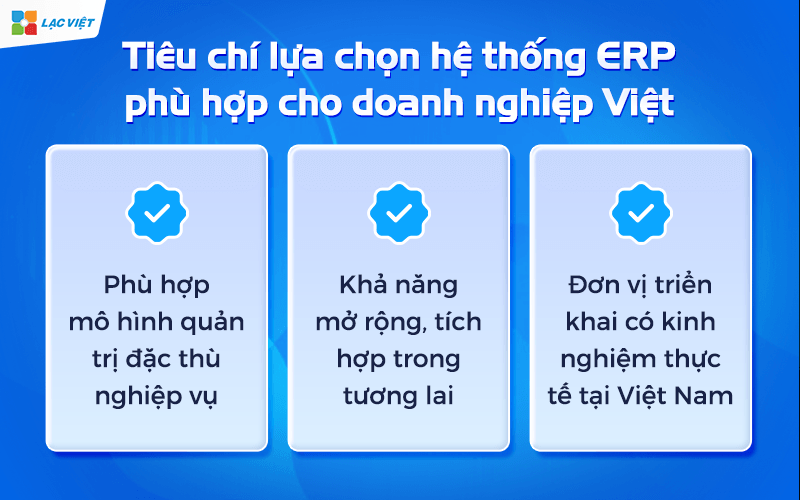
5.1. Suitable model management special services
A system, ERP business management good right “according to the business rather than getting business right in software”. This means that software should accurately reflect the business process's current business instead of forcing businesses to change things just to fit in with the system.
The fact is that many businesses encounter difficulties when using the ERP solution “package” not consistent with industry or scale of his led to the need to change internal processes in a forced manner, it is time-consuming and reduced effective coordination between departments.
Một hệ thống phù hợp sẽ giúp doanh nghiệp tự động hóa các quy trình kinh doanh chính như kế toán, mua bán, tồn kho, sản xuất… nhưng vẫn giữ được đặc thù vận hành riêng của tổ chức. Đặc biệt trong các ngành có nghiệp vụ phức tạp như sản xuất đa biến thể hay thương mại phân phối đa kênh, việc ERP phản ánh đúng nghiệp vụ sẽ giúp doanh nghiệp tiết kiệm thời gian, chi phí đào tạo người dùng, đồng thời giảm thiểu sai sót trong vận hành.
Illustrative example: Business A and business B, the same can demand inventory management, but if A is A retail unit need to calculate inventory for each store, B is the unit production need to management in batches, expiry date, then the ERP system must be able to distinguish customized process for each of these cases. A system of “one size fits all business” often can not meet this demand, businesses will have to customize the operation process, causing interruption of the operation.
5.2. Scalable, integrated in the future
When business development, requirements management operation will be increasingly more complex. An ERP system is ideal not only meet current needs but also to scale well for the future.
- Scalability means that the system has flexible architecture to add the new module, support more users, or deployed in multiple branches at the same time without interrupting operation. Some businesses choose to put the system onto the cloud platform to easily expand access from everywhere, but need to consider factors such as security and stability when deciding which deployment model.
- Khả năng tích hợp là yếu tố quyết định để ERP hoạt động trơn tru với các công cụ khác mà doanh nghiệp đang sử dụng như hệ thống quản lý khách hàng (CRM), quản lý nhân sự (HRM), hay các nền tảng bán hàng trực tuyến. Khi hệ thống quản lý ERP tích hợp tốt, dữ liệu giữa các hệ thống sẽ được đồng bộ, giảm sai sót nhập liệu thủ công và giúp lãnh đạo nắm bắt bức tranh quản trị tổng thể mà không phải dò xét từng hệ thống riêng lẻ.
When ERP has the ability to expand, integrate well is to increase the effective coordination between departments, reducing costs, managing the operation, optimal flow of data throughout the entire organization.
5.3. Unit deployment has practical experience in Vietnam
Select a supplier management system erp is not only a choice of software, but also is to choose a partner in transition management. So, the experience of unit of deployment is a key factor deciding the success of the project.
Một đơn vị có kinh nghiệm tại thị trường Việt Nam sẽ hiểu rõ những quy định về kế toán – thuế, thực tiễn quy trình doanh nghiệp nội địa, cũng như các thách thức thường gặp trong quá trình triển khai giúp đảm bảo rằng hệ thống được cấu hình đúng với thực tế vận hành của doanh nghiệp, không chỉ chạy theo lý thuyết công nghệ.
In addition, the service support after deployment is also very important. Businesses need to assess whether partners can provide services, user training, technical support, timely software updates periodically and quick response when problems arise or not. A good partner will significantly reduce the risks of interruption in operation when the given ERP system into practical use.
Actual note: Don't select a partner based solely on the brand that omit elements appropriate to the specific industry and business model. A supplier of “global brand” but the lack of implementation experience in Vietnam can make businesses take a lot of time, the cost to customize, causing miss rhythm operate.
Các tiêu chí như phù hợp với mô hình quản trị nghiệp vụ, khả năng mở rộng tích hợp trong tương lai, kinh nghiệm của đơn vị triển khai sẽ giúp doanh nghiệp tối ưu hóa chi phí đầu tư, giảm rủi ro vận hành đảm bảo giá trị lâu dài từ ERP.
6. Solution Lac Viet comprehensive ERP for enterprises
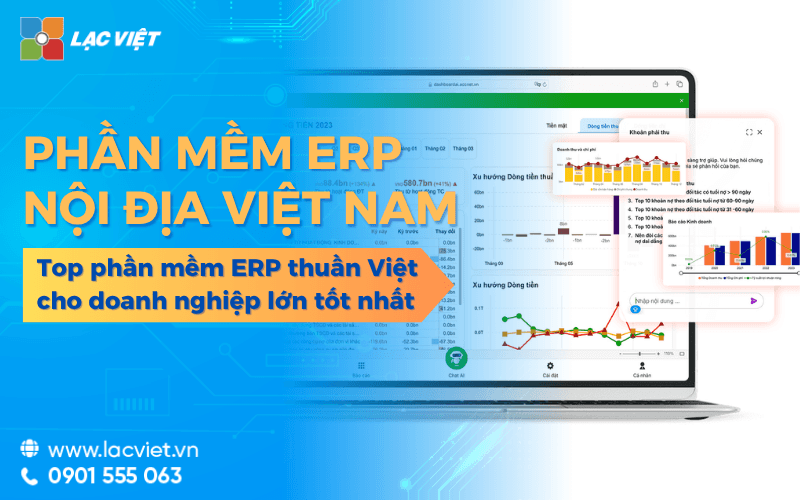
When evaluating an ERP system for Vietnamese businesses, the focus shouldn't be solely on the number of features, but rather on three core factors: suitability to operational realities, ability to solve existing management problems, and long-term value the system provides. Lac Viet ERP is one such example. domestic ERP software solutions It meets these three criteria quite clearly.
6.1. Overview of ERP system, Lac Viet ERP
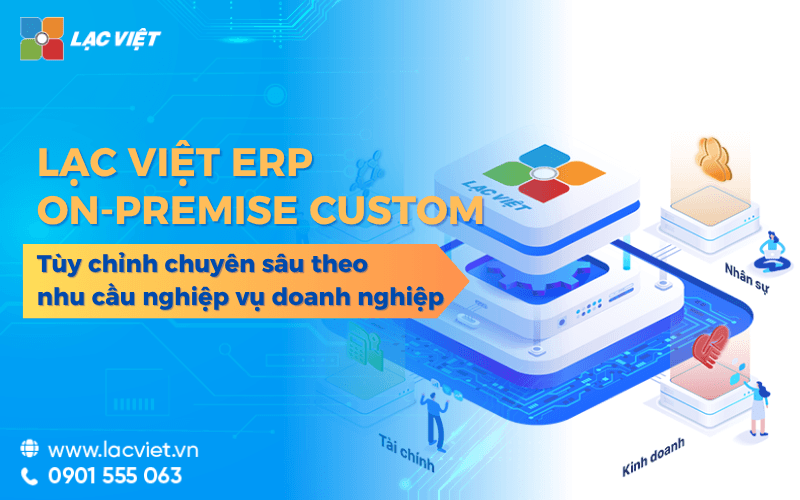
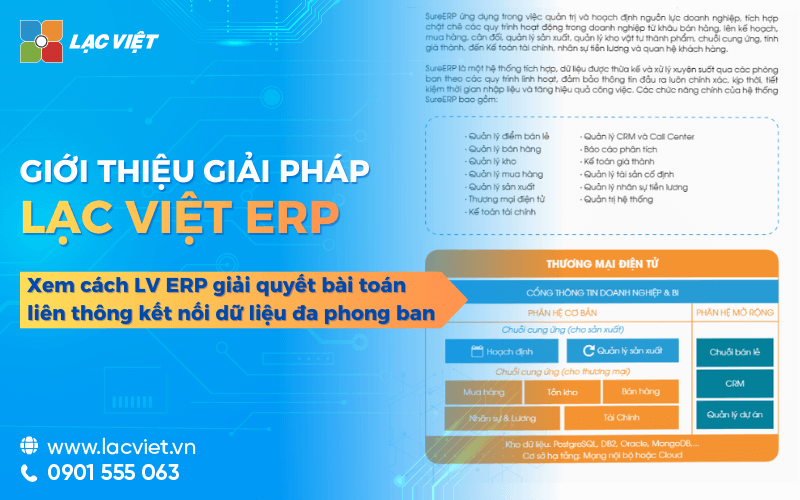
Lac Viet ERP is one of the ERP software in Vietnam the professionally customized ERP system developed by Lac Viet Information Technology JSC is fully implemented based on the management practices of Vietnamese businesses in various fields such as manufacturing, trade - distribution, and services. According to Lac Viet's official introductory document, the ERP system is oriented towards three core values: Comprehensive - Flexible - User-friendly.
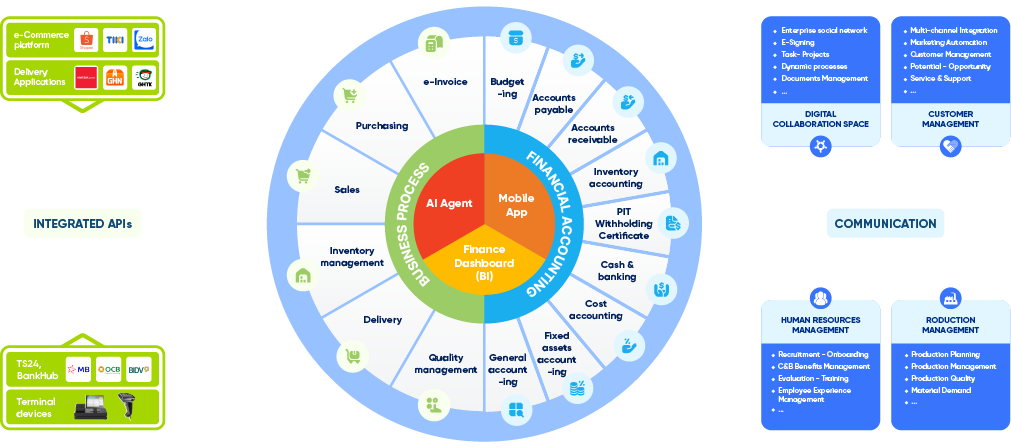
- Comprehensive is understood here as a system, covering the full operation of the business, from sales, purchase, warehouse, manufacturing, accounting and finance to human resources – salary to help businesses avoid the situation of each department uses a different software, leading to scattered data, difficult to control.
- Flexible expressed in the ability to configure, customize the process according to the management model actual value of each business, rather than impose a rigid template. This is very important point to business English, where each industry, each company has particular operating separately.
- Friendly be understood in the sense of user services can use the system without grounding IT in-depth. Interface, processing flow is built around the workflow fact, help reduce training time and reduce errors when putting the system into operation.
From the perspective of management, a management system ERP is only really valuable when users are ready to use and the data is fully updated constantly. This is the foundation for the system to develop effective long term.
6.2. LV ERP solve operate the business like?
In fact, the big problem most of the many businesses do not have to be “missing software”, which is the lack of contact information data and the lack of overall picture of the operation. LV ERP is designed to solve a direct problem this through the management throughout the entire operational chain.
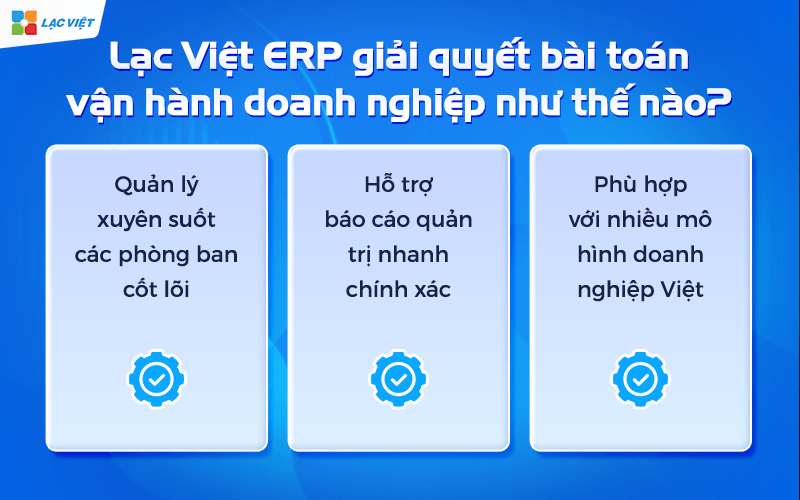
- Firstly, management throughout the departments to the core. LV ERP allows data from sales, purchase, warehouse, manufacturing, accounting, hr is connected on the same system. For example, when a single sale is recorded, the system will simultaneously update inventory, revenue recognition and reflect the public debt. This helps enterprises to reduce significantly the manipulate data entry, duplicate, limit deviations of data between the parts
- Monday, support governance report fast and accurate. With data updated in real time, leaders can track the situation of business, inventory, cash flow or production efficiency, without waiting for general craft.
- Tuesday, suitable with many models business English. LV ERP is deployed for both business production, trade, distribution and services. For business production and system support plan, track progress, work. With commercial enterprises, LV ERP to help control inventory, orders, liabilities more effectively. This is the strong point of a system, ERP business management is developed based on the practices of the local market, rather than relying only on the standard model international.
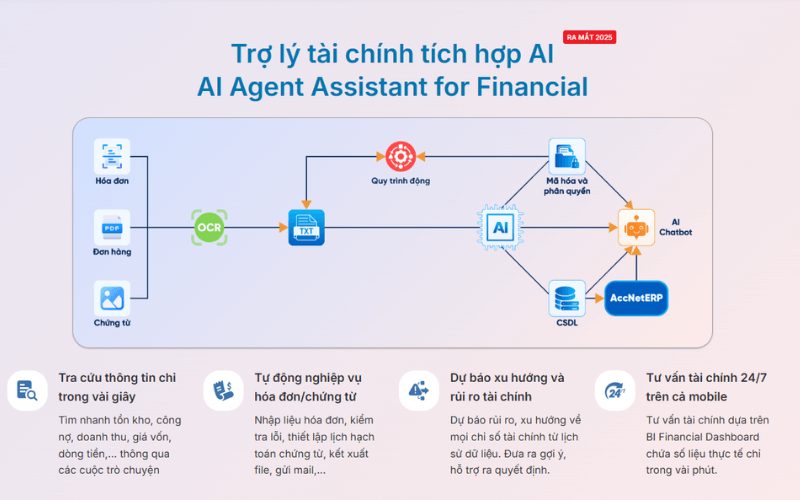
INTEGRATING AI ACCELERATES DIGITAL TRANSFORMATION AND PROMOTES COMPREHENSIVE OPERATIONS MANAGEMENT
AI in LV ERP goes beyond just data entry automation; it also includes:
- Identification & classification certificate from smart: AI scan, read & sort invoice, voucher, receipt, limit errors due to input manually.
- Financial forecasting & budget: the system uses algorithms machine learning to forecast cost, revenue, business support decision fast.
- Warning risk accounting: AI to detect abnormalities in the book, from which timely warning of false or fraud risks.
- Reports assistant smart: AI suggested report template, automatic data aggregation support, leadership, financial analysis instant.
Lac Viet ERP is particularly suitable for:
- Medium and large business
- Manufacturing enterprises have multiple stages
- Commercial enterprise – scale distribution
- Business has multiple departments, branches
- Businesses need ERP “go deep operation”, not only management accounting
TYPICAL CLIENTS CURRENTLY IMPLEMENTING LAC VIET ERP
From manufacturing and trade to multinational corporations, LV ERP đã giúp doanh nghiệp chuẩn hóa quy trình – tối ưu chi phí – nâng cao năng lực quản trị.
- Nitto Denko – Kiểm soát chi phí sản xuất hiệu quả: Ứng dụng phân hệ kế toán giá thành giúp doanh nghiệp tính toán chi phí chính xác, đồng bộ dữ liệu sản xuất – tài chính, nâng cao hiệu quả kiểm soát và tối ưu chi phí.
- ANTESCO – Tái cấu trúc quy trình vận hành: Triển khai ERP giúp chuẩn hóa quy trình liên phòng ban, cải thiện khả năng quản trị vận hành, tăng tính linh hoạt và đồng bộ trong toàn hệ thống.
- Hương Thủy Corporation – Chuẩn hóa quản trị tổng thể: Ứng dụng ERP để kết nối dữ liệu toàn doanh nghiệp, nâng cao khả năng kiểm soát và hỗ trợ ra quyết định nhanh, chính xác.
- Mễ Tân – Số hóa hoạt động sản xuất: Triển khai hệ thống ERP giúp tối ưu quản lý sản xuất, tồn kho và nguyên vật liệu, nâng cao năng suất và tính minh bạch trong vận hành.
6.3. Practical benefits when businesses deploy Lac Viet ERP
From practical experience of many projects ERP, one can see the largest value that the business receives when deploying LV ERP is not located at each feature individually, which in change in the way businesses operate, and management.
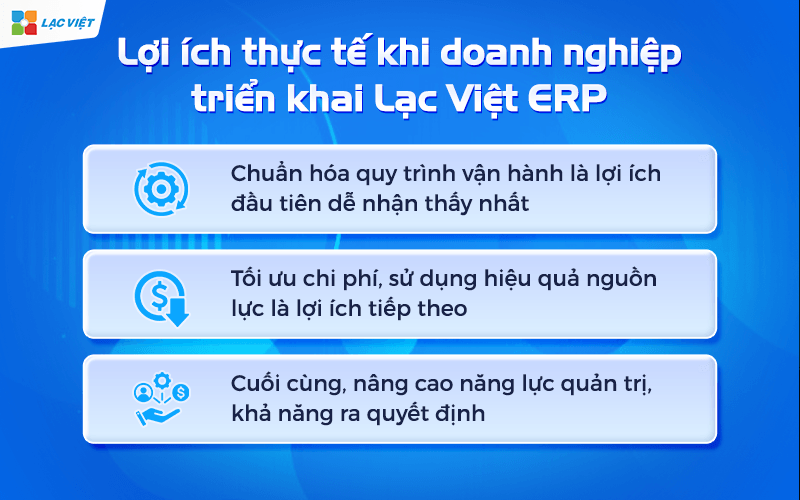
- Standardized operating procedures is the first benefit most visible. When the process is put up ERP system, businesses are forced to revise and unified standardized way of working between departments helping to reduce dependence on the individual, increase transparency, ensure the work is still smooth operation even when there are fluctuations in hr.
- Optimal cost, efficient use of resources is a benefit next. When data, inventory, expenses, cash flow is centralized control business has the facility to reduce inventory excess, limiting waste in the production and control public debt better.
- Finally, advanced management capability, the ability to make decisions. With LV ERP, leadership not only see the number of results, but also understand the causes behind the fluctuations on revenues, costs, or performance. This foundation is important for enterprises to move from management, according to the experience to the administrator based on data – an inevitable trend in the context of competition increasingly fierce.
In summary, from the perspective of governance operate, Lac Viet ERP is not just an ERP system support service, which is a tool to help enterprises build platform administrator basically, transparency ready to expand in the future, with the cost and the level of fit is optimized for the context in the country.