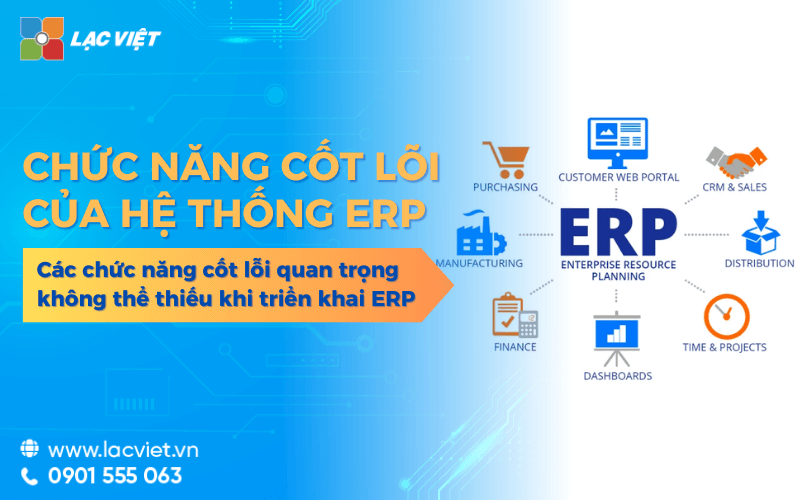

In essence, the function of ERP is connected manage the entire data operation of the business in real time, from financial accounting, personnel management, sales, inventory management to production and supply chain. Thanks to that, leaders can track the situation of business in a transparent way, make a decision fast more accurate.
In this article, along Lac Viet learn the detailed functions of ERP in business, the way this system supports the departments operate more efficiently, as well as the actual value that ERP brings operations management and long-term development of the organization.
1. Function of financial management – accounting
Financial management – accounting is one of the most important functions of các hệ thống ERP hiện nay. This module helps businesses keep track of the entire financial activities on a centralized platform from transactions arising daily to the financial statements serve governance and legal compliance.
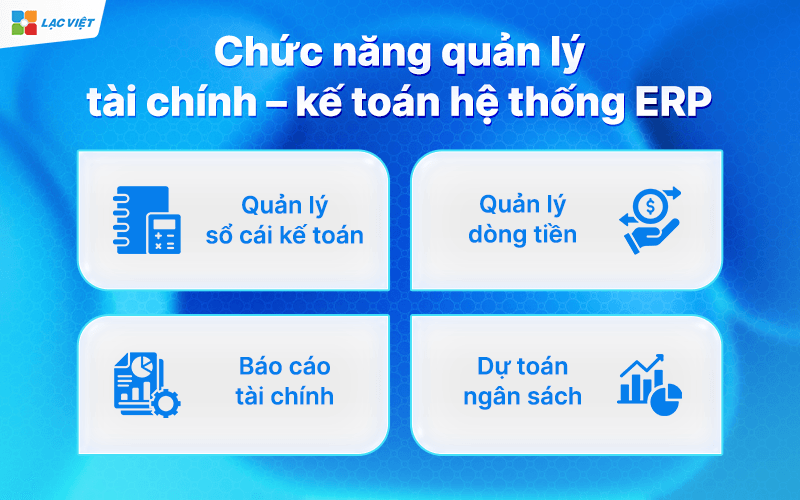
Management ledger accounting
Ledger is where notes the whole of the financial transactions of the business. ERP helps to automatically update the data on the ledger as soon as the business arising from the other parts such as sales, purchasing or production.
For example: When an order is invoiced, the system will automatically recognize revenue and accounts receivable without accounting re-enter data.
Debt management: ERP support track receivables from customers and accounts payable to suppliers. The system can alert the debt due, or overdue, helps businesses control cash flow.
Cash flow management
The finances allow tracking the entire outflow of cash into the business in real time. The administrator can know:
- The business is how much cash
- The receivables in the next time
- The payment need done
Financial statements
ERP can automatically aggregate data, create financial reports such as:
- Report business results
- Statements of cash flows
- Balance sheet
Thanks to the data is constantly updated reports always reflect the exact financial situation of the business.
Draft budget: Business can plan a budget for each department, project or business stage. The system will compare the actual costs with the budget to help manage your spending more effectively.
The use of ERP in financial management brings many obvious benefits:
- Control the cost better: Businesses can track costs for each department, project or cost center. This helps in early detection of expenditure exceeding the budget.
- A decision fast accurate: financial Data is updated in real time to help leaders can assess the business situation as need.
- Reduce errors in accounting: Thanks to the automation of data entry, data integration between the parts, ERP helps to significantly reduce the errors due to input manually.
2. Function sales manager
Sales manager is the system to help businesses control the entire process from receiving the demand of the customer until the complete payment. When integrated in the ERP system, all sales data will be directly connected with the other parts such as inventory, accounting and customer care.
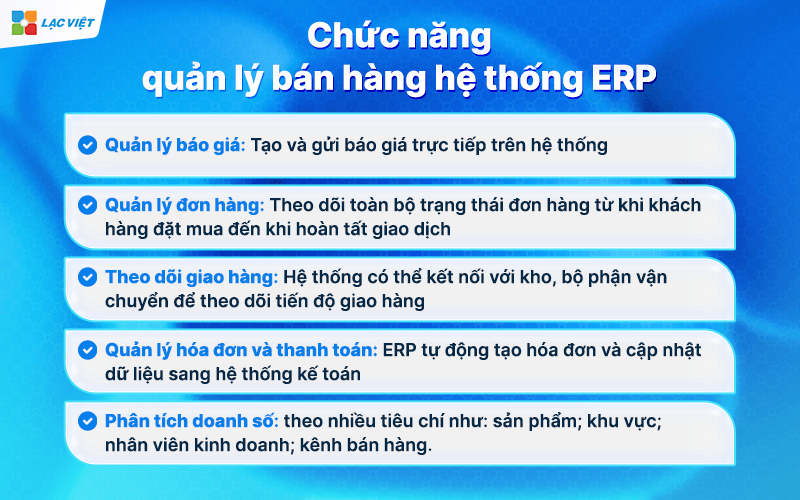
- Quotation management: sales Staff can create and send quotes directly on the system. The policy of price, discount or promotion is pre-set to help ensure consistency between the parts.
- Order management: ERP allows to track the entire order status from when a customer order until the completion of the transaction. This helps limit the misplaced or mishandled orders.
- Delivery tracking: the System can connect with warehouses, shipping departments to monitor the progress of the delivery. Sales staff can easily update the order status for customers.
- Invoice management and payment: ERP automatically generate the invoice and updates the data into the accounting system, helping to reduce processing time and vouchers.
- Analyze sales: Businesses can analyze sales according to many criteria, such as: products; region; business; sales channel
Enterprise value received:
- Control the sales process is closely: Businesses can track the entire sales activities on a single system helps to reduce errors, increase transparency.
- Analyze business performance: The sales reports help managers quickly identify hot selling products, the potential market or the effectiveness of each sales campaign.
- Enhance customer experience: When order information is updated fast, accurate, clients will get feedback more timely.
3. Management functions purchase
Purchase order management help enterprises control the entire operation procurement of raw materials, goods or services operated manufacturing business.
In many businesses, the purchase of goods is often dispersed between departments, leading to difficult-to-control costs. ERP helps to standardize this process.

The main function
- Management requires purchase: departments can send purchase inquiries directly on the system. An approval process is pre-set to help ensure the shopping requirements.
- Supplier management: ERP full archive information providers such as: historical transaction; purchase price; delivery time; assessment of quality, ... to help businesses choose the suitable offers.
- Manage orders: once approved, the system will create orders and track the progress of the delivery.
- Track the goods: When goods are warehoused data will automatically update to the system inventory and accounting.
- Cost control purchase: ERP allows to compare the purchase price between the suppliers and track purchase cost, according to each states.
Enterprise value received
- Optimal process shopping: purchase process is standardized, reduced processing time and restrictions the steps manually.
- Control the entry price effective: Thanks to historical data purchases, the business can negotiate better prices with suppliers.
- Reduce excess inventory: the System can propose the number of purchase based on inventory and demand.
4. Function inventory management
Inventory is one of the factors that directly affect operating costsability to meet customer needs. ERP helps businesses manage inventory correctly transparency.
The main function
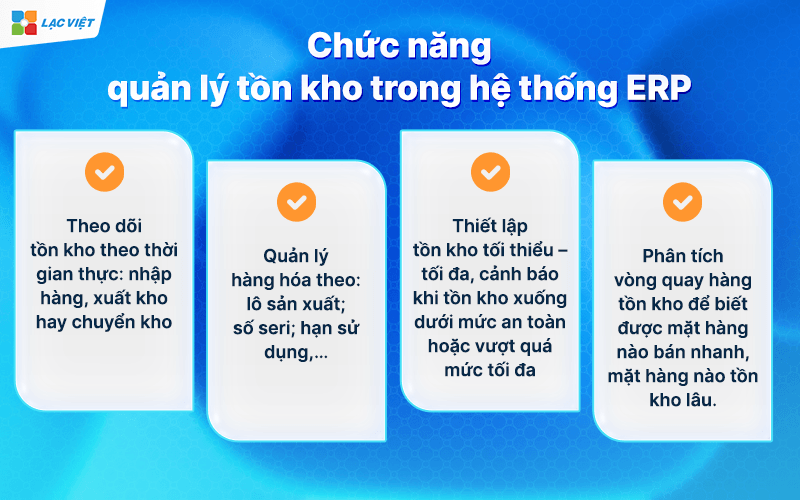
- Track inventory in real time: Every fluctuations in inventory from order entry, warehouse export or transfer inventory are updated on the system.
- Batch management term use: ERP allows the management of the goods according to: batch production; series number; limit use, ... this is particularly important for industries such as food, pharmaceutical or retail.
- Set inventory minimum – maximum: the System can alert when inventory drops below a safe level, or exceeds the maximum level.
- Analysis of inventory turnover: ERP helps businesses know which items sell fast, any items unsold long.
Enterprise value received
- Reduce inventory costs: excess inventory will increase the cost of storage and misappropriation of funds. ERP helps businesses maintain inventory levels reasonable.
- Avoid missing goods: warning System inventory helps businesses timely complementary goods when needed.
- Improve the efficient use of capital: optimal inventory can help businesses reduce 20% to 50% of the amount of inventory and increase the ability to meet customer needs.
5. Function production management
With respect to the business of manufacturing, ERP plays an important role in the planning and control of the entire production process.
The main function
- Production planning: ERP allows the construction of a production plan based on: orders customers; demand forecast; power machinery and manpower
- Manage production orders: the System helps monitor each production order, from the raw materials to finished products.
- Monitor production progress: managers can see the status of each stage of production in order to timely adjust the plan.
- Calculate the demand for raw materials: ERP automatically calculate the amount of materials needed for each order production.
- Reviews production capacity: the System can analyze the performance of each line, machinery or workers.
Enterprise value received
- Optimal plant capacity: ERP helps business efficient use of production resources, avoid machinery or manpower is wasted.
- Reduce the waste of raw material: The exact calculation demand for raw materials help to reduce losses and optimize production costs.
- Increased productivity: Thanks to the track production progress in real-time, businesses can detect early points of congestion in the process.
6. Management functions the product price
Manage product price is an important function in the ERP system, especially for the manufacturing enterprise or business there are many cost structure of products. The goal of this function is to help the business understand each product are consuming how much it costs to create, from that given strategy, selling price, optimal reasonable cost.
In fact, many businesses have difficulty when determining the price of accuracy of cost data scattered in many parts such as accounting, warehouse and manufacturing. ERP helps to connect the data in this together to create paintings full cost transparency.

The main function
Calculate the price of products: ERP allows businesses to calculate prices based on many factors such as:
- raw material directly
- cost
- the cost of production in common
For example, When a production order is completed, system can automatically aggregate cost of raw material was used from inventory, the cost of staff from hr system and the cost of machinery to calculate product price.
Allocation of costs: some costs in business can't be tied directly to a specific product, for example, electricity costs, depreciation expense, machinery or cost management. ERP will automatically allocate these costs according to the criteria was set as:
- number of products
- hours of machine running
- production time
Thanks to that product prices more accurately reflect actual production.
Compare prices over time: ERP allows businesses to compare product prices between the states as different as month, quarter, or year. This helps to detect the fluctuations in the cost and determine the cause of increase or decrease in price.
Analysis of cost structure: the System can analyze the proportion of each cost item in the total price of the product. For example, businesses can see that raw materials account for 60 percent of the cost, labor accounts for 25%, and other expenses account for 15%.
Enterprise value received
- Determine the exact profit: When the product price is calculated properly, businesses can know exactly the profitability of each product or each order.
- Adjusted selling strategies: cost information to help businesses make decisions as price increases, optimal manufacturing processes, or changing suppliers of raw materials.
- Optimum cost of production: According to research by Deloitte, the application system cost analysis in ERP can help your business reduce production costs from 10% to 20% thanks to discovery the point of waste in the production process.
7. Function of personnel management
Hr is important resource of any business. However, in many organizations, hr data often be managed using a spreadsheet discrete or more different software, causing difficulty in the synthesis of information.
ERP functional integration, personnel management helps businesses manage the entire life cycle of employees from recruitment, work, training to performance reviews on a single system.
The main function
Records management staff: ERP store the entire information of the employees, such as:
- personal information
- contract labor
- the process of work
- certificates and diplomas
Thanks to that the hr department can look up data quickly when needed.
- Attendance – payroll: the System can connect with the timekeeping device or system to work online to record the working time of employees. From this data, ERP automatically calculate salary based on the rules already set up as: base pay; allowances; overtime; bonus
- Recruitment management: ERP support track the entire recruitment process from posting recruitment, receiving resumes, interview to hiring decisions.
- Management training: Businesses can set up a training plan and track the learning process of employees to improve team capability.
- Performance evaluation: the System allows the evaluation of work performance based on indicators such as KPI or objective work.
Enterprise value received
- Optimal human resource management: managers can quickly capture the number of personnel costs, wages and labour productivity of each department.
- Reduces errors in payroll: The automation salary calculator helps to reduce errors, saving time for the hr department.
8. Functional customer management (CRM)
Functional customer management in ERP helps businesses build and manage database customer focused. This is an important foundation to help improve sales effectiveness, and customer care.
The main function
- Manage customer data: ERP store entire customer information, including: contact information; purchase history; the demand shopping behavior. Thanks to which business staff can understand more customers.
- Manage sales opportunities: the System allows tracking of sales opportunities at each stage, such as: reach customers; consulting; negotiation; contract
- Track transaction history: Every interaction with customers such as email, call, or transaction are saved on the system.
- Management campaign marketing: ERP can support management marketing campaigns such as email marketing or program customer care.
Enterprise value received
- Increase the rate of sales conversion: When customer information is centralized management, sales staff can make a proposal in accordance with the needs of each customer.
- Enhance customer experience: Employees can quickly access your transaction history to support customers better.
- Building long-term relationships with customers
9. Functional analysis and management reports
In the environment of modern business, data plays an important role in decision-making. ERP provides the analytical tools and reports help the management to understand the operations of the business.
The main function
- Dashboard admin: Dashboard is a table summing up the important metrics of business, such as revenue, cost, profit or inventory. This data is typically displayed in the form of graphs.
- Analyze sales: ERP helps business analysis, sales figures, according to many criteria, such as: products; market; sales channels; business staff
- Cost analysis: System can cost analysis according to each department or project to assess the operational efficiency.
- Analyze business performance: ERP helps to make comparison between plan and actual results to assess operational efficiency of the business.
Enterprise value received
- Decisions based on data Instead of relying on feelings, managers can use real data to make decisions.
- Detect risks early: The report analysis helps to detect the trend abnormalities such as reduced revenues or increased costs.
10. Function system administration and data security
In ERP systems, system administration and data security role to ensure system operation stability, business data are securely protected.
The main function
- Authorized user: ERP allows to set access permissions for each user or each of the departments. For example sales staff can only view customer data, while accounting have the right to access financial data.
- Access control: the System can control the login and data access to ensure only those authorised can use the system.
- Track history manipulation: ERP recorded the entire operation of the user on the system. This helps businesses easily check upon the occurrence of errors or dispute data.
- Integration with other systems: ERP can connect with other systems such as hr software, software sales, or system electronic commerce.
Enterprise value received:
- Security business data: business Data is an important asset of the business. ERP helps protect data from unauthorized access.
- Risk control system: tracking the history manipulation to help businesses detect and handle the risks related to data.
- Ensure transparency: All operations on the system are recorded, to help businesses build process transparent management professional.
Software lacviet ERP related information management holistic treatment for business
Trong quá trình triển khai ERP, yếu tố quan trọng không chỉ nằm ở việc doanh nghiệp lựa chọn một phần mềm ERP Việt Nam có nhiều tính năng, mà còn ở khả năng liên thông dữ liệu và hỗ trợ quản trị toàn diện giữa các phòng ban. Một hệ thống ERP hiệu quả cần đảm bảo mọi hoạt động từ tài chính – kế toán, bán hàng, mua hàng, quản lý kho đến nhân sự và vận hành được kết nối trên cùng một nền tảng dữ liệu thống nhất.
Lac Viet ERP is developed with the orientation to become the platform overall management for business in Vietnam, helping, contact information data, standardized operating procedures across the organization. The system allows business management sync core activities such as financial management, accounting, sales management, purchasing, logistics, production and management personnel. When data is centralized on a single system, leaders can monitor activities in real time, reduce false data between departments to enhance their ability to make decisions based on data.
Besides the integration of the management system, Lac Viet ERP is also flexible design to fit particular operating of the business. Support system, standardize processes, automate the processing steps and provide reporting systems administrator, multi-dimensional, help managers to quickly capture the performance of each department as well as the whole business.
With the possibility to link more data – optimized process – decision support, Lac Viet ERP become solutions help enterprises step by step construction management platform, modern, enhance operational efficiency, and ready to expand the scale in the context of transformation of increasingly powerful.