ERP implementation This is the process of selecting and configuring a system to connect data and standardize management processes on a unified platform. This process typically includes key steps such as: Surveying the current situation, selecting solutions, configuring the system, and converting dataUser training and testing are crucial before the system officially goes live to minimize the risk of work disruption.
In a context where businesses increasingly need to manage multiple departments, vast amounts of data, and complex operational processes, ERP is becoming an inevitable trend rather than an experimental option. ERP is not just software to support accounting, sales, or warehousing; it's a system that helps businesses connect data, standardize processes, and enhance overall management capabilities.
The article below Lac Viet This will help businesses understand what ERP is, what steps are involved in the ERP implementation process, and what are the key experiences to ensure the system truly delivers value in operational management.
1. Overview of ERP implementation in business
1.1 deployment what is ERP?
ERP implementation is the process of putting a system ERP (Enterprise Resource Planning – System resource planning, enterprise) into actual operation in the business. Don't just install software, ERP implementation was organized the way businesses manage data and operating procedures from which to create the link between the parts such as finance, accounting, personnel, purchasing, logistics, sales... in a management platform sole.
If each department uses its own tools (Excel spreadsheets, software, independent), then after ERP implementation, all important data is aggregated into the same system helps to eliminate the wrong number, increased processor speed of work and brings the total picture more about business operations.
Imagine the business you are taking many handbooks, other spreadsheets to manage sales, inventory and accounting. When there is ERP, all information is transferred into the same table “data only” that all departments are accessible according to the powers. Thanks to that, the cycle business faster more consistent.
1.2 The form of ERP deployment popular today
Khi triển khai ERP, bên cạnh việc lựa chọn phần mềm phù hợp, doanh nghiệp cũng cần cân nhắc hình thức triển khai sao cho phù hợp với quy mô, nguồn lực và yêu cầu quản trị dữ liệu. Hiện nay, các doanh nghiệp thường lựa chọn một trong ba hình thức ERP phổ biến dưới đây.
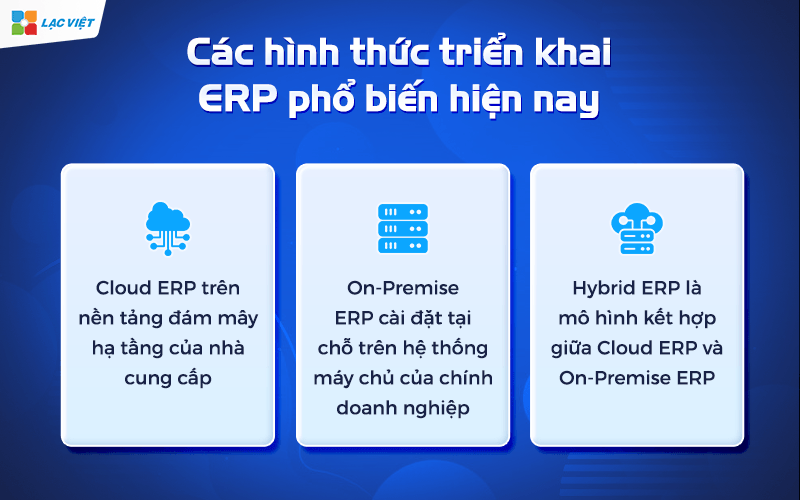
- Cloud ERP (Cloud-based ERP) Cloud ERP is a business model that uses ERP software via the internet, with data stored on the provider's infrastructure. The biggest advantage of Cloud ERP is its low initial investment cost, no need to invest in servers, ease of deployment, and rapid scalability as the business grows. This model is particularly suitable for small and medium-sized enterprises or organizations that need to deploy quickly to standardize processes. However, businesses need to carefully assess factors related to security, network connectivity, and compliance with data management regulations.
- On-Premise ERP (On-premise ERP installation) On-Premise ERP is a form of ERP implementation on a company's own servers. With this model, businesses have tight control over data, infrastructure, and access rights, making it suitable for organizations with high security requirements, internal data security, or complex management processes. Although the initial investment cost and implementation time are usually higher than Cloud ERP, On-Premise ERP provides long-term stability and autonomy for large-scale businesses or those operating in specialized fields.
- Hybrid ERP This model combines Cloud ERP and On-Premise ERP, allowing businesses to deploy some modules on the cloud while maintaining critical modules on their internal systems. This approach helps businesses leverage the flexibility of Cloud ERP while ensuring control over core data, making it particularly suitable for businesses undergoing gradual digital transformation or those with multiple branches and subsidiaries.
The choice of the form of ERP implementation is suitable right from the start will help businesses optimize costs, reduce technical risks to ensure the ERP system is really efficient support for active management and long-term operation.
2. What benefits does ERP implementation bring to businesses?
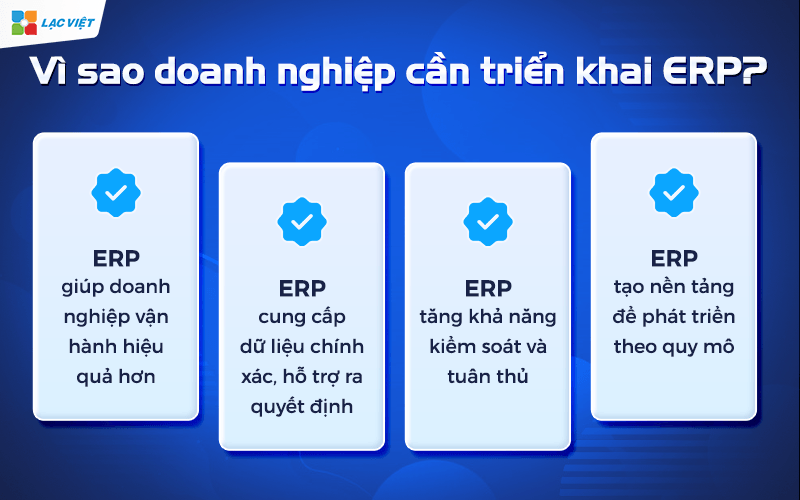
2.1 ERP helps businesses operate more effectively
One of the biggest benefits of ERP implementation is the optimization of internal processes. When data is automatically updated in real time between departments, businesses no longer need to manually enter data multiple times, reducing errors and shortening processing times. According to research by the software company Asana, the average employee spends up to 62% of their working time on repetitive tasks, and ERP helps eliminate a large portion of such tasks.
This has a direct impact on business operations: many business ERP implementation for know they significantly reduced the processing time of transactions, operating costs than before with the system.
2.2 ERP provide accurate data, decision support
Before implementation, data on inventory, sales, finance, or human resources were often scattered across different systems, leading to slow and inaccurate reporting. ERP system for operational management Centralized data allows leaders to see the big picture in real time, enabling them to make faster, more informed decisions based on digital evidence rather than intuition.
2.3 ERP increased ability to control and compliance
With ERP, business set the standard procedure, data access according to role. This helps to reduce the risk of errors crafts, at the same time help your business easily comply with the requirements, financial reporting, tax, auditing.
2.4 ERP create a platform to develop according to the scale
When business expansion — as more branches, increase production capacity or diversity channel sales — management model, old (Excel, many individual software) will quickly become not afford to meet. ERP helps businesses cope with the growth that does not cause fracture process thanks to data and processes are standardized.
3. The signs that the business was “time to” deploy ERP
Deciding to implement ERP is not simply about buying new software. It's a strategic decision for business operations – when the current management system begins to bottleneck performance, hinder growth, and waste personnel or data. Therefore, identifying the right time to implement the system helps businesses optimize processes, reduce costs, and make better decisions in a competitive environment.
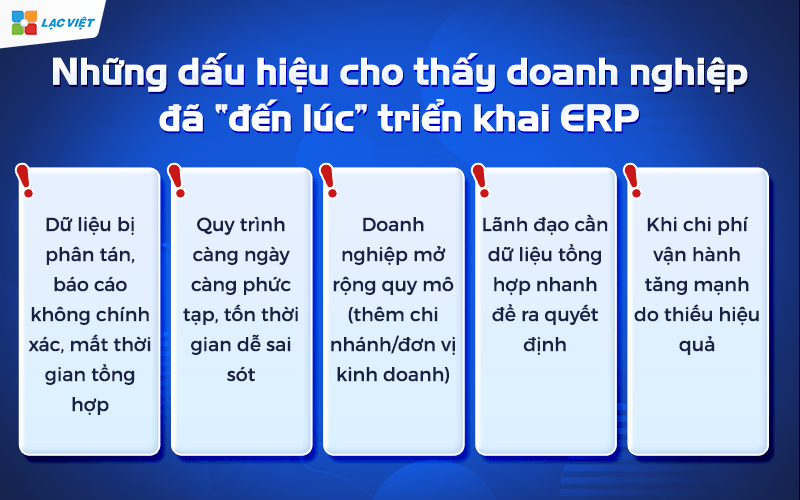
Here are the signs practical, easy to recognize from daily operations of the business, for file management system has come to the threshold no longer afford to meet:
Data is dispersed, incorrect statements, take time synthetic
When data is collected, stored, discrete in many different software (Excel, software private sales, retail, accounting, etc.), synthesis report is often late or incorrectly. This should make the leader board does not have the overall look, timeliness of performance, business results, leading to the decision to delay or deviation. Here are typical signs and shows the current system was “overwhelmed” and ERP can be solved by centralizing data on a single platform.
Process increasingly complex, time-consuming to errors
When the business expands, the business processes will arise more steps or exception (exception). If at this time operated mainly based on handcrafted, employees will take more time to process step by step repeat, at the same time prone to error. ERP helps to automate the process step core and remove data-entry craft repetitive.
Business scale up (add branch/business unit)
As businesses grow to multiple locations or business units, management systems old really difficult to control. The report, compiled from multiple sources easily lead to false, causing the leader board with no painting data consistency. ERP helps to link all units in a single system, reduce errors, increase transparency in management.
Leaders need to aggregate data quickly to a decision
In the business environment competitive, strategic decisions must be based on accurate data and updates in real time. When the old system for the synthetic data take many days or weeks, the business will miss market opportunities. ERP provides real-time data to help the decision-making fast right over.
When operating costs increase sharply due to lack of effective
Operating costs increase may be a sign the business is wasting resources on the unnecessary tasks, errors, duplicate data, flaws inventory – the issues of ERP has the ability to solve. Recent research shows that many businesses after the ERP implementation has shortened the processing time of orders, inventory reduction is not necessary, and increase resource efficiency.
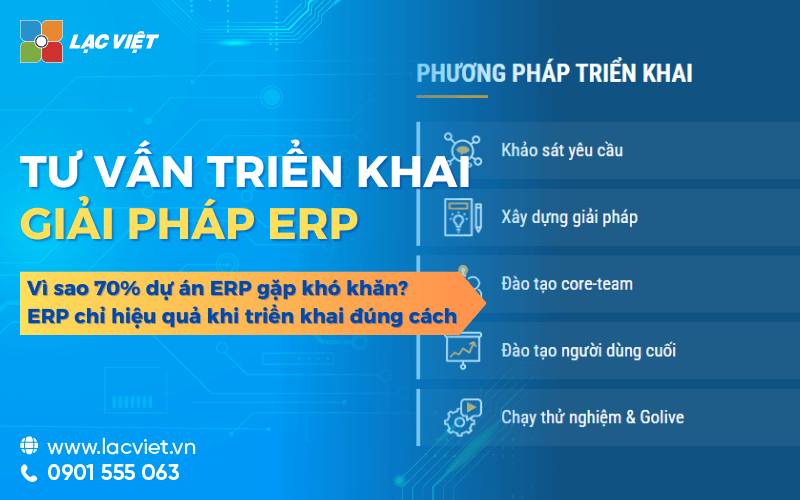
4. The process of project implementation standard ERP in business
ERP implementation is a project operated switch business requires planning and cooperation between leaders, project teams, internal consulting partner/supplier. A standard procedure not only helps to reduce technical risks, but also ensure that the business benefit practices such as the operation more efficient, data-focused, transparent decision right over.
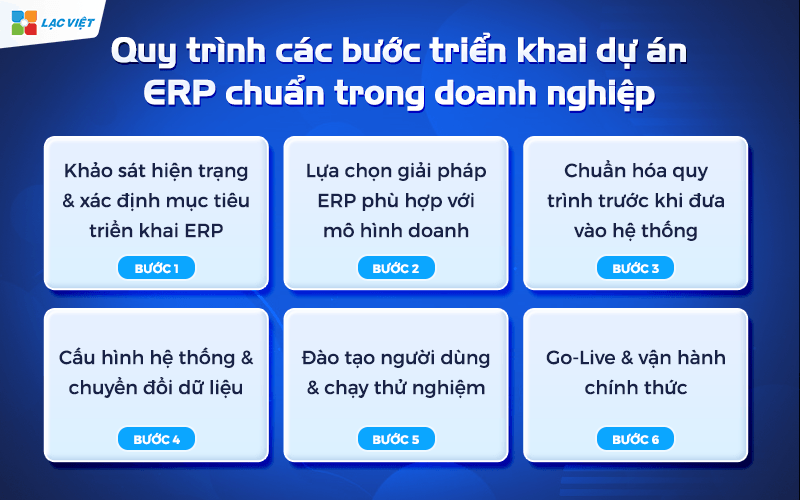
Step 1 – Survey the current status and identify the target deployment ERP
Objective: to Understand the “pain points” in current operations and determine the desired result after the ERP system.
In this step, the business should assess the existing process are wasting time, cost, where, in particular as:
- Employee time lost to aggregate reports from many different data sources.
- The number of holes, fix the data due to data entry manually.
- Not unification process between departments.
The survey skills to help businesses identify clear objectives for ERP project: be it financial management, precise control inventory in real time or standardized operating procedures. When clear goals, the project team easily design, ERP solution suitable and measurable success later.
The business does not depend emotional when choosing software or new process that has clear direction based on the problem to be solved.
Step 2 – choose ERP solution fits your business model
Target: Selected ERP solution matching the scale of operations and growth pattern of the business.
In this step, the business should consider factors such as:
- ERP standard (off-the-shelf) to fit most prevalent processes, help in faster deployment at a lower cost.
- ERP custom (customized) suitable if the business can process individual peculiarities.
- ERP internal storage (on-premise) compared with ERP running on the cloud (cloud): Cloud ERP helps businesses save costs, infrastructure, access data anytime, anywhere, while on-premise provides direct control over.
Suitable option helps to avoid situations purchase the software too strong, but not necessary, or too weak not meet the demand, leading to large cost but low efficiency.
Step 3 – Standardized process before bringing into the system
Objective: to Identify and refine internal processes to ERP support effective rather than re-create old bugs.
One of the common misunderstandings is ERP can “fix” every problem process. Fact, the system is only as good as business processes are standardized, updated before putting on ERP. This requires business:
- Collect existing procedures of each department.
- Compare with best practice industry.
- Adjust to achieve efficiency, compatibility with the system.
The standard process the goods before to help ERP work properly expectations, avoid the wrong operation and reduce the time to adjust after Go-Live.
Step 4 – system Configuration & data conversion
Goal: set the right ERP needs, data transfer from the old system to the new system.
In this step, the business need:
- Standardized input data: remove duplicate data, not the exact or error-free.
- Set role access: ensure each user to only see and manipulate the data according to his work.
- Check carefully before moving the entire data.
Data migration is the biggest challenge in ERP implementation, as outdated and non-standardized data will affect new reports and processes. Studies have shown that standardizing data before migration helps reduce the risk of errors and improve the quality of information after implementation.
Data full accuracy on ERP help every report, leadership decisions become more precise, effective support strategies.
Step 5 – user Training & test run
Goal: Ensure that users really understand the system and the system works as designed.
Training according to the actual role (such as accounting, logistics, sales) rather than general training will help employees capture fast, correct application ERP functions necessary for their work. At the same time, the test runs parallel between the old system and ERP in the period before the Go-Live will:
- Early detection error.
- Minimize disruption of work.
- Increase the level of reliability when switching to ERP official.
Đào tạo bài bản giúp tăng tỷ lệ nhân viên ứng dụng hệ thống, giảm sự kháng cự thay đổi, nâng cao hiệu quả sử dụng sau Go-Live.
Step 6 – Go-Live & operate the official
Objective: ERP was officially put into use in daily activities.
This stage is not just “turn the system up”. Business need:
- Activity tracker in the first 3-6 months to assess effectiveness, adjust if necessary.
- Plans after deployment support from both internal and partner provider to handle problems that arise in a timely manner.
Once officially implemented, ERP systems will begin to deliver value by increasing efficiency, reducing errors, and providing real-time data for leaders to make more accurate decisions.
Process standard ERP deployment not only is the technique to install the software, which is a journey of transformation management. Each step is associated with the actual value that the business received: from understanding the needs, choose the appropriate solution, standardizing processes and data, to training to operate effectively.
5. Experience ERP implementation success from the perspective of governance operate
In reality, many ERP projects fail or don't deliver the expected value, not because the software is poor, but because businesses approach ERP as a purely technology project. From an operations management perspective, ERP is a project that changes how a business operates, directly impacting people, processes, and decision-making.
Below is the core experience to help businesses deploy ERP success and create real value.
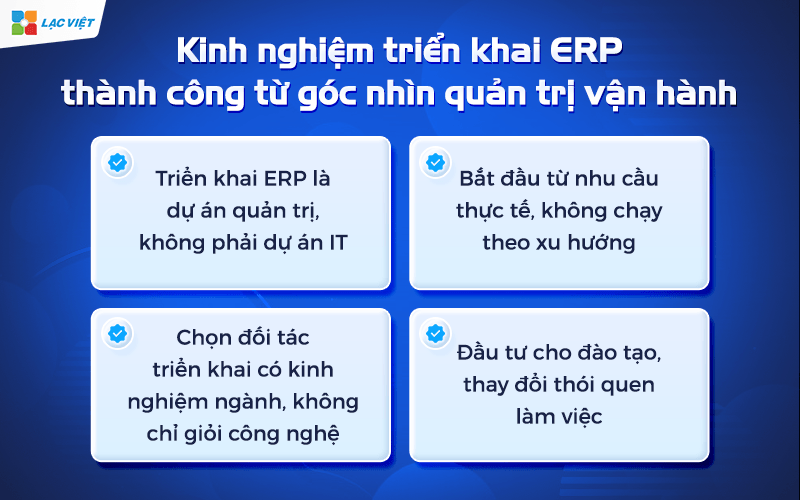
5.1 Implementing an ERP system is a management project, not an IT project.
A common mistake is the entire ERP project for the IT department or software vendors. This makes ERP misunderstood to be “installed software”, while the nature of ERP is standardized, re-structure the way business operate.
Trong các dự án ERP thành công, vai trò của ban lãnh đạo và các bộ phận nghiệp vụ là yếu tố quyết định:
- CEO: Sets strategic goals, resolves conflicts between departments, and demonstrates a strong commitment to the project.
- CFO / chief accountant: Ensure consistency of financial data, cost control, efficiency measurement after deployment.
- HR: change Management, internal communications, training, mounted ERP with the work performance of employees.
- Head of the service department: Is the decision ERP can properly reflect the actual operating or not.
5.2 starting from the actual needs, not chasing trends
Many businesses adopt ERP systems because "competitors are using them," "they see other businesses using them," or they are drawn to concepts like AI, Big Data, and comprehensive automation. This can easily lead to large investments that fail to address the core problems.
From the perspective of commissioning, the most important question before the ERP implementation is not:
“ERP has the features what?”
that is:
“Business is having problems, the most serious in operation?”
For example:
- Commercial business casual “pain” in inventory control and cash flow.
- Manufacturing enterprises often encounter difficulty in planning, progress tracking.
- Business multi-branch often lack data synthesis timely for leaders.
5.3 Select partners deploy experienced industry not only good at technology
Industry experience is just as important – if not more important – than technology. A partner who understands the specifics of the industry will:
- Grasp the actual process, not to impose theory.
- Anticipate the risks commonly encountered in operation.
- Tư vấn cách triển khai phù hợp với văn hóa, năng lực quản trị của doanh nghiệp.
For example, ERP for manufacturing businesses is completely different from ERP for trade or services. If the partner is only technically skilled but lacks industry experience, the business can easily end up needing many modifications, prolonging the implementation time and increasing costs.
The actual value is business, reduce risk, save deployment time to receive solutions close to the business operations practice.
5.4 investment for training, change work habits
ERP only really work when the user is using the correct and regular use. In fact, the resistance to change from employees is one of the biggest causes why ERP implementation does not reach expectations.
Experience operation management shows:
- Training needs associated with daily work, no training, spreading.
- Need to explain to employees seen ERP help them reduce manual work, reduce errors, rather than to “control them”.
- Leaders and middle managers have to be the example in the use of the system.
Enterprise value received is ERP become a part of routine work, help to increase productivity, data transparency, improve efficiency, long-term operation.
6. Lac Viet ERP – An ERP platform suitable for the specific operational management characteristics of Vietnamese businesses.
During the implementation of an ERP system, one of the key factors determining the long-term effectiveness of the project is choosing an ERP platform that suits the specific management and operational characteristics of Vietnamese businesses. In reality, not all ERP systems adequately meet the requirements for flexibility in processes, legal accounting and tax compliance, as well as the ability to scale up to each stage of a business's development.
Lac Viet ERP is developed with that orientation in mind: a comprehensive ERP system, designed based on the operational practices of Vietnamese businesses, helping businesses standardize processes, connect data across departments, and enhance management capabilities without disrupting current operations. Instead of mechanically applying international ERP models, Lac Viet ERP allows businesses to implement a suitable roadmap, flexibly according to scale and readiness level, thereby reducing risks, optimizing costs, and increasing value during use.
With years of experience partnering with businesses on digital transformation and operational management projects, Lac Viet positions LV ERP not only as one of the leading ERP providers. các phần mềm ERP ở Việt Nam lâu đời mà còn là giải pháp hỗ trợ doanh nghiệp triển khai ERP bài bản, hiệu quả bền vững.
ERP implementation is not merely invest in a new software, which is a strategic decision that directly affects the way businesses operate in the next several years. When deployed properly, ERP helps business transparent data, optimize processes, reduce dependence on people and improve ability to make decisions based on actual data.







![Hệ thống hoạch định nguồn lực doanh nghiệp ERP [Tài liệu chuẩn]](https://lacviet.vn/wp-content/uploads/2025/02/he-thong-hoach-dinh-nguon-luc-doanh-nghiep.png)