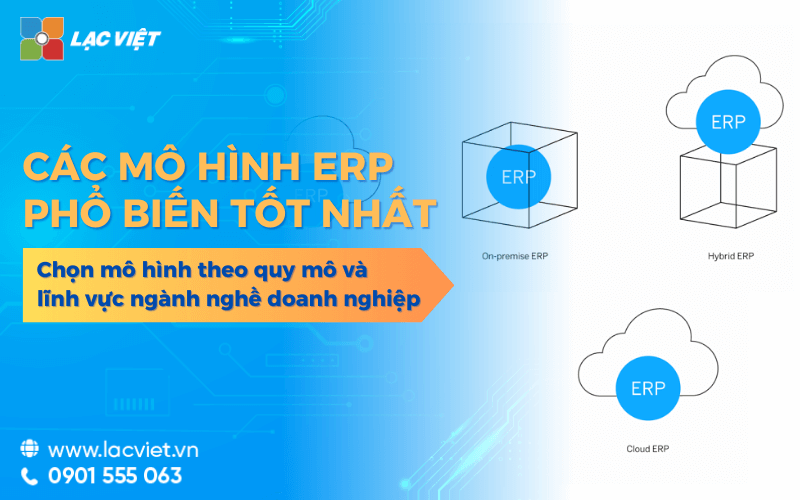

Model ERP is the business organization, system deployment, Enterprise Resource Planning to manage the entire resources such as finance, sales, inventory, production, human resources in a unified platform. Depending on the scale and strategic transformation of the business can choose the pattern ERP to ERP On-premise, Cloud ERP Hybrid ERP or ERP in the industry.
Choosing the right pattern ERP helps business standardized processes, optimize operating costs and improve capacity decisions based on data. The same Lac Viet find out details in this article.
1. What is ERP Model?
ERP (Enterprise Resource Planning) is a software system that helps business overall management of important resources such as finance, hr, sales, inventory, manufacturing and supply chain on the same platform. Instead of each department using a individual software, ERP connection, all data and processes into a unified system.
Model ERP được hiểu là cách tổ chức triển khai hệ thống ERP cho doanh nghiệp để quản lý toàn bộ hoạt động vận hành. Mô hình này không chỉ là phần mềm mà còn là cách doanh nghiệp thiết kế quy trình, luồng dữ liệu, phương thức phối hợp giữa các phòng ban.
To easily visualize, can consider a simple example:
Before applying ERP, many businesses operating in a discrete way. Parts sales order management on Excel, accounting use accounting software private inventory tracking enter by another system. When you need synthetic data, the employee must re-enter information multiple times, easy things take time.
When deploying ERP, all the departments use a common system. For example, when the sales department create orders, data will update automatically to warehouse to check inventory, at the same time switch to accounting to recognize revenue/public debt. Thanks to that, the business significantly reduce the input and can track their business in real time.
2. The model ERP popular today
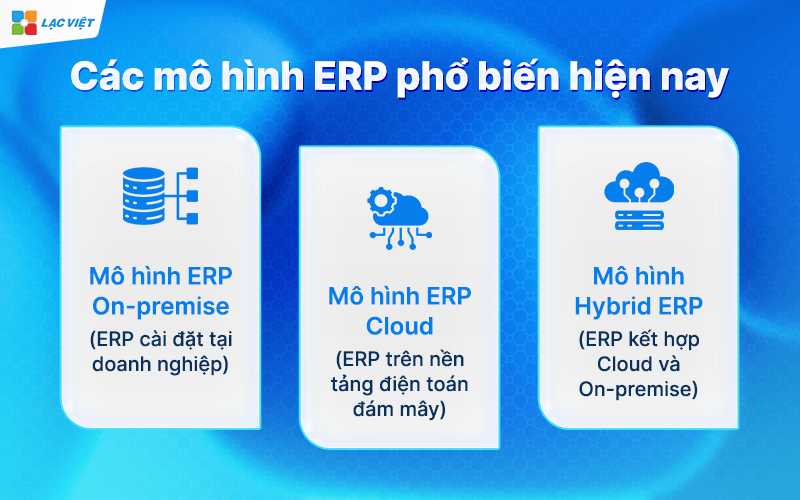
Currently, the ERP system is typically deployed in three main models include: ERP On-premise, Cloud ERP Hybrid ERP. Each model has operating characteristics, cost, and level of control over different data.
Understanding the pattern this ERP will help businesses choose the right solution, avoid investing in the wrong direction, ensure the ERP system really brings value in operation management.
2.1 Model ERP On-premise enterprise resource planning (ERP installed in business)
ERP On-premise model is deployed tradition, in which the entire system ERP software be installed and operated on the internal server of the enterprise. This means data, software and infrastructure technology are located in the company's system.
For example, if a manufacturing enterprise to deploy ERP On-premise system will be installed directly on the server located at the headquarters or the data center of the enterprise. Departments such as accounting, inventory, sales or production access to the system via the internal network or system VPN.
The actual value that the business get
- Control data at the highest level: For many big business, business data is an important asset. ERP On-premise enables enterprises to store the entire data in the internal system, which strictly control access and information security. This is especially important with the business in the field of manufacturing, finance, or organizations with sensitive data.
- The ability to customize the process operation: Every business has the own process. With model ERP On-premise systems can be custom depth to fit with professional characteristics such as production management, multi-stage assessment of complex or supply chain management, multi-tier. Thanks to that, the ERP system not only is management software but also a true reflection of how business operates.
- Stable performance when processing large volumes of data: Due to be operated on infrastructure, private enterprise can optimize the server configuration according to actual needs, ensure the system handle well the business has large data such as production management or warehouse management.
The factors that businesses need to consider: besides the benefits, pattern ERP On-premise also requires the business to have significant investment for technology infrastructure such as servers, storage systems, data, security and IT team to operate.
According to research conducted by Panorama Consulting, the cost to deploy ERP On-premise often Business does match the pattern ERP On-premise
Model ERP is usually in accordance with:
- Manufacturing business medium and large scale
- Business process operator complex
- Business need tightly controlled internal data
- The organization has available a team of IT system administrator
2.2 Model Cloud ERP (ERP platform on cloud)
ERP Cloud is a deployment model, modern, in which ERP software is operated on the infrastructure cloud provider's. Businesses do not need to install the system on an internal server that is accessible through the internet.
In simple words, Cloud ERP like the use of a service online. Employees only need to log into the system via web browser or app to work.
The actual value that the business get
- Simple deployment quickly: One of the biggest benefits of Cloud ERP is the speed of deployment. Do not need to build a server infrastructure, businesses can deploy the system in a shorter time than the model ERP tradition.
- Reduce the cost of the initial investment: Instead of investing the entire technology infrastructure right from the start, businesses only need to pay the cost of using the system by month or by year. This helps to reduce the financial pressure, particularly for the small and medium enterprises.
- Flexible expansion according to the development of the business: When business scale, more branches or increase the number of users, ERP Cloud can be extended quickly, without the need to upgrade infrastructure internal. This fits very well with the business is in the growth phase.
The factors that businesses need to consider
- ERP Cloud depends on the internet connection, and infrastructure of the provider. So, businesses need to select units reputable supplier to ensure the stability of system and data security.
- In addition, a number of Cloud system can limit the ability to customize deeper than ERP On-premise.
Any business in accordance with ERP Cloud
- Small and medium enterprises
- Startup is growing fast
- Enterprise want to implement ERP fast
- Organizations do not want to invest in IT infrastructure, big
2.3 Model Hybrid ERP (ERP combines Cloud and On-premise)
Hybrid ERP is pattern matching between ERP On-premise and Cloud ERP. In this model, a part of the ERP system is deployed on internal infrastructure, while another part to be operated on the cloud platform.
For example, a business could put the financial system and important data on the internal server to ensure security, while the distribution system, such as sales or CRM is operated on the cloud to support employees working remotely.
The actual value that the business get
- Flexibility in strategy, technology: Hybrid ERP allows businesses to leverage the advantages of both models ERP. The system should strictly control can be set to internal when the application needs the ability to access flexible and can be deployed on cloud.
- Optimal cost, operational efficiency: Business, no need to switch the entire system to the cloud or invest the entire internal infrastructure. Instead, the system is designed to be flexible for optimum cost and performance.
- Support transition of step by step: Many traditional businesses are not willing to transfer the entire system to the cloud. Hybrid ERP allows businesses to convert gradually part by part without interrupting business operations.
Any business matching Hybrid ERP
Hybrid ERP generally in accordance with:
- Businesses are in the transition period of
- Businesses have ERP system needs upgrading
- The group has many branches, complex systems
- Businesses want to incorporate data security, the ability to flexibly access
In general, each model ERP has advantages and limitations individually. Choosing the right pattern ERP will help the business leverage the maximum benefits of the system, from the optimal operation process, improve efficiency management to support decision-making based on data.
3. How to choose pattern ERP implementation in each scale business
The choice of model ERP should not be applied according to a general formula for all business. Each organization has the scale, peculiar to operate, the level of complexity in the different admin. If the choice model ERP does not match, the system can become too simple (does not meet the management needs) or too complex (waste cost and difficult to implement).
So, when choosing a model ERP, enterprises need to consider two main factors: the scale of the organization and industry.
3.1 model Selection ERP for small business startup
Small businesses, startups often have the financial resources and personnel limitations. Operating procedures also not too complex, so the pattern ERP should prioritize simple, reasonable cost, rapid deployment.
A number of important criteria when selecting ERP for small business include:
Deploy fast and easy to use
Hr in small business often, part-time role. Therefore, ERP systems need user-friendly interface, easy to learn and does not require training too complicated.
For example, a commercial company had 20-30 employees only need the ERP system management of business such as:
- sales manager
- inventory management
- debt management customers
- financial accounting
If you use ERP system is too complex, the business may have to spend a lot of time for the operating system, instead of focusing on business operations.
Investment costs reasonable
With small business, budgets, technology is often limited. So, the pattern ERP form cloud (deployment platform on cloud) is often preferred because of no need for infrastructure investment initial server.
3.2 model Selection ERP for medium-sized businesses
Medium businesses are in expansion phase of business operations. The number of personnel increased, the operation process is also more complex than small business.
In this stage, the model ERP need to be able to expand, integrate multiple departments.
An ERP system suitable for medium-sized businesses usually consists of subsystems such as:
- sales management and CRM
- manage purchase order and supplier
- inventory management
- financial management accounting
- hr manager salaries
The greatest benefit when the business just apply ERP is a data connection between the departments.
For example, when the sales department create orders on the system, the data will automatically switch to the parts warehouse to prepare, at the same time updates the revenue for the financial department. Thanks to that, the business reduced the status input multiple times limited data error.
3.3 model Selection ERP for large enterprises and corporations
Big businesses or corporations often have many branches, plant or business unit. So, the ERP system should have the ability to manage data focus but still flexible according to each unit.
A number of important requirements for model ERP for large enterprises, including:
Management capabilities, multi-branch
The system should allow the leader board to track data from multiple branches on the same platform. For example: sales, inventory, cost and operational efficiency of each unit to help businesses have the overall look to make strategic decisions more accurate.
Flexibility in custom
Large corporations often have operating procedures peculiarities. So ERP need to have the ability to customize processes and integration with other systems such as:
- system production management (MES)
- management system, customer relationship management (CRM)
- system supply chain management (SCM)
Ability to handle big data
When the number of transactions per day up to thousands or millions, the ERP system should ensure the ability to handle fast data stability.
4. Choose the model ERP under each field industry
In addition to factors of scale, industry and business also affect the choice of model ERP.
4.1 ERP for manufacturing enterprises
Manufacturing businesses need ERP systems have the ability to manage the entire life cycle of production, from production planning to manage raw materials.
The important functions often include:
- managing bill of material (BOM)
- production planning
- track production progress
- quality control products
- inventory management of raw materials
ERP helps business production, reduce the waste of raw materials and optimal production capacity.
4.2 ERP for business and retail trade
With commercial business or retail, ERP need to focus on the management of:
- sales
- inventory
- supply chain
- customer data
For example, a retail chain stores need ERP system helps to track inventory for each branch, avoid a situation where a lack of goods, but where other excess inventory.
4.2 ERP for business services
For business services, the most important asset is the staff and quality of service. Therefore, ERP systems often focus on functions such as:
- personnel management
- project management
- expense tracking service
- contract management customer
Thanks to that, the business can control the cost better project, enhance effective service provider.
5. Solution Lac Viet ERP flexibly customized according to business needs
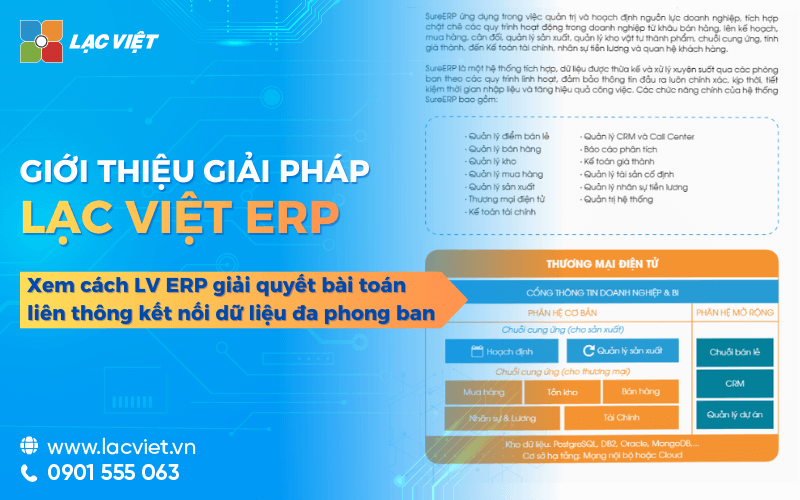
In the context of business increasingly focus on optimal efficiency and management, standardized operation process, the application ERP system is becoming inevitable trend. However, to ERP really bring value, businesses need a solution designed in accordance with the characteristics operations and business environment in Vietnam. This is why many organizations choose software lacviet ERP as a platform overall management helps connect data, process automation throughout the enterprise.
Lac Viet ERP is the unit have many years of experience in the field of software business management. The system is built according to the pattern, modern ERP, integration of subsystems as important as financial – accounting management, purchasing, sales, logistics, personnel, and management processes. Thanks to that, the data of the departments are connected on the same platform, help leaders track business performance in real time and make decisions quickly, the more accurate.
Don't just stop at the digitized data, Lac Viet ERP also helps enterprises standardize operating procedures, reduce the working status discrete between the departments. For example, when the business department, create orders, the system can automatically update inventory, at the same time to transfer data to the accounting department to track revenue and public debt. The synchronization of this helps reduce errors in data entry, saving significant processing time job.
A point worth noting is the solution Lac Viet ERP is designed to be flexible, allowing deployment in stages, customized according to the actual needs of the business. This is especially fit with the organization is in the process of converting some, but not want to invest the system too complicated right from the start.
With the ability to integrate data, automate processes and support centralized administration, Lac Viet ERP is becoming a platform that helps businesses enhance operational efficiency, cost control and building management system more transparent.