Product price là toàn bộ chi phí thực tế để sản xuất hoàn thiện một đơn vị sản phẩm, gồm chi phí nguyên vật liệu, nhân công và chi phí sản xuất chung. Đây là chỉ số giúp xác định giá vốn, xây dựng giá bán, không phải là giá bán thị trường. Xác định đúng giá thành giúp doanh nghiệp kiểm soát chi phí cũng như ra quyết định điều hành chính xác.
Many enterprises still face difficulties due to cost classification has a standard allocation of indirect cost was estimated and choose the method of price calculation is not appropriate. This price deviations from the fact, entail risks in the selling price, performance evaluation as well as financial management.
So, businesses need to understand the true nature price, the cost components to choose methods appropriate to control costs and maximize profits. The article below Lac Viet will the same business learn as well as clarify the concept of price of the product, classifications and methods work in practice management.
1. Product price is what?
Product price là tổng chi phí thực tế doanh nghiệp phải bỏ ra để sản xuất một đơn vị sản phẩm trong một kỳ, không phải là giá bán mà là chi phí để sản phẩm được hình thành và sẵn sàng đưa ra thị trường. Trong kế toán, giá thành được tập hợp từ các khoản chi trực tiếp cho sản xuất như nguyên vật liệu trực tiếp, nhân công trực tiếp và chi phí sản xuất chung, phản ánh đầy đủ mức độ hao hụt nguồn lực mà doanh nghiệp phải chịu để tạo ra sản phẩm.
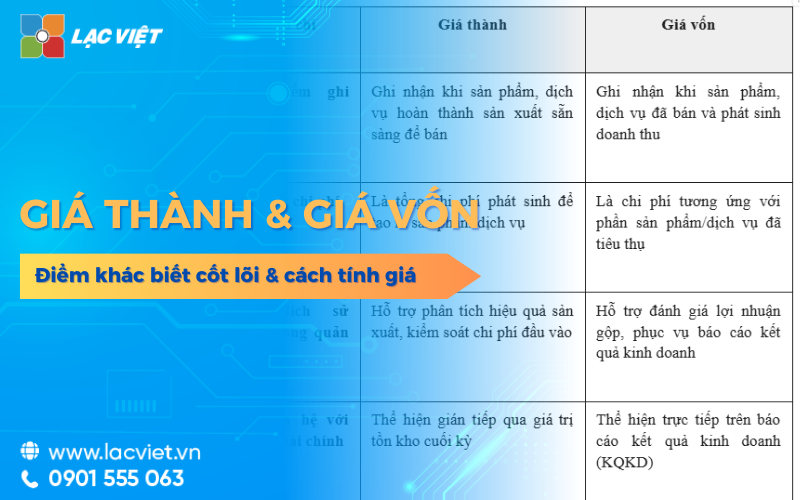
Differentiate prices & product sale price
The price, the sale price products are two concepts closely related but serve the target completely different in governance and business accounting.
| Criteria | Price of the product | Sale price product |
| Nature | The cost to create the product | Price business transactions |
| Purpose | Base price of capital, profit and cost control | Service sales target, the optimal revenue |
| Base form | Based on the actual cost incurred in the production | Based on cost, profit margin and market factors |
| Impact factor | Production processes, productivity, cost control | Competition, customer needs, business strategy |
| Properties | Bearing the internal service management | Iconic market, catering business |
Note: If pricing is missing or wrong, the business can determine the selling price wrong (too low or too high), leading to risk of loss, loss конкурент force or misjudged business performance.
The role of the product price in financial reporting & internal management
the price of product is only goal of accounting is important, at the same time as data platform, service management and decision making in business. In particular, the price has the following roles:
- Base notes cost of goods sold (COGS): COGS reflect the actual cost of products sold; determine the right price to help reflect the gross profit.
- Impact on financial performance & obligations tax: Price directly affects the profit margin, profits taxable. Wrong price wrong evaluate the effectiveness as well as potential tax risks.
- Provide data for cost management & decision-making: the Price of help track fluctuations in cost, performance evaluation, each stage as a basis for improvement and investment.
2. The product price includes cost?
Businesses often incorrect price due to the identification as well as sorting costs not true. Especially confusion between the cost price, cost states. According to the current accounting year, the price of the product, including the three main costs and some costs directly related.

2.1. The cost of raw materials directly
The cost of direct material is the total value of materials used directly to create the product, including:
- Main materials: the material constituting the bulk texture of the product, for example in furniture manufacturing is raw wood.
- Extra materials: raw materials, support finishing products such as paints, glues, accessories...
- Semi-finished products purchased outside: the parts have been machined part and put in the process of finishing products.
In structure, the price of the product, the cost of raw materials directly often accounted for a large proportion (usually 30%-70% of the total production costs). Direct influence on business results, so cost control is the key element to the product prices, improve profit margins.
Illustrative example: In a manufacturing business furniture
- Wood raw materials determine the structure and quality products
- Paint, glue, metal fittings material is mature, but indispensable in the process of finishing
All these amounts are set at the cost of direct material of each product or order.
2.2. Costs directly
Costs directly cover the entire costs related to workers directly involved in production, in particular:
- Tiền lương theo thời gian hoặc theo sản phẩm
- Allowances bring food quality
- Deductions from wages as social insurance, health insurance, unemployment insurance in accordance
Only direct labor created new product is calculated into the cost of direct labour. Labor management and indirectly to be accounted for into the cost of joint production or cost management.
The influence of the productivity of labor to the price of the product. In fact, the same salary, but:
- If low productivity → cost per unit of product increase
- If high productivity → cost allocation on each product reduction
Therefore, the price of the product reflects not only wages, but also reflects effective organization of production, skilled labor and the level of standardization processes.
2.3. The cost of production in common
Production overhead is the indirect cost, but necessary to the production activities take place, including:
- Depreciation machinery, equipment, buildings
- The cost of electricity, water, fuel production service
- Cost of repairs, maintenance, machinery
- Salary costs related to staff management workshop
This is the cost hard to follow prone to allocate wrong, especially with businesses that have multiple lines or more types of products.
These costs are often overlooked when calculating the price in business:
- The cost of minor repairs arising regular
- Chi phí công cụ dụng cụ phân bổ nhiều kỳ
- The cost to hire technical services, maintenance, safety production
The omission of this clause, causing the price of products is lower than the actual leads to false when profitability analysis.
2.4. Other costs are related to the price of the products
In addition to the three main costs, a number of other costs can still be calculated into the price if directly related to creating the products, for example:
- Machining cost outsourced by stage
- Cost of inspection, test and evaluate the quality of products before enter warehouse
These amounts generally arise unevenly, but if not, be followed are prone to “drift” to cost states, distort prices.
Cost segregation charged to prices & costs not charged to the business need to distinguish:
- Cost calculated in the price: only include the costs tied directly to the production
- Costs not included in the price: cost of sales, cost management, business, finance charges – is accounted for by the states and not allocated to cost of production
3. Vì sao doanh nghiệp phải tính đúng giá thành sản phẩm?
Trong doanh nghiệp sản xuất, giá thành sản phẩm không chỉ là một chỉ tiêu kế toán mà còn là cơ sở cho hầu hết các quyết định kinh doanh quan trọng. Khi giá thành được xác định chính xác, doanh nghiệp có thể xây dựng giá bán hợp lý, kiểm soát chi phí, đánh giá hiệu quả sản xuất và lập kế hoạch tài chính sát với thực tế. Ngược lại, nếu tính sai giá thành, những sai lệch nhỏ ở khâu tập hợp hoặc phân bổ chi phí có thể kéo theo hàng loạt quyết định thiếu chính xác về giá bán, lợi nhuận, kế hoạch sản xuất và đầu tư.
Một cách dễ hình dung, chuỗi tác động của việc tính sai giá thành có thể diễn ra như sau:
Tính sai giá thành → Xác định sai giá bán → Sai lệch lợi nhuận → Đưa ra quyết định kinh doanh thiếu chính xác.
3.1 Xác định giá bán hợp lý
Giá bán không thể được xây dựng chỉ dựa trên mức giá của đối thủ hoặc cảm tính của người quản lý. Nền tảng của một chiến lược định giá hiệu quả luôn bắt đầu từ việc xác định đúng giá thành sản phẩm.
Nếu giá thành được tính thấp hơn thực tế, doanh nghiệp có thể đưa ra mức giá bán hấp dẫn nhưng lợi nhuận thực tế lại rất thấp, thậm chí càng bán càng lỗ. Ngược lại, khi giá thành bị tính cao hơn thực tế, giá bán sẽ tăng theo, khiến sản phẩm mất lợi thế cạnh tranh và khó tiếp cận khách hàng.
Đối với kế toán trưởng, việc xác định đúng giá thành còn giúp ban lãnh đạo có cơ sở xây dựng chính sách giá bán theo từng nhóm khách hàng, từng khu vực hoặc từng thời điểm thị trường mà vẫn đảm bảo mục tiêu lợi nhuận.
3.2 Đánh giá hiệu quả sản xuất
Giá thành là “thước đo” phản ánh mức độ hiệu quả của toàn bộ quá trình sản xuất. Khi doanh nghiệp theo dõi giá thành theo từng sản phẩm, đơn hàng hoặc công đoạn, bộ phận kế toán có thể nhanh chóng nhận biết những khu vực đang phát sinh chi phí bất thường để phối hợp với các phòng ban liên quan tìm nguyên nhân và đưa ra biện pháp cải thiện.
Ví dụ, nếu giá thành của cùng một sản phẩm tăng liên tục qua các kỳ nhưng sản lượng không thay đổi, doanh nghiệp cần xem xét liệu nguyên nhân đến từ việc tiêu hao nguyên vật liệu vượt định mức, năng suất lao động giảm hay chi phí sản xuất chung đang tăng cao.
Thông tin này không chỉ phục vụ công tác hạch toán mà còn hỗ trợ nhà quản lý đánh giá hiệu quả của từng dây chuyền sản xuất, từng phân xưởng hoặc từng đơn hàng. Đây là cơ sở để tối ưu quy trình, cải thiện năng suất và nâng cao khả năng cạnh tranh trên thị trường.
3.3 Kiểm soát lãng phí nguyên vật liệu
Đối với nhiều doanh nghiệp sản xuất, chi phí nguyên vật liệu thường chiếm tỷ trọng lớn trong giá thành sản phẩm. Vì vậy, chỉ cần tỷ lệ hao hụt nguyên vật liệu tăng thêm một mức nhỏ cũng có thể làm tổng chi phí sản xuất tăng đáng kể.
Việc tính đúng giá thành giúp kế toán theo dõi mức tiêu hao thực tế so với định mức đã xây dựng. Nếu phát hiện nguyên vật liệu sử dụng vượt định mức trong nhiều kỳ liên tiếp, doanh nghiệp có thể kiểm tra lại quy trình sản xuất, chất lượng vật tư đầu vào hoặc tình trạng vận hành của máy móc để giảm thất thoát.
Chẳng hạn, doanh nghiệp sản xuất bao bì nhựa quy định mỗi tấn thành phẩm sử dụng 1,02 tấn hạt nhựa. Nếu báo cáo giá thành cho thấy mức tiêu hao thực tế lên tới 1,08 tấn, doanh nghiệp cần xác định nguyên nhân đến từ chất lượng nguyên liệu, tỷ lệ phế phẩm hay thao tác của công nhân. Việc phát hiện sớm giúp hạn chế lãng phí và tiết kiệm đáng kể chi phí trong dài hạn.
3.4 Xác định lợi nhuận chính xác
Lợi nhuận là chỉ tiêu được ban lãnh đạo, cổ đông và nhà đầu tư đặc biệt quan tâm. Tuy nhiên, lợi nhuận chỉ phản ánh đúng thực trạng kinh doanh khi giá thành sản phẩm được tính chính xác.
Nếu doanh nghiệp ghi nhận giá thành thấp hơn thực tế, báo cáo tài chính sẽ thể hiện lợi nhuận cao hơn thực tế. Điều này có thể dẫn đến những quyết định như mở rộng sản xuất, đầu tư thêm máy móc hoặc chia lợi nhuận khi nguồn lực tài chính chưa thực sự đáp ứng.
Ngược lại, nếu giá thành bị ghi nhận cao hơn thực tế, doanh nghiệp có thể đánh giá sai hiệu quả kinh doanh của sản phẩm, dẫn đến quyết định cắt giảm hoặc ngừng sản xuất những mặt hàng vẫn đang mang lại lợi nhuận.
Đối với chuyên viên kế toán và kế toán trưởng, việc đảm bảo số liệu giá thành chính xác không chỉ giúp lập báo cáo tài chính đáng tin cậy mà còn hỗ trợ doanh nghiệp tuân thủ quy định kế toán, phục vụ hiệu quả cho công tác kiểm toán, quyết toán thuế.
3.5 Lập kế hoạch ngân sách và dự báo chi phí
Giá thành sản phẩm còn là dữ liệu đầu vào quan trọng để xây dựng ngân sách sản xuất và dự báo chi phí trong các kỳ tiếp theo. Khi doanh nghiệp có dữ liệu giá thành chính xác theo từng sản phẩm, từng dây chuyền hoặc từng đơn hàng, việc lập kế hoạch mua nguyên vật liệu, dự toán chi phí nhân công và xác định nhu cầu vốn lưu động sẽ trở nên sát thực tế hơn.
Ví dụ, nếu doanh nghiệp dự kiến tăng sản lượng thêm 20% trong năm tới, bộ phận kế toán có thể sử dụng dữ liệu giá thành của các kỳ trước để ước tính tổng chi phí sản xuất, nhu cầu nguyên vật liệu, dòng tiền cần chuẩn bị. Điều này giúp doanh nghiệp chủ động nguồn lực, hạn chế tình trạng thiếu vốn hoặc tồn kho vượt mức cần thiết.
Trong bối cảnh thị trường liên tục biến động, việc xây dựng kế hoạch tài chính dựa trên dữ liệu giá thành đáng tin cậy còn giúp doanh nghiệp phản ứng nhanh với sự thay đổi của giá nguyên vật liệu, chi phí nhân công hoặc nhu cầu thị trường. Đây là nền tảng để nâng cao năng lực quản trị chi phí, tối ưu lợi nhuận và phát triển bền vững.
4. Công thức tính giá thành sản phẩm & các phương pháp thường dùng
In fact, the price of products is the basis for decisions about price, production planning and cost control. If the method does not fit data, whether true books still no support for effective management.
4.1. Công thức tính giá thành của sản phẩm cơ bản
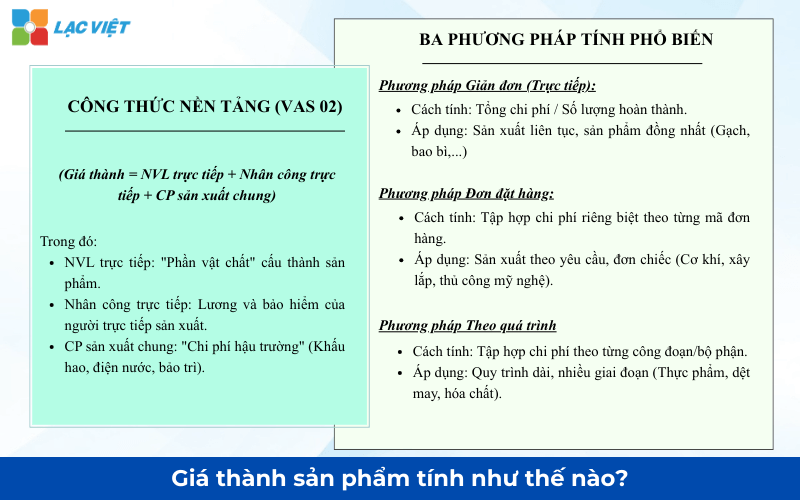
Theo nguyên tắc kế toán giá thành, chi phí sản phẩm được xác định theo công thức:
(Product cost = Cost of direct material + Cost of direct labour + manufacturing Costs general)
In which:
- The cost of direct material: the entire cost for the type of supplies used directly to create products. Can understand simple this is “the visible physical” structure of the product.
- Cost, direct labour: Is the cost paid to the employee directly made products, including the salaries, allowances and deductions from wages as prescribed.
- The cost of production in common: That the indirect costs, but indispensable to production, such as depreciation, machinery, electricity, water workshop, maintenance costs, production management. Can understand this is the “cost the scenes” to help produce stable operation.
This is a recipe platform which is used uniformly in the system accounting standards and accounting regime prevailing in Vietnam, especially is specified in the accounting Standards of Vietnam 02 – inventory.
4.2 Các phương pháp tính giá thành sản phẩm phổ biến hiện nay
The method of calculating the price of simple
Phương pháp giản đơn là cách tập hợp toàn bộ chi phí sản xuất phát sinh trong kỳ cho một loại sản phẩm, sau đó phân bổ đều chi phí này cho số lượng sản phẩm hoàn thành. Phương pháp tính giá thành này phù hợp với doanh nghiệp có quy trình sản xuất đơn giản, khép kín, chu kỳ ngắn và sản phẩm đồng nhất hoặc có mức chi phí chênh lệch không đáng kể giữa các dòng sản phẩm.
When business should apply
- Business process, continuous production closed (for example: concrete, brick, packaging, insulation sheet).
- Products less volatility in terms of categories or do not need to track expenses detailed in the paragraph.
- Cost allocation is considered to be evenly over the entire finished product.
This method helps simplify the recording costs, in accordance with medium enterprise/ small unorganized accounted for by the stage; however, if the product variety or indirect costs accounted for a large proportion, accuracy in cost analysis, as well as the selling price may be restricted.
Illustrative example: A business manufacturing packaging for 6 months total cost of production is 1.200.000.000 and complete 20,000 products, there is no unfinished products end – to-end states.
The price of units is determined as follows:
Price unit = 1.200.000.000 / 20.000 = 60.000/products.
This result helps business basis to determine the selling price calculate profit compared with the previous period to evaluate the effectiveness of cost control.
The method of calculating the cost of orders
This method determines the cost of production on each specific orders, considered each order as a “cost object” private and set direct cost on that order. Production overhead is allocated by reasonable grounds (such as hours of work, hours of machine).
This is the method in accordance with the business produced according to customer requirements or according to each project in retail, not mass-produced uniformity.
Strengths in management
- Cost analysis details by each order helps to control input costs, compared to the cost of the plan.
- Optimize the selling price for each contract, improving the profit margin.
- More clear when customer requires cost transparency.
This method is applied for manufacturing enterprises as simple as machinery design, separate crafts or construction; the cost is set and allocated separately for each contract to determine the price.
The method of calculating the cost of the production process
This method aggregates expenses according to each stage of production or parts, then calculate the price of the average for the finished product in the states. It business suit mass production process, many stages.
Strengths in management
- Reflect the cost according to each stage, help analyze efficient operation each workshop, manufacturing organization.
- Business support, construction norms, cost control, more effective in mass production.
When should I apply this method:
- Business production, food processing, textiles, chemicals, cement...
- The product line has many stages, difficult to split the cost for each unit of product individually.
Phương pháp này tạo ra bức tranh chi phí chi tiết theo từng bước sản xuất, giúp lãnh đạo có số liệu để phân bổ nguồn lực, tối ưu năng lực sản xuất và nâng cao chất lượng dự báo giá thành trong kế hoạch.
5. Quy trình tính giá thành sản phẩm theo Thông tư 99/2025/TT-BTC
Follow Circular 99/2025/TT-BTC, doanh nghiệp phải tập hợp đầy đủ các khoản chi phí phát sinh liên quan trực tiếp đến hoạt động sản xuất, xác định chính xác giá trị sản phẩm dở dang để tính giá thành sản phẩm hoàn thành trong kỳ. Nguyên tắc này giúp đảm bảo số liệu kế toán phản ánh trung thực chi phí thực tế và là cơ sở để xác định giá vốn, lợi nhuận cũng như lập báo cáo tài chính.
Bước 1. Tập hợp chi phí sản xuất phát sinh
Kế toán cần tập hợp toàn bộ chi phí phát sinh theo từng đối tượng tính giá thành như sản phẩm, đơn hàng, công đoạn hoặc phân xưởng. Các khoản chi phí thường bao gồm:
- Chi phí nguyên vật liệu trực tiếp.
- Chi phí nhân công trực tiếp.
- Chi phí sản xuất chung như điện, nước, khấu hao máy móc, chi phí sửa chữa, lương quản lý phân xưởng…
Việc tập hợp chi phí phải dựa trên chứng từ kế toán hợp lệ và được ghi nhận đầy đủ vào sổ kế toán theo quy định của Thông tư 99.
Bước 2. Xác định chi phí sản xuất dở dang
Đến cuối kỳ kế toán, doanh nghiệp cần kiểm kê và đánh giá giá trị sản phẩm chưa hoàn thành.
Chi phí sản xuất dở dang cuối kỳ sẽ không được tính vào giá thành của sản phẩm đã hoàn thành mà được chuyển sang kỳ sau để tiếp tục theo dõi. Đây là bước rất quan trọng vì nếu đánh giá sai sản phẩm dở dang sẽ làm sai lệch giá thành và lợi nhuận của cả hai kỳ kế toán.
Bước 3. Xác định tổng giá thành sản phẩm
Công thức tính tổng giá thành vẫn được áp dụng như sau:
Tổng giá thành = Chi phí sản xuất dở dang đầu kỳ + Chi phí sản xuất phát sinh trong kỳ − Chi phí sản xuất dở dang cuối kỳ
Sau khi xác định được tổng giá thành, kế toán tiếp tục tính giá thành đơn vị.
Bước 4. Tính giá thành đơn vị
Giá thành đơn vị = Tổng giá thành / Sản lượng sản phẩm hoàn thành
Đây là chỉ tiêu được sử dụng để xác định giá vốn hàng bán, phân tích lợi nhuận và xây dựng giá bán sản phẩm.
Illustrative example
Giả sử doanh nghiệp có số liệu trong tháng như sau:
- Chi phí sản xuất dở dang đầu kỳ: 80 triệu đồng
- The cost of raw materials directly: 700 triệu đồng
- Costs directly: 220 triệu đồng
- Production costs, general: 180 triệu đồng
- Chi phí sản xuất dở dang cuối kỳ: 100 triệu đồng
- Sản lượng hoàn thành: 3.000 sản phẩm
Tổng chi phí sản xuất phát sinh:
700 + 220 + 180 = 1.100 triệu đồng
Tổng giá thành:
80 + 1.100 − 100 = 1.080 triệu đồng
Giá thành đơn vị:
1.080 triệu ÷ 3.000 = 360.000 đồng/sản phẩm
Nếu doanh nghiệp bán sản phẩm với giá 480.000 đồng/sản phẩm thì bộ phận kế toán có thể nhanh chóng xác định biên lợi nhuận gộp, đồng thời đánh giá mức độ hiệu quả của hoạt động sản xuất.
6. Những sai lầm phổ biến khi xác định giá thành sản phẩm trong doanh nghiệp
In practical advice, much deviation about the price does not come from lack of that recipe from the identification, handling costs, not true essence. If prolonged, the business can fall into a state of increased revenue, but profit does not increase, even without identifying the cause.

6.1. Tính thiếu chi phí gián tiếp, khiến giá thành không phản ánh đúng thực tế
A very common mistake is business only focus on the cost of materials and labor, while the cost of production would be set sketchy or allocate an estimate.
The account is often overlooked or underestimated, including:
- Depreciation of machinery and equipment production
- The cost of maintenance, repair arises frequently
- Water, electricity, fuel used for the workshop
- Cost management production
When indirect costs are not allocated the full price of the product is “beautiful” than it actually is, leading to the sale price too low. Businesses can still make a sale, but real profit is not commensurate with the effort as well as resources spent.
6.2. Nhầm lẫn giữa chi phí kỳ & chi phí giá thành
Many businesses, especially the small & medium business, still confused between:
- The cost calculator on the product price (cost attached directly to the production process)
- Costs such as cost of sales, cost management, business
Putting the costs not directly related to production on price will make the price of being team-up not required, to make it difficult to compare between the products, the states, or other orders.
Conversely, if “push” production costs out to cost states, price of the product is lower than reality, distort reviews production efficiency.
This mistake not only affect the reported internal management, but also can pose a risk when profitability analysis, construction budget as well as business decisions long-term.
6.3. Không cập nhật biến động chi phí theo thời gian
In the context of the price of raw materials, wages and input costs constantly fluctuating, many businesses are still:
- Use cost norms in long time
- Don't revise the price when production conditions change
This makes product prices no longer reflect the reality at the present time. Meanwhile, leaders still make decisions based on data, “obsolete”, which leads to deviations in the selling price, production planning as well as control the profits.
With respect to the organizations and enterprises are to find out information about the price of the product, this is a big risk if the system management accounting is not flexible enough to update as well as analysis of fluctuations in costs in real time.
6.4. Tác động tổng thể của các sai lầm trên
If the mistake is not remedied promptly, the business will face:
- the price of products reliable
- Hard to control, profit margin realistic
- Business decisions based on inaccurate data
In the long term, this is the cause deterioration of competitiveness, especially in the environment of market volatility.
7. Phần mềm kế toán Accnet ERP hỗ trợ tính giá thành sản phẩm hiệu quả cho doanh nghiệp
AccNet ERP is the solution designed in accordance with the characteristics operating standards, the Vietnamese accounting. Serve manufacturing enterprise in controlling the optimal cost and decision support executive.
Instead of just stopping in the recorded data, AccNet ERP helps businesses:
- Set cost automatically according to each object price: AccNet ERP data link purchasing, warehouse, manufacturing, accounting to automatically record the cost according to the product, stage, orders or lines, helps reduce manual action, limit errors, as well as ensure data rates of consistency.
- Allocation of cost, accuracy, transparency: The software allows setting the allocated according to the actual production (production, hours of machine consumption,...), help to allocate indirect cost police more practical as well as improve the quality of reporting prices.
- Analysis of fluctuations in price over time & objects: AccNet ERP allows comparing the price of the products, orders or chains to determine the cause fluctuations in costs to support the timely adjustment.
- Support governance decisions based on data: cost Data is standardized analysis focus on helping leaders decisions more precise in control costs and maximize profits.
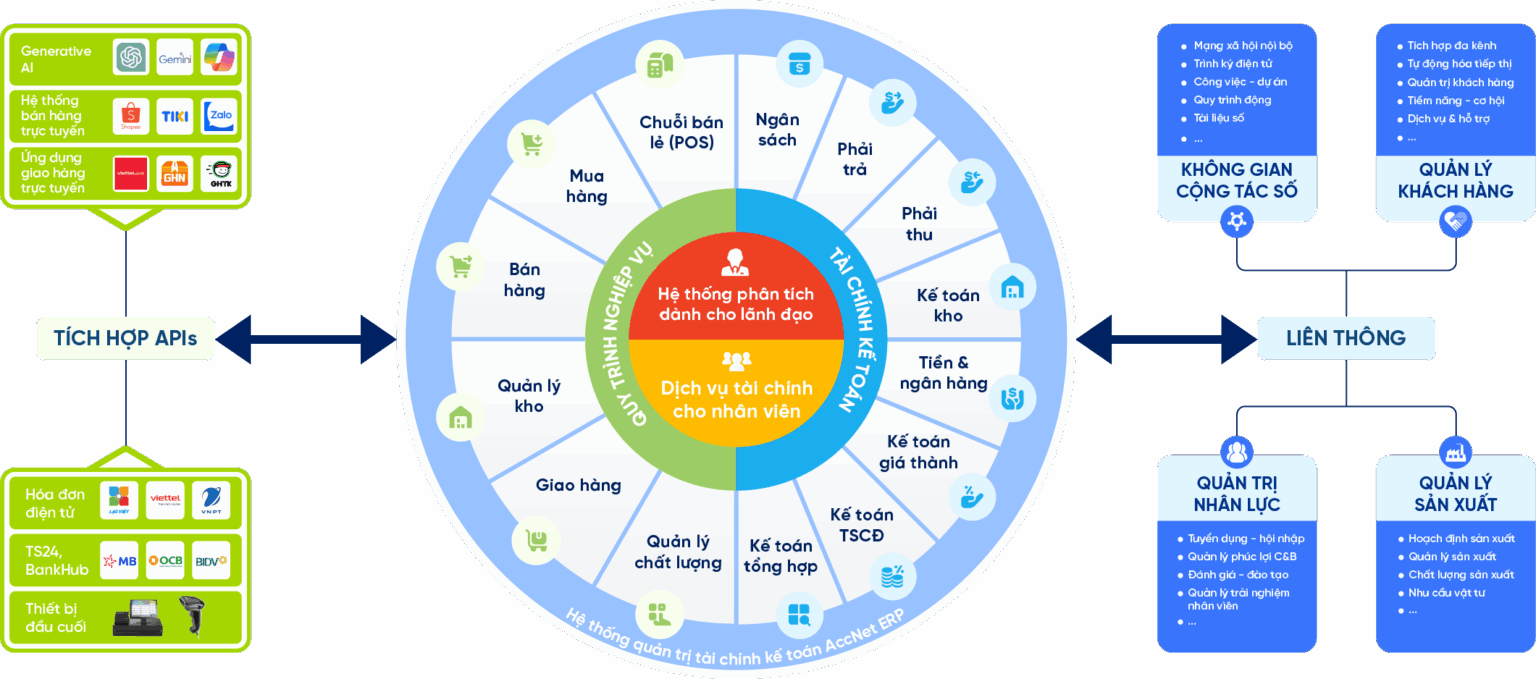
INTEGRATED AI ACCELERATION CONVERTER OF ACCOUNTING
AI in AccNet ERP't just stop at automate data entry, but also:
- Identification & classification certificate from smart: AI scan, read & sort invoice, voucher, receipt, limit errors due to input manually.
- Financial forecasting & budget: the system uses algorithms machine learning to forecast cost, revenue, business support decision fast.
- Warning risk accounting: AI to detect abnormalities in the book, from which timely warning of false or fraud risks.
- Reports assistant smart: AI suggested report template, automatic data aggregation support, leadership, financial analysis instant.

BUSINESS IS WHAT WHEN IMPLEMENTING ACCOUNTING SOFTWARE LAC VIET?
- Experience more than 30 years develop software solutions business management in Vietnam.
- Ecosystem of comprehensive: AccNet ERP easily connect with other solutions of Lac Viet (HRM, Workflow, Portal...).
- Advanced technology: Integrated AI support, cloud & on-premise flexible.
- Services dedicated support: A team of knowledgeable professionals with accounting – finance in Vietnam, companion throughout the deployment.
- Trust from thousands of customers in many areas: finance, banking, manufacturing, trade, services.
The price of product is only the core goal reflects the quality cost management in the operational efficiency of the business. Determining the correct, timely price help business valuation reasonable control, profitability, and enhance the competitiveness. In the context of cost fluctuations, management price should be approached in the direction system in data encryption, fastened with out operating decisions. Mastered price as a condition for business sustainable development on the platform is the most effective substance.